Pulakeshin I: The Lion of Vatapi and Founder of a Deccan Empire
In the grand tapestry of Indian history, the 6th century CE marks a period of profound transformation. The sun had set on the mighty Gupta Empire in the north, and the great Vakataka dynasty of the Deccan was breathing its last. Into this vacuum of power, amidst the fragmented kingdoms and ambitious feudatories vying for control, stepped a figure of immense resolve and vision: Pulakeshin I. He was not a conqueror of vast territories in the mould of his famous grandson, but his contribution was arguably more critical. He was the architect, the patriarch, the man who transformed a family of local chieftains into the sovereigns of a new and formidable power—the Chalukya Dynasty of Vatapi.
Through a combination of strategic genius and a powerful assertion of cultural identity, Pulakeshin I carved out an independent kingdom from the rugged, red sandstone cliffs of the Malaprabha river valley. He laid the foundation stone, both literally and figuratively, for an empire that would dominate southern and central India for over two centuries, leaving behind an unparalleled legacy of art, architecture, and administration.
Early Life & The Deccan Cauldron
The origins of Pulakeshin I, like those of many ancient Indian rulers, are shrouded in the mists of time, pieced together from the regal prose of later inscriptions. What we know for certain is that he was the son of Ranaraga and the grandson of Jayasimha. These ancestors were not paramount sovereigns. The titles they held, likely Maharaja, suggest they were feudatory rulers, governing a modest territory under the suzerainty of a greater power. Historians speculate that they owed their allegiance either to the Kadambas of Banavasi to the south or the Rashtrakutas of Manapura to the north, the dominant forces in the region during the early 6th century.
Pulakeshin I was born into a world of political flux. The Deccan was a mosaic of competing powers. The decline of the Vakatakas had created opportunities for ambitious leaders to assert their independence. This was the environment that shaped the young Pulakeshin. While no records survive of his education or formative years, his later actions demonstrate a deep understanding of both military strategy and the powerful symbolism of statecraft. He would have been keenly aware of the limitations of his family's feudatory status and the immense potential that lay waiting for a leader bold enough to seize it.
His very name, Pulakeshin (sometimes rendered as Polekeshin), is thought by some scholars to be a Sanskrit-Kannada hybrid meaning "Tiger-Haired" or "Great Lion," a fitting epithet for the man who would establish a dynasty known for its martial prowess. He inherited not a throne, but a challenge: to break the shackles of vassalage and forge a new destiny for his lineage.
Career & Major Contributions: The Forging of a Kingdom
Pulakeshin I's reign, which began around 543 CE, was defined by one singular, monumental achievement: the declaration of Chalukyan sovereignty. This was not accomplished through a single, epic battle recorded by court poets, but through a series of deliberate, strategic, and profoundly symbolic acts that announced the arrival of a new power on the Deccan stage.
The Seizure and Fortification of Vatapi
His first and most crucial move was the selection and fortification of a new capital. He chose a location of immense strategic value: the hill-fort of Vatapi, known today as Badami in Karnataka. Nestled in a gorge between two rugged sandstone cliffs, Vatapi was a natural fortress. It was easily defensible, controlled access to important trade routes, and offered a commanding presence over the surrounding plains.
His earliest known inscription, the Badami cliff inscription dated to 543 CE, stands as a testament to this foundational act. Engraved on a boulder, it proudly proclaims that he, Shri-prithvi-vallabha Pulakeshin, fortified the hill of Vatapi (Vatapi-adurga), making it an impregnable fortress (adurga) from above and below. This was a clear statement of intent. By building a formidable capital, he was not just creating a military stronghold; he was establishing a permanent center of power, a nucleus from which his new kingdom could grow. This act marked the physical birth of the Chalukyan kingdom.
The Revival of the Ashvamedha: A Declaration of Sovereignty
If the fortification of Vatapi was the physical foundation of his kingdom, his next act was its spiritual and political consecration. The same 543 CE inscription declares that Pulakeshin I performed the Ashvamedha or the great horse sacrifice. This was an act of immense significance in ancient India.
The Ashvamedha was not merely a religious ritual; it was the ultimate political statement. It was a Vedic ceremony that could only be performed by a chakravartin, a paramount and undisputed sovereign. The ritual involved consecrating a stallion and allowing it to roam freely for a year, followed by the king's army. Any rival ruler who challenged the horse's passage was met in battle. If the horse returned unchallenged after a year, it was sacrificed, and the king's status as an emperor was confirmed.
By performing the Ashvamedha, Pulakeshin I was making an unambiguous declaration to the Kadambas, the Rashtrakutas, and every other regional power: he was no longer a vassal. He was a sovereign king, equal to the greatest emperors of the past. The inscription further notes that he performed other elaborate Shrauta (Vedic) sacrifices, including the Hiranyagarbha (the "golden womb" ritual), Agnishtoma, Agnichayana, Vajapeya, and Bahusuvarna. This comprehensive revival of ancient imperial rites served to legitimize his new-found status, connecting his nascent dynasty to the hallowed traditions of righteous, universal kingship.
The Assumption of Imperial Titles
To complement his actions, Pulakeshin I adopted a series of powerful titles that reinforced his sovereign claims. His inscriptions refer to him as:
- Satyashraya: "The Abode of Truth." This was more than an honorific; it became a dynastic name, a byword for the Chalukyan lineage, used by many of his illustrious successors. It positioned him as a just and righteous ruler.
- Ranavikrama: "Valorous in War." This title advertised his military prowess, the bedrock upon which his new kingdom was built.
- Shri-prithvi-vallabha: "The Beloved Lord of Fortune and the Earth." This was a classic imperial title, directly asserting his dominion over the land.
These titles, combined with his fortification of Vatapi and his performance of the Ashvamedha, formed a tripartite strategy to establish and legitimize his rule. He built the fort, performed the rites, and took the names of a true sovereign king.
His reign, lasting until about 566 CE, was primarily one of consolidation. He successfully defended his fledgling kingdom against its powerful neighbours, ensuring that the seed of the Chalukya dynasty could take firm root. He bequeathed to his sons, Kirtivarman I and Mangalesha, not a sprawling empire, but something more valuable: a secure, independent, and ideologically potent kingdom, ready for expansion.
Legacy & Influence: The Chalukyan Dawn
Pulakeshin I's legacy is not measured in the square miles of territory he conquered, but in the enduring institution he created. He is remembered as the adi purusha, the founding father of one of India's most brilliant imperial dynasties.
Founder of an Empire: His most significant legacy is the Chalukya dynasty of Vatapi. This dynasty would go on to rule the Deccan for over two hundred years, acting as a crucial bridge between the north and south of India. His grandson, Pulakeshin II, would expand the empire to its zenith, famously defeating the great northern emperor Harsha of Kannauj on the banks of the Narmada. All the glory that followed—the military victories, the administrative innovations, and the stunning artistic achievements—grew from the sovereign foundation laid by Pulakeshin I.
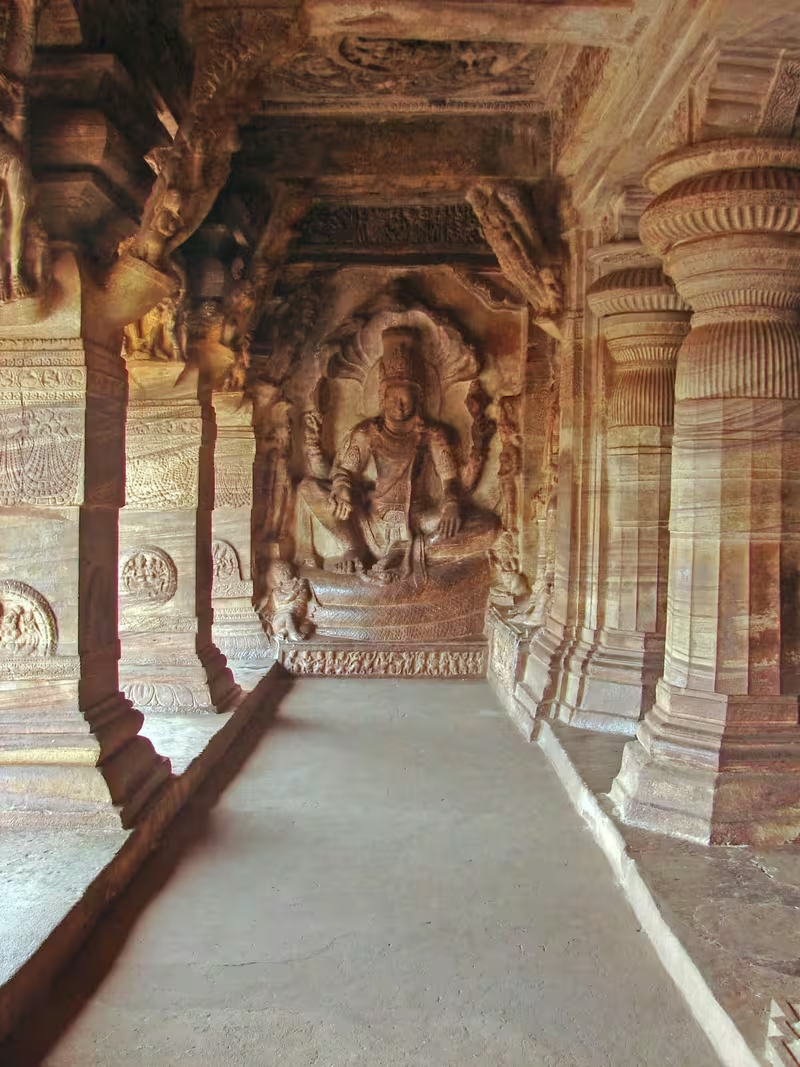
The Architect of Badami's Destiny: While the magnificent rock-cut cave temples of Badami were carved under his successors, it was Pulakeshin I who had the foresight to choose this site as his capital. He established the fortress that would protect and nurture this burst of creative genius. He turned a naturally defensible gorge into the heart of a kingdom, and his sons and grandsons would turn that heart into a world-renowned center of art and culture.
A Cultural Revivalist: Pulakeshin I's revival of grand Vedic sacrifices was a powerful cultural statement. In an era where Buddhism and Jainism were prominent, his patronage of elaborate Brahmanical rituals signaled a resurgence of Vedic traditions as a cornerstone of royal authority and state ideology. This set a precedent for many later southern dynasties and reinforced the image of the king as the upholder of dharma.
The Satyashraya Lineage: The title he adopted, Satyashraya, became so intrinsically linked with his lineage that later branches of the family, such as the Eastern Chalukyas of Vengi and the Western Chalukyas of Kalyani, continued to use it with pride for centuries. It became a mark of their noble ancestry, tracing their origins back to the great founder.
In the final analysis, Pulakeshin I stands as a pivotal figure in the history of the Deccan. He was the catalyst who ended a period of political uncertainty and initiated a new imperial age. He was a master of statecraft who understood that a kingdom is built not only with swords and stones but also with potent symbols and grand ideas. Though his reign was relatively short and his direct military exploits are unrecorded, his vision was enduring. He was the lion who first roared from the cliffs of Vatapi, and the echo of that roar would resound across the Indian subcontinent for generations to come.