Pulakeshin II: The Chalukya Emperor Who Halted an Empire
In the grand tapestry of Indian history, certain figures stand out not just for the empires they built, but for the empires they stopped. Pulakeshin II, the greatest sovereign of the Chalukya dynasty of Vatapi (modern Badami), was one such monumental figure. His reign, a whirlwind of conquest, diplomacy, and cultural patronage, reached its zenith in a single, earth-shaking event: the defeat of the seemingly invincible Emperor Harshavardhana. This victory on the banks of the Narmada did more than secure a border; it defined the political and cultural geography of India for centuries, ensuring the Deccan would forge its own glorious destiny, distinct from the great powers of the north.
Early Life & The Struggle for the Throne
Born Ereya (or Eraya), the future emperor was the son of the Chalukya king Kirtivarman I. When his father died around 597 CE, Ereya was still a minor, too young to rule. The regency, and effectively the throne, passed to his uncle, Mangalesha. While Mangalesha proved to be a capable ruler, expanding the Chalukya domains, he harbored ambitions not for his nephew, but for his own son.
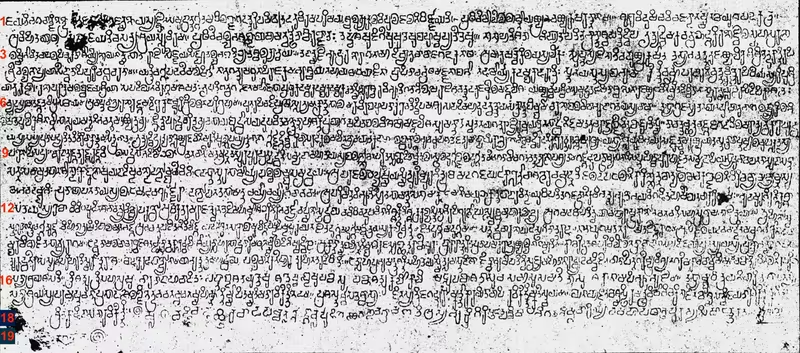
As Ereya came of age, it became clear that his uncle had no intention of relinquishing power. The Aihole inscription, a magnificent eulogy composed by his court poet Ravikirti, delicately describes Mangalesha's mind being "envidiously diverted" by the desire to secure the succession for his own lineage. Faced with a choice between submission and his birthright, the young prince chose conflict. This was his first and most formative test.
Ereya, now adopting the regnal name Pulakeshin, was forced to flee the capital. He meticulously planned his rebellion, gathering allies and building an army. The ensuing civil war was a brutal affair that tore the fledgling kingdom apart. The details are sparse, but the Aihole inscription speaks of Mangalesha’s formidable strength, possessing a large army and a fleet of elephants. Yet, Pulakeshin, displaying the strategic genius that would later define his reign, outmaneuvered and ultimately defeated his uncle's forces. Mangalesha was killed in the conflict, and Pulakeshin II ascended the throne of Vatapi around 610 CE, not as a fortunate heir, but as a battle-hardened victor who had seized his own destiny.
Career & The Forging of an Empire
The kingdom Pulakeshin inherited was in turmoil. The civil war had emboldened rivals and feudatories to declare independence. His first task was not expansion, but consolidation. The Aihole inscription vividly recounts his initial campaigns. He swiftly suppressed internal rebellions, besieging and conquering rebellious chieftains like Appayika and Govinda in the Bhima river region. With his home territory secured, Pulakeshin embarked on a series of breathtaking conquests that would make him the undisputed master of the Deccan.
Conquests in All Directions:
His military campaigns radiated outwards from Vatapi with relentless purpose.
The West: He turned his attention to the traditional powers of the Konkan coast and Karnataka. The Kadambas of Banavasi, an ancient and proud dynasty, saw their capital stormed and their power shattered. The Gangas of Talakad and the Alupas of South Canara, awed by his military might, submitted to his suzerainty.
The East: Looking towards the fertile eastern Deccan, he subjugated the Vishnukundins and conquered the coastal Andhra region. This strategic move was not just about territorial gain. In a stroke of administrative foresight, he appointed his younger brother, Vishnuvardhana, as the viceroy of this new territory, centered around Vengi. This act laid the foundation for the Eastern Chalukya dynasty, which would rule the region for over four centuries, long after the main Vatapi line had faded.
The North: He subdued the Latas, Malavas, and Gurjaras in the regions of modern-day Gujarat and Malwa, pushing the boundaries of his influence to the very doorstep of northern India's supreme power, the Empire of Harsha.
The Clash of Titans: Pulakeshin II vs. Harshavardhana
The inevitable conflict with Emperor Harshavardhana of Kannauj was the defining moment of Pulakeshin's career. Harsha, having earned the title Sakalottarapathanatha (Lord of the entire northern region), sought to extend his dominion southwards and become the undisputed emperor of all of India. Pulakeshin II was the great southern bulwark standing in his way.
Sometime between 630 and 634 CE, Harsha marched south with a colossal army. The Chinese pilgrim Xuanzang, who was traveling through India at the time, provides a vivid, albeit second-hand, account. He notes that Harsha, "flushed with victory," gathered forces from across his empire and marched to subdue the Chalukyas. But Pulakeshin and his people, Xuanzang observed, were "a warlike race" who would not be easily conquered.
The two great armies met on the banks of the river Narmada. The details of the battle are lost to history, but the outcome is indisputable. Pulakeshin II inflicted a decisive and humiliating defeat upon Harsha. The Aihole inscription poetically declares that Harsha’s harsha (joy) melted away in the face of Pulakeshin's might, his mighty elephant corps rendered powerless.
This victory was a landmark event in Indian history. It established the Narmada River as the political boundary between the northern and southern spheres of influence. Pulakeshin assumed the proud titles of Parameshvara (Supreme Lord), Satyashraya (Refuge of Truth), and Dakshinapatheshvara (Lord of the Southern Path). He had not just defended his kingdom; he had checked the ambition of India's most powerful ruler and cemented his own status as an equal sovereign.
The Pallava Rivalry and International Fame
With his northern frontier secure, Pulakeshin turned his attention to the south, to his great rivals, the Pallavas of Kanchi. He led a successful invasion into their territory, defeating King Mahendravarman I and advancing to the very outskirts of the Pallava capital, Kanchipuram. Though he was unable to capture the heavily fortified city, his campaign devastated the Pallava kingdom and initiated a bitter, multi-generational conflict that would define Deccan politics.
Pulakeshin's fame was not confined to India. His power and prestige reached as far as Persia. Historians widely believe that a famous mural in Cave 1 of the Ajanta Caves depicts the reception of a Persian embassy sent by the Sassanian king Khosrow II to Pulakeshin's court around 625 CE. This diplomatic exchange highlights the Chalukya empire's international standing and economic importance, likely linked to the flourishing trade from the ports of the Konkan coast.
Legacy & The Fall of a Conqueror
For over three decades, Pulakeshin II reigned as the undisputed master of the Deccan. His empire stretched from the Narmada in the north to the Kaveri in the south, from the Arabian Sea to the Bay of Bengal. The account of Xuanzang, who visited the Chalukya kingdom around 641 CE, paints a picture of a prosperous and well-administered land. He described the soil as fertile and the people as proud, martial, and fiercely loyal to their king, who "in return for their services, often grants them rewards."
However, the rivalry with the Pallavas, which Pulakeshin had so aggressively pursued, would ultimately be his undoing. The son of Mahendravarman I, Narasimhavarman I, was a ruler of equal ambition and military skill. Burning with a desire for revenge, he spent years building up his army. Around 642 CE, Narasimhavarman launched a massive counter-offensive.
In a stunning reversal of fortunes, the Pallava forces defeated the Chalukyas in a series of battles, pushing them back deep into their own territory. The final confrontation took place at the Chalukya capital itself. Narasimhavarman I stormed and captured Vatapi, putting the city to the torch. In this final, cataclysmic battle, Pulakeshin II, the great conqueror, was almost certainly killed. The Pallava king, in triumph, took the title Vatapikonda—the Conqueror of Vatapi.
The death of Pulakeshin II plunged the Chalukya empire into darkness. For thirteen years, the kingdom was in disarray, with the Pallavas occupying its southern territories. It was only in 655 CE that his son, Vikramaditya I, managed to expel the invaders and restore Chalukya rule.
Pulakeshin II is remembered today as a military genius and a visionary empire-builder. His greatest legacy was the creation of a powerful, unified Deccan empire that acted as a counterbalance to the powers of the north. His victory over Harsha is not merely a footnote in military history; it was a pivotal moment that allowed the Deccan and Southern India to continue their unique cultural, artistic, and political trajectories. He was a patron of art and literature, immortalized by Ravikirti in the Aihole inscription, a masterpiece of Sanskrit poetry. His life was a saga of spectacular rise, glorious reign, and a tragic, violent end—a conqueror who forged an empire with his sword and ultimately fell by it.