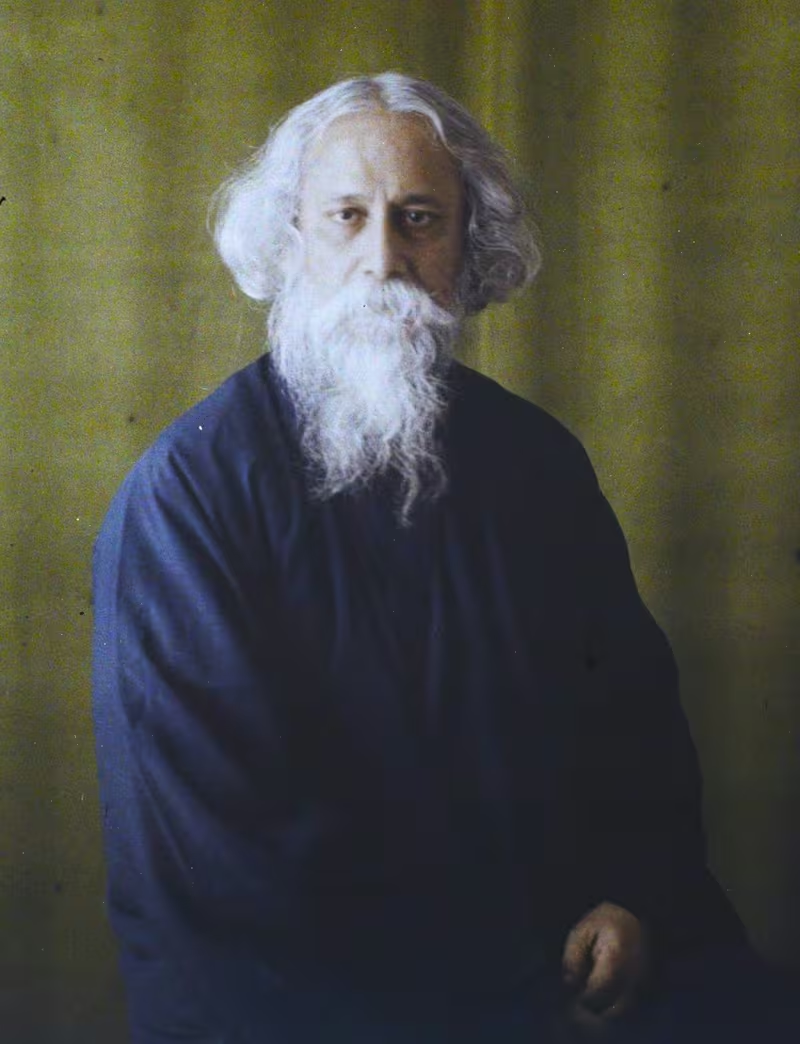
Rabindranath Tagore: The Universal Poet
In the grand tapestry of modern Indian history, few figures loom as large or cast as long a shadow as Rabindranath Tagore. He was not merely a poet but a polymath in the truest sense: a writer, composer, painter, philosopher, and educator whose genius reshaped the cultural and intellectual landscape of Bengal and India. Known affectionately as Gurudev (revered teacher), his life was a testament to the synthesis of Eastern spiritualism and Western humanism, a bridge between India’s ancient soul and the modern world. His winning of the Nobel Prize in Literature in 1913 was not just a personal triumph but a moment of profound significance, placing Indian literature on the global stage for the first time.
Early Life & Background
The Crucible of Jorasanko
Rabindranath Thakur was born on 7 May 1861 in Calcutta (now Kolkata), into the rarefied world of the Jorasanko Thakurbari, the ancestral mansion of a family that was a crucible of the Bengal Renaissance. He was the youngest of thirteen surviving children of Debendranath Tagore, a leader of the Brahmo Samaj, and Sarada Devi. The Tagores were no ordinary family; they were patrons of art, proponents of social reform, and pioneers in blending Indian and Western traditions. Rabindranath’s grandfather, Dwarkanath Tagore, was a prominent industrialist and philanthropist. His elder siblings were already accomplished poets, philosophers, musicians, and playwrights. This environment was his first and most profound school, a vibrant ecosystem of intellectual curiosity, artistic expression, and spiritual inquiry.
A Reluctant Scholar, A Voracious Learner
Formal schooling chafed against Rabindranath’s free spirit. He found the rigid, mechanical nature of classroom education stifling, once describing it as a “prison-house.” He was enrolled in several institutions, including the Oriental Seminary and St. Xavier's Collegiate School, but his attendance was fleeting. His true education took place within the walls of Jorasanko, under the guidance of tutors and, more importantly, through his own insatiable reading and observation.
A pivotal experience occurred in 1873 when, at the age of eleven, he accompanied his father on a journey across India, culminating in a months-long stay in the Himalayan foothills near Dalhousie. Away from the cloistered life of Calcutta, Debendranath personally tutored his youngest son in Sanskrit, astronomy, and literature, introducing him to the profound wisdom of the Upanishads. This journey instilled in the young Rabindranath a deep reverence for nature and a spiritual foundation that would permeate his work for the rest of his life.
In 1878, at the age of seventeen, he was sent to England with the intention of studying law at University College London. While he did not complete his degree, his time in England was formative. He immersed himself in English literature, from Shakespeare to Shelley, and was deeply influenced by Western classical music, an influence he would later blend with Indian ragas to create his unique musical genre, Rabindra Sangeet.
Career & Major Contributions
The Ascent of a Literary Titan
Tagore’s literary career began at an astonishingly young age. He was a published poet in his early teens, initially writing under the pseudonym Bhanusimha (Sun Lion). His early works, while showing immense promise, were a prelude to the revolutionary shift he would bring to Bengali literature. He broke free from the constraints of classical Sanskrit forms, introducing new verse structures, lyrical prose, and the use of colloquial language, making literature more accessible and psychologically resonant.
His body of work is staggering in its volume and variety:
Poetry: This was the soul of his expression. Collections like Manasi (The Ideal One, 1890), Sonar Tori (The Golden Boat, 1894), and Balaka (A Flight of Cranes, 1916) are landmarks of Bengali poetry. They explore themes of love, nature, divinity, and the transient nature of life with unparalleled lyrical beauty.
Novels: Tagore was a masterful novelist who explored the complex social and political currents of his time. Gora (1910) is a monumental work that grapples with questions of Indian identity, nationalism, and religious orthodoxy. Ghare Baire (The Home and the World, 1916) offers a profound critique of radical nationalism through the prism of a domestic love triangle, while Chokher Bali (A Grain of Sand, 1903) is a powerful psychological novel dissecting the complexities of human relationships.
Short Stories: He is widely credited with pioneering the short story genre in Bengali. Stories like Kabuliwala, The Postmaster, and Nastanirh (The Broken Nest) are celebrated for their deep empathy, sharp characterization, and poignant portrayal of the lives of ordinary people.
Plays and Dance-Dramas: Tagore wrote numerous plays, often symbolic and allegorical. Dak Ghar (The Post Office, 1912) is a moving tale of a confined boy yearning for freedom, while Raktakarabi (Red Oleanders, 1926) is a powerful allegory against soulless materialism and mechanization.
The Nobel Prize and Global Recognition
The turning point in Tagore’s global recognition came in 1913. On the suggestion of the British artist William Rothenstein, he translated a selection of his devotional poems from the collection Gitanjali into English prose-poems. Published as Gitanjali: Song Offerings with an admiring preface by W. B. Yeats, the collection captivated the Western world with its mystical depth and lyrical grace.
On November 13, 1913, the Swedish Academy awarded Rabindranath Tagore the Nobel Prize in Literature, citing “his profoundly sensitive, fresh and beautiful verse, by which, with consummate skill, he has made his poetic thought, expressed in his own English words, a part of the literature of the West.” He was the first non-European, and the first Indian, to be so honored. The news, sent via telegram to Calcutta, catapulted him to international fame overnight.
A Voice of Conscience
Tagore was not an ivory-tower artist; he was a deeply engaged public intellectual and a voice of conscience for his nation. In 1915, he accepted a knighthood from the British Crown. However, his relationship with the British Raj was forever altered by the horrific Jallianwala Bagh massacre of April 13, 1919, where British troops fired upon a peaceful gathering, killing hundreds of unarmed Indians.
In an act of profound moral courage, Tagore renounced his knighthood. In a powerful letter to the Viceroy, Lord Chelmsford, dated May 30, 1919, he wrote, “The time has come when badges of honour make our shame glaring in their incongruous context of humiliation, and I for my part wish to stand, shorn of all special distinctions, by the side of those of my countrymen, who, for their so-called insignificance, are liable to suffer a degradation not fit for human beings.” This act of protest resonated across India and cemented his status as a moral leader.
Legacy & Influence
Visva-Bharati: A Vision for Education
Perhaps Tagore’s most enduring tangible legacy is Visva-Bharati, the university he founded at Santiniketan in 1921. It was the culmination of his lifelong critique of conventional education. He envisioned an institution free from the confines of nationality and rigid curricula, a place where learning would be a joyous, organic process in communion with nature. The motto of Visva-Bharati, Yatra viśvaṁ bhavatyekanīḍam (“Where the world makes its home in a single nest”), encapsulates his philosophy of internationalism and humanistic education. It remains a unique institution, a testament to his dream of nurturing free-thinking, creative, and globally-minded individuals.
The Music of Bengal and the Anthems of Nations
Tagore’s contribution to music is immeasurable. He composed over 2,230 songs, now known as Rabindra Sangeet, which form a distinct and beloved genre of music. Drawing from Hindustani classical ragas, Bengali folk traditions, and even Western melodies, these songs are woven into the very fabric of Bengali culture, marking seasons, festivals, and the entire spectrum of human emotion. In a unique historical achievement, his compositions were chosen as the national anthems of two countries: India’s Jana Gana Mana and Bangladesh’s Amar Shonar Bangla.
The Late-Blooming Painter
In his late sixties, Tagore embarked on an entirely new artistic journey: painting. Unburdened by formal training, he produced thousands of haunting, expressionistic works. His art, characterized by its bold lines, mysterious figures, and fantastical creatures, was a deeply personal exploration of his subconscious. It was yet another dimension of his boundless creativity, placing him among the pioneers of modern art in India.
A Universal Humanist
Rabindranath Tagore passed away on August 7, 1941, leaving behind a legacy that transcends borders and disciplines. He is remembered not just as a poet but as a prophet of a universal humanism. He championed international cooperation over narrow nationalism, engaging in famous debates with Mahatma Gandhi on the subject. While he deeply respected Gandhi, Tagore feared that an unthinking, chauvinistic patriotism could become a new form of bondage.
Today, his birthday, Rabindra Jayanti, is celebrated with fervor across the Bengali-speaking world. His works continue to be read, translated, and adapted, his songs sung in countless homes, and his ideas on education and the environment feel more relevant than ever. Rabindranath Tagore remains a guiding star, a timeless voice who taught the world that the truest form of freedom is the freedom of the mind, and the highest form of patriotism is love for all humanity.