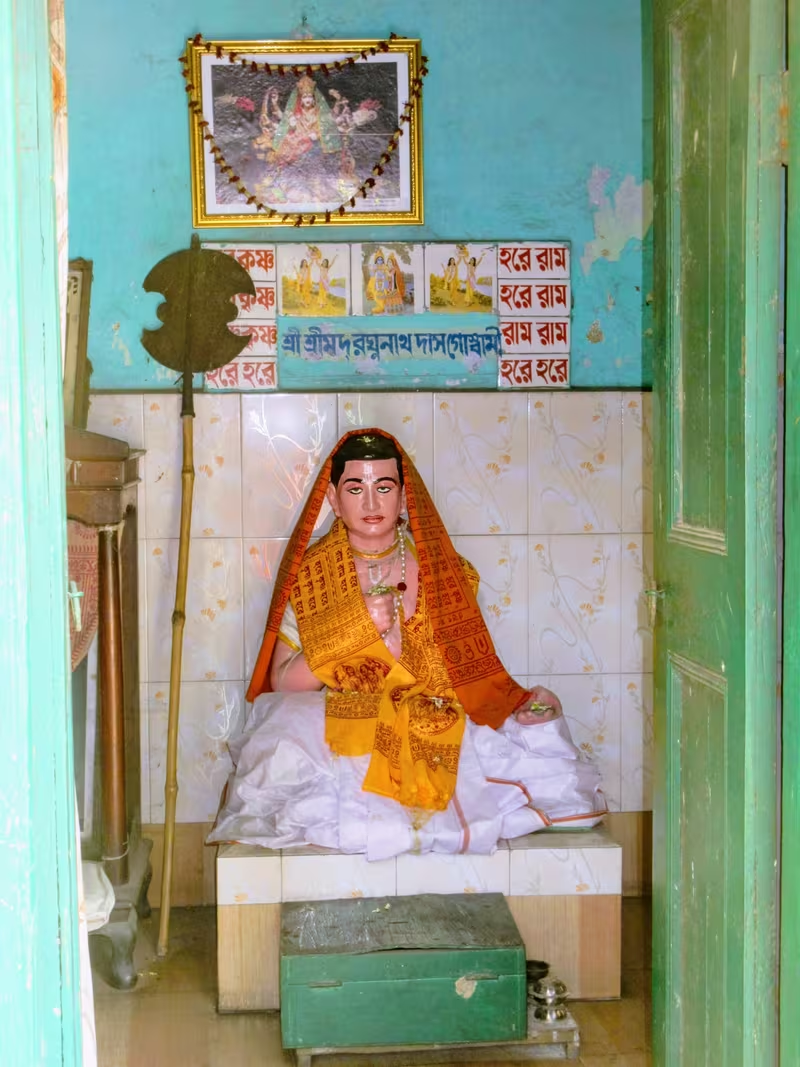
Raghunath Das Goswami: The Paragon of Renunciation
In the vibrant spiritual landscape of 16th-century Bengal, amidst the devotional fervor ignited by Sri Chaitanya Mahaprabhu, there lived a figure whose life became the very definition of renunciation. Raghunath Das Goswami, one of the revered Six Goswamis of Vrindavan, was not a king, a warrior, or a philosopher in the traditional sense. He was an heir to unimaginable wealth who chose a life of extreme austerity, a scholar of the heart whose only subject was divine love. His story is a powerful testament to the idea that true wealth is not what one possesses, but what one is willing to give up for a higher calling. As the prayojana-acharya, the master who exemplifies the ultimate goal of life, his journey from a gilded cage to the sacred dust of Vrindavan remains a cornerstone of the Gaudiya Vaishnava tradition.
Early Life & Background: The Reluctant Heir
Raghunath Das was born in the late 15th century in the village of Krishnapur, within the Hooghly district of West Bengal. He was the sole heir to a staggering fortune. His father, Govardhana Majumdar, and his uncle, Hiranya, were immensely wealthy zamindars, holding lucrative positions as revenue collectors for the Sultan of Bengal, Alauddin Husain Shah. Their annual income was said to be astronomical, placing the family in the highest echelons of society. Raghunath was raised in opulent palaces, surrounded by every conceivable luxury, destined to inherit a life of power and prestige.
From a young age, however, it was clear that Raghunath’s heart was not in worldly affairs. A deep spiritual longing stirred within him, first kindled by his encounters with Haridasa Thakura, the great saint and master of the holy name. But the pivotal moment of his youth came when he met Sri Chaitanya Mahaprabhu, the charismatic saint who was sweeping through Bengal with his message of ecstatic love for Krishna. The brief meeting left an indelible mark on the young Raghunath, solidifying his desire to renounce his worldly life and follow the saint.
His family, however, was determined to keep their only son and heir bound to his duties. They arranged his marriage to a woman of exquisite beauty and surrounded him with ever-greater luxuries, hoping to distract him. They even hired guards to watch him day and night, preventing any attempt to escape. Raghunath made several attempts to flee to Puri to join Chaitanya, but each one was thwarted. He lived like a prisoner in his own opulent home, his external reality in stark contrast to his internal state of desperate spiritual yearning.
A turning point occurred at the village of Panihati, on the banks of the Ganga. Here, Raghunath met Nityananda Prabhu, one of Chaitanya’s most intimate associates. Desperate for a way to achieve his goal, Raghunath humbly approached Nityananda for his blessings. In a famously playful and profound exchange, Nityananda declared Raghunath a “thief” for trying to steal divine grace without paying the price. As a loving “punishment,” he instructed Raghunath to host a grand festival and feed yogurt and chipped rice (dahi-chida) to all the assembled devotees.
This event, known as the Danda Mahotsava (the festival of punishment), was deeply symbolic. By using his father’s immense wealth to serve the Vaishnavas, Raghunath began the process of severing his attachment to it. Nityananda, pleased with his sincerity, blessed him, prophesying that he would soon overcome all obstacles and attain the shelter of Sri Chaitanya. This festival is still commemorated annually at Panihati, a celebration of Raghunath’s first great act of devotional service.
Career & Major Contributions: The Path of Pure Devotion
The Great Escape
Empowered by Nityananda’s blessing, Raghunath finally succeeded in his escape. Following the counsel of his family's priest, he feigned complacency, lulling his guards into a false sense of security. One night, he slipped away, embarking on an arduous journey of over 600 kilometers to Puri in Orissa, where Chaitanya Mahaprabhu resided. He traveled for twelve days, mostly on foot, eating only when absolutely necessary, driven by the singular goal of reaching his spiritual master.
Upon his arrival, gaunt and travel-worn, he fell at Chaitanya’s feet. Chaitanya lovingly embraced him, acknowledging the great sacrifice he had made. Recognizing his deep sincerity and potential, Chaitanya entrusted Raghunath to the care of his most confidential associate and secretary, Svarupa Damodara Goswami. For the next sixteen years, Raghunath lived in Puri under their direct guidance, absorbing the deepest esoteric teachings of Gaudiya Vaishnavism.
A Life of Unparalleled Austerity
In Puri, Raghunath’s life became a masterclass in asceticism. He rejected all comforts. Initially, he would stand at the Simha-dvara (Lion's Gate) of the Jagannath Temple, accepting whatever alms were offered. Later, deeming this too much like begging, he began to subsist entirely on the temple’s discarded mahaprasada—the sacred food offerings to Lord Jagannath that had been set aside, deemed unfit for sale, and were often picked over by street cows. He would collect these soiled grains of rice, wash them thoroughly, and eat a small portion with a bit of salt.
When Chaitanya Mahaprabhu learned of this extreme practice, he was not dismayed but deeply moved. He visited Raghunath and, taking a handful of the washed rice, ate it himself, declaring it to be supremely delicious. Through this act, he glorified Raghunath’s profound spirit of renunciation, establishing his disciple as an exemplar for all future generations.
In a gesture of immense spiritual significance, Chaitanya gifted Raghunath two precious items: a Govardhana Shila, a stone from the sacred Govardhan Hill in Vrindavan, and a gunja-mala, a simple necklace of red and black seeds. He instructed Raghunath to worship the stone as the non-different form of Lord Krishna and the necklace as a representation of Srimati Radharani. These became the focus of Raghunath’s life, his only possessions and the center of his devotional world.
From Puri to Vrindavan
After the disappearance of Sri Chaitanya and Svarupa Damodara, Raghunath was consumed by grief. The pain of separation was so intense that he resolved to end his own life. He traveled to Vrindavan, the holy land of Krishna’s pastimes, with the intention of jumping from the top of Govardhan Hill.
In Vrindavan, he met Rupa Goswami and Sanatana Goswami, the two leading theologians of the tradition appointed by Chaitanya to excavate the lost holy places and write devotional scriptures. When they heard of Raghunath’s plan, they intervened with love and compassion. They convinced him that instead of ending his life, he should live on to share the divine love and teachings he had received directly from Chaitanya and Svarupa Damodara. His life, they argued, was a treasure meant for the benefit of the world.
Heeding their counsel, Raghunath settled in Vrindavan, making his home on the banks of the sacred lake, Radha-kunda, which he considered the most sacred place on earth. Here, he spent the remaining four decades of his long life in intense devotional practice (bhajana). His daily routine was legendary for its rigor. He spent over twenty-two hours a day chanting the holy names, meditating on the pastimes of Radha and Krishna, and offering thousands of prostrated obeisances. He slept for less than two hours and ate only a small leaf-cup of buttermilk every day, just enough to keep his body and soul together.
Literary Contributions
While not as prolific a writer as Rupa or Jiva Goswami, Raghunath Das Goswami’s literary works are considered jewels of Gaudiya Vaishnava literature. They are not theological treatises but deeply personal, emotional outpourings of a soul steeped in the mood of separation and longing for the divine. His primary collection of prayers is the Stavavali, which includes:
- Vilapa-kusumanjali (A Handful of Flower-like Lamentations): An intensely personal and poignant prayer expressing his desperate longing for the direct service of Srimati Radharani.
- Manah-shiksha (Instructions to the Mind): A concise and powerful set of verses where he instructs his own mind on how to conquer pride, envy, and desire, and to focus single-pointedly on the service of Radha and Krishna in Vrindavan.
- Radha-kunda-ashtaka: Eight verses glorifying the supreme sanctity and spiritual potency of Radha-kunda.
He also authored the Mukta-charita (The Story of the Pearl), a poetic narrative describing a pastime of Krishna. His writings provide a profound glimpse into the ultimate goal of the tradition: selfless, loving service to Radharani, the divine feminine counterpart of Krishna.
Legacy & Influence: The Paragon of Renunciation
Raghunath Das Goswami’s legacy is monumental, not for what he built or wrote, but for how he lived. As one of the Six Goswamis, he was a foundational pillar of the movement, but his unique contribution was to be the living embodiment of its highest ideal: vairagya, or complete detachment from all that is not related to Krishna.
While Sanatana Goswami explained the philosophy of devotional practice (sambandha) and Rupa Goswami detailed the process (abhideya), Raghunath Das demonstrated the ultimate goal (prayojana). His life was a practical exhibition of the theological truths his colleagues were articulating. For this reason, he is honored as the prayojana-acharya.
His unwavering devotion established Radha-kunda as the prime location for the most advanced practitioners of Gaudiya Vaishnavism, a status it holds to this day. His samadhi (tomb) on its banks is a place of deep reverence and pilgrimage.
Today, Raghunath Das Goswami is remembered as a saint of unparalleled determination and humility. His life story is a constant source of inspiration, retold in countless discourses and songs. It serves as a powerful reminder that the path to spiritual realization often requires radical sacrifice and that the greatest freedom comes from renouncing the ephemeral pleasures of the material world for the eternal ecstasy of divine love. In an age of materialism, the tale of the wealthy prince who chose to live on discarded rice for the love of God continues to resonate with profound and timeless significance.