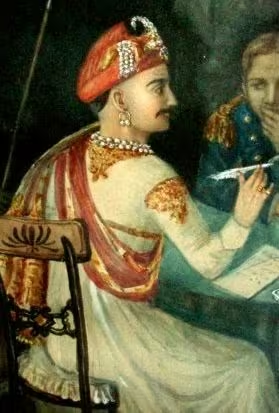
Raghunathrao Bhat: The Peshwa of Paradox
In the grand, sweeping tapestry of the Maratha Empire, few figures are as complex, brilliant, and tragic as Raghunathrao Bhat, popularly known as Raghoba. He was a man of glaring contradictions: a military genius who carried the saffron Maratha flag to the farthest northern reaches of the subcontinent, and a deeply ambitious politician whose personal quest for power ultimately invited the very foreign entity that would dismantle the empire he helped build. His life was a dramatic saga of triumph and treachery, a cautionary tale of how the pursuit of personal glory can eclipse the well-being of a nation. To understand Raghunathrao is to understand the zenith of Maratha power and the beginning of its precipitous decline.
Early Life & Background: A Prince of the Peshwai
Raghunathrao was born on August 18, 1734, into the heart of Maratha power. He was the second surviving son of the legendary Peshwa Bajirao I, the brilliant and aggressive general who had transformed the Marathas into the dominant military force in India. His mother was Kashibai, Bajirao's first wife. Growing up in the bustling political hub of Shaniwar Wada in Pune, Raghunathrao was immersed in a world of statecraft, diplomacy, and constant warfare. He was the younger brother of Balaji Bajirao, who would later become the third Peshwa, also known as Nana Saheb.
His education was befitting a prince of the de facto ruling family. He was trained in swordsmanship, horse riding, and the complex art of 18th-century military strategy. He learned administration and finance, watching his father and brother manage a sprawling, fast-expanding empire. Yet, he grew up in their formidable shadows. Bajirao I was a larger-than-life figure, and Balaji Bajirao presided over a period of immense territorial gain. From a young age, Raghunathrao possessed a burning desire to prove his own worth, to carve out a legacy as monumental as that of his forebears.
Career & Major Contributions: The Conqueror and the Conspirator
Raghunathrao's career can be divided into two distinct, conflicting phases: his time as a celebrated military commander and his later years as a disgruntled, power-hungry claimant to the Peshwa's throne.
The Northern Expeditions: To the Banks of the Indus
As a young man, Raghunathrao quickly distinguished himself on the battlefield. He was a bold and capable commander, embodying the aggressive military doctrine of his father. His most significant accomplishments came during the great Maratha northern expeditions of the 1750s.
In 1757, at the head of a large Maratha army, Raghunathrao marched on Delhi. He drove out the agents of the Afghan king, Ahmad Shah Abdali, and reasserted Maratha influence over the crumbling Mughal court. This was a statement of intent: the Marathas were the true kingmakers of Hindustan.
His ambition, however, soared even higher. In 1758, in what is considered the pinnacle of Maratha expansion, Raghunathrao pushed further north into the Punjab. He chased Timur Shah Durrani, the son and viceroy of Ahmad Shah Abdali, out of Lahore and Sirhind. The Maratha armies marched triumphantly through the plains of Punjab, eventually reaching the river Indus at Attock. For a brief, glorious moment, the Maratha Empire stretched from the Cuttack in the east to the Indus in the west. Raghunathrao had achieved what no Maratha general had before, planting their standard on the traditional northwestern frontier of India. This audacious campaign, however, was a strategic overreach. It incurred massive debts and, more dangerously, provoked the wrath of Ahmad Shah Abdali, setting the stage for the catastrophic Third Battle of Panipat in 1761.
The Seeds of Dissent: A House Divided
The aftermath of Panipat was a turning point for the Marathas, and for Raghunathrao. The death of his brother, Peshwa Balaji Bajirao, from the shock of the defeat, created a power vacuum. The Peshwa's eldest son and heir, Vishwasrao, had been killed in the battle. The throne passed to Balaji Bajirao's second son, the seventeen-year-old Madhavrao I.
Raghunathrao, as the senior-most male in the family, was appointed regent. Here, his personal ambition began to clash destructively with his duty to the state. He saw his young, inexperienced nephew as an obstacle to his own power. He constantly undermined Madhavrao's authority, seeking to be the de facto ruler. The young Peshwa, however, was a prodigy of immense administrative skill and integrity. He refused to be a puppet.
This led to a bitter and prolonged internal power struggle. Raghunathrao repeatedly rebelled against his nephew, leading to open battles between two factions of the Maratha army. Despite his military experience, Raghunathrao was outmaneuvered and defeated by the brilliant young Peshwa on several occasions and was placed under house arrest. This period of internal strife weakened the Maratha state at a critical time when it needed to recover and consolidate after the disaster at Panipat.
The Ultimate Betrayal: Assassination and Alliance
In 1772, the great Peshwa Madhavrao I died an untimely death from tuberculosis. His younger brother, Narayanrao, ascended to the throne. The resentful Raghunathrao was released from confinement and once again attempted to seize control. The relationship between uncle and nephew quickly deteriorated.
What followed was the darkest chapter in the history of the Peshwas. On August 30, 1773, a group of Gardi guards stormed Shaniwar Wada and brutally assassinated the young Peshwa Narayanrao in broad daylight. While direct evidence remains debated, historical consensus holds Raghunathrao and his ambitious wife, Anandibai, responsible for the conspiracy. A popular, though perhaps apocryphal, tale claims that Anandibai intercepted the written order from Raghunathrao to the guards, which read "Narayanrao-la dhara" (Hold/capture Narayanrao), and deviously changed a single letter to make it read "Narayanrao-la maara" (Kill Narayanrao). Regardless of the exact details, Raghunathrao was the immediate beneficiary of the murder. He swiftly had himself declared the next Peshwa.
His reign, however, was built on blood and was destined to be short. A powerful council of twelve Maratha ministers and nobles, led by the astute diplomat Nana Phadnavis, refused to accept the murderous usurper. This group, known as the Barbhai Council, rallied against Raghunathrao. Their cause was strengthened when Gangabai, Narayanrao's widow, gave birth to a posthumous son, who was immediately declared the legitimate heir, Sawai Madhavrao.
Outmaneuvered and facing a united Maratha nobility, Raghunathrao was forced to flee Pune. Desperate and isolated, he made a fateful and catastrophic decision. He turned to the British East India Company in Bombay for help.
The First Anglo-Maratha War
On March 6, 1775, Raghunathrao signed the Treaty of Surat with the British. In exchange for a force of 2,500 soldiers to help him reclaim the Peshwaship, he agreed to cede the strategically important territories of Salsette and Bassein, along with a share of revenues from Surat and Bharuch. This act of inviting a foreign power to arbitrate an internal Indian succession dispute was a monumental betrayal. It opened the door for direct British military intervention in the heart of the Maratha confederacy.
The treaty triggered the First Anglo-Maratha War (1775-1782). The war was a long and arduous affair. The Maratha forces, united under the leadership of Nana Phadnavis and commanders like Mahadji Shinde, fought fiercely and handed the British a humiliating defeat at the Battle of Wadgaon in 1779. Despite this, the war dragged on, draining the Maratha treasury and exposing the cracks in their confederacy. The war finally concluded with the Treaty of Salbai in 1782. The treaty was a political victory for the Marathas: the British recognized Sawai Madhavrao as the rightful Peshwa and abandoned Raghunathrao's cause. In return, the British retained the island of Salsette. Raghunathrao, the man who had started the war, was granted a generous pension and ordered to retire from public life.
Legacy & Influence: A Fallen Hero
Raghunathrao died a year later, in December 1783, a broken and disgraced man. His legacy is one of the most contentious in Indian history. He is remembered not as the conqueror of Attock, but as the man who sold his nation's sovereignty for a chance at personal power.
Historical Significance:
- Architect of Maratha Zenith: It is undeniable that Raghunathrao's northern campaigns represent the absolute peak of Maratha territorial expansion. He was a gifted and fearless general who realized the Maratha dream of ruling from sea to sea.
- Catalyst of Internal Decay: His relentless ambition and his destructive conflict with the brilliant Madhavrao I sowed discord and instability within the empire, preventing it from fully recovering from the Panipat disaster.
- Pioneer of British Dominance: His most damning legacy is the Treaty of Surat. By inviting the British to settle a domestic dispute, he gave them the political and legal pretext they needed to interfere in Maratha affairs. The First Anglo-Maratha War was the first major conflict between the two powers, setting in motion a chain of events that would culminate in the final destruction of the Maratha Empire four decades later.
In the annals of Maharashtrian history, Raghunathrao's name—Raghoba-dada—became synonymous with treachery. He is remembered as a ghardrohi, one who betrays his own house. His life story serves as a powerful historical lesson: that of a man blessed with immense talent, courage, and opportunity, who was ultimately undone by a single, fatal flaw—an insatiable ambition that recognized no loyalty to family, state, or country.