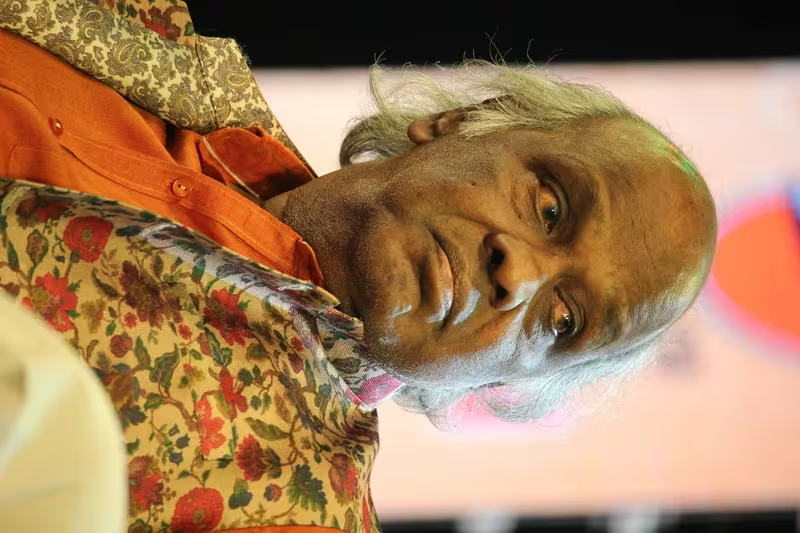
The Roar and the Verse: The Unforgettable Voice of Rahat Indori
On the stage of a mushaira, under the glare of the lights, a man with a shock of white hair and eyes that held a storm would approach the microphone. A hush would fall over the thousands gathered, a collective breath held in anticipation. He would begin, his voice a low rumble, and then it would rise, a crescendo of passion, wit, and rebellion that could ignite a stadium. This was Rahat Indori. He was not merely a poet; he was a phenomenon, a force of nature who commanded language and performance in a way that few ever have. His journey from the bustling streets of Indore to the heart of millions is a testament to the enduring power of a single, fearless voice.
From the Mills of Indore to the Mastery of Urdu
Rahat Qureshi was born on 1 January 1950, in Indore, Madhya Pradesh, into a family of modest means. His father, Rafatullah Qureshi, was a worker in a local cloth mill, and his mother was Maqbool Un Nisa Begum. Growing up in a post-independence India grappling with its identity, the young Rahat was a witness to the daily struggles and vibrant syncretic culture of a heartland city. These early experiences would deeply embed themselves in his consciousness, later emerging as the raw, unfiltered truth in his poetry.
His childhood was not one of literary privilege. To support his family, the young man who would one day command words with such artistry took up work as a commercial sign-painter. For nearly a decade, his canvas was the city itself, his brush shaping letters on shop hoardings. This period, far from being a detour, was formative. It kept him grounded, connected to the language of the common person—the slang, the idioms, the directness—which he would later masterfully weave into the sophisticated tapestry of Urdu ghazal.
Despite financial hardships, his passion for learning burned bright. He completed his schooling and went on to earn a Bachelor of Arts from Islamia Karimia College, Indore, in 1973. His love for Urdu, however, demanded a deeper exploration. He pursued a Master of Arts in Urdu literature from Barkatullah University in Bhopal in 1975. This academic pursuit culminated in a doctorate that was almost pre-ordained: in 1985, he was awarded a PhD from Bhoj University for his thesis, ‘Urdu Mein Mushaira’ (The Mushaira in Urdu). The very art form he was destined to conquer became the subject of his scholarly inquiry. This unique combination of a street-level sensibility and deep academic rigour would become the hallmark of his genius.
The Poet as a Performer: Conquering the Mushaira
While Rahat Indori had a successful career as a professor of Urdu literature and a popular Bollywood lyricist, his true kingdom was the stage of the mushaira. Traditionally a genteel, sophisticated gathering, the mushaira in Rahat Indori's hands became an electrifying, rock-concert-like event. He understood that in modern India, poetry needed to be performed, not just recited.
His style was revolutionary. He would walk the stage, gesticulating, his voice modulating from a conspiratorial whisper to a defiant roar. He employed dramatic pauses, locking eyes with the audience, making them a participant in the creation of the moment. When he delivered the killer couplet—the ‘maqta’—the explosion of applause, the chorus of ‘Waah! Waah!’, was not just appreciation; it was a catharsis. He had given voice to their unspoken frustrations, their hidden loves, and their simmering anger.
His poetry was a mirror to the society around him. While he wrote exquisite ghazals on love and longing, he is most remembered for his unflinching social and political commentary. He spoke truth to power with a courage that was both startling and inspiring. His verses were sharp, direct, and devoid of the ornate ambiguity that could sometimes distance classical poetry from the masses. He wielded Urdu not as a language of the elite, but as a weapon for the common citizen.
Perhaps no verse encapsulates his spirit more than this iconic couplet, which became a national anthem of protest and inclusivity:
“Sabhi ka khoon hai shamil yahan ki mitti mein, Kisi ke baap ka Hindustan thodi hai.”
(Everyone's blood is mixed in this soil, Hindustan is not the property of anyone's father.)
This couplet, written years ago, found a new and potent life during the protests against the Citizenship Amendment Act (CAA) in 2019-2020. It was emblazoned on posters, chanted by students, and shared millions of times online, cementing Indori’s status as the poetic conscience of a generation. He reminded a nation of its composite, secular fabric with a clarity that cut through the noise of divisive politics.
Other verses carried similar weight, addressing communalism, political hypocrisy, and social injustice:
“Lagegi aag toh aayenge ghar kayi zad mein, Yahan pe sirf hamara makaan thodi hai.”
(If a fire starts, many houses will fall in its path, It's not just my house that is here.)
This was his warning against the flames of hatred, a powerful plea for collective responsibility and shared destiny.
A Pen for Bollywood
Rahat Indori’s powerful and accessible style also found a home in the world of Hindi cinema. He penned lyrics for over fifty films, bringing his unique blend of poetic depth and conversational flair to the silver screen. He collaborated with celebrated music directors like Anu Malik, A. R. Rahman, and Shankar-Ehsaan-Loy.
His songs became chart-topping hits, including:
- “Chori Chori Jab Nazrein Mili” from Kareeb (1998)
- “Koi Jaye To Le Aaye” from Ghatak (1996)
- “Neend Churai Meri” from Ishq (1997)
- “M Bole Toh” from Munna Bhai M.B.B.S. (2003)
- “Dil ko Hazar Baar Roka” from Murder (2004)
While his film work brought him widespread fame and financial stability, he always maintained that the mushaira was his first love. It was there, in direct communion with a live audience, that his soul as a poet truly soared.
A Legacy of Fearless Words
Rahat Indori passed away on 11 August 2020, in his beloved city of Indore, after complications arising from COVID-19. His death sent a shockwave across the subcontinent and the global Urdu-speaking diaspora. The timing felt cruelly ironic; a voice that had roared against injustice was silenced by a virus that had brought the world to its knees. His final tweet, confirming his diagnosis but asking people to pray for his swift recovery, showed his characteristic fighting spirit to the very end.
His legacy, however, is immortal and multifaceted:
The People's Poet: More than any other contemporary, he earned the title of ‘Awami Shayar’ (The People's Poet). He demolished the wall between high art and popular sentiment, proving that poetry could be both profound and profoundly popular.
The Revitalizer of the Mushaira: In an age of digital distraction, Rahat Indori made the mushaira a blockbuster event. He drew young people in droves, making them fall in love with the power and beauty of Urdu poetry. He was, in essence, the rockstar of the Urdu world.
A Voice of Dissent and Unity: His verses have become enduring symbols of resistance against authoritarianism and communalism. He championed a pluralistic, compassionate vision of India, and his words continue to echo in protest movements and university campuses. He used his art not to escape from reality, but to confront it head-on.
Digital Immortality: Through countless videos on YouTube and clips on social media, Rahat Indori’s electrifying performances have gained a powerful afterlife. A new generation, who may never have seen him live, can still witness the fire of his delivery and the genius of his words. He remains one of the most-watched poets on the internet, a testament to his timeless appeal.
Rahat Indori was more than a poet; he was a custodian of a culture, a champion of the underdog, and a fearless truth-teller. He proved that a simple couplet, delivered with conviction, could be more powerful than a political speech. From the dusty lanes of Indore, he rose to become the heartbeat of millions, a voice that roared with the collective anguish and aspirations of a nation. His body may be gone, but his verses remain, etched forever on the soul of India, a defiant and enduring flame.
“Main mar jaaun toh meri ek alag pehchaan likh dena, Lahoo se meri peshaani pe Hindustan likh dena.”
(When I die, give me a unique identity, With my blood, write 'Hindustan' on my forehead.)