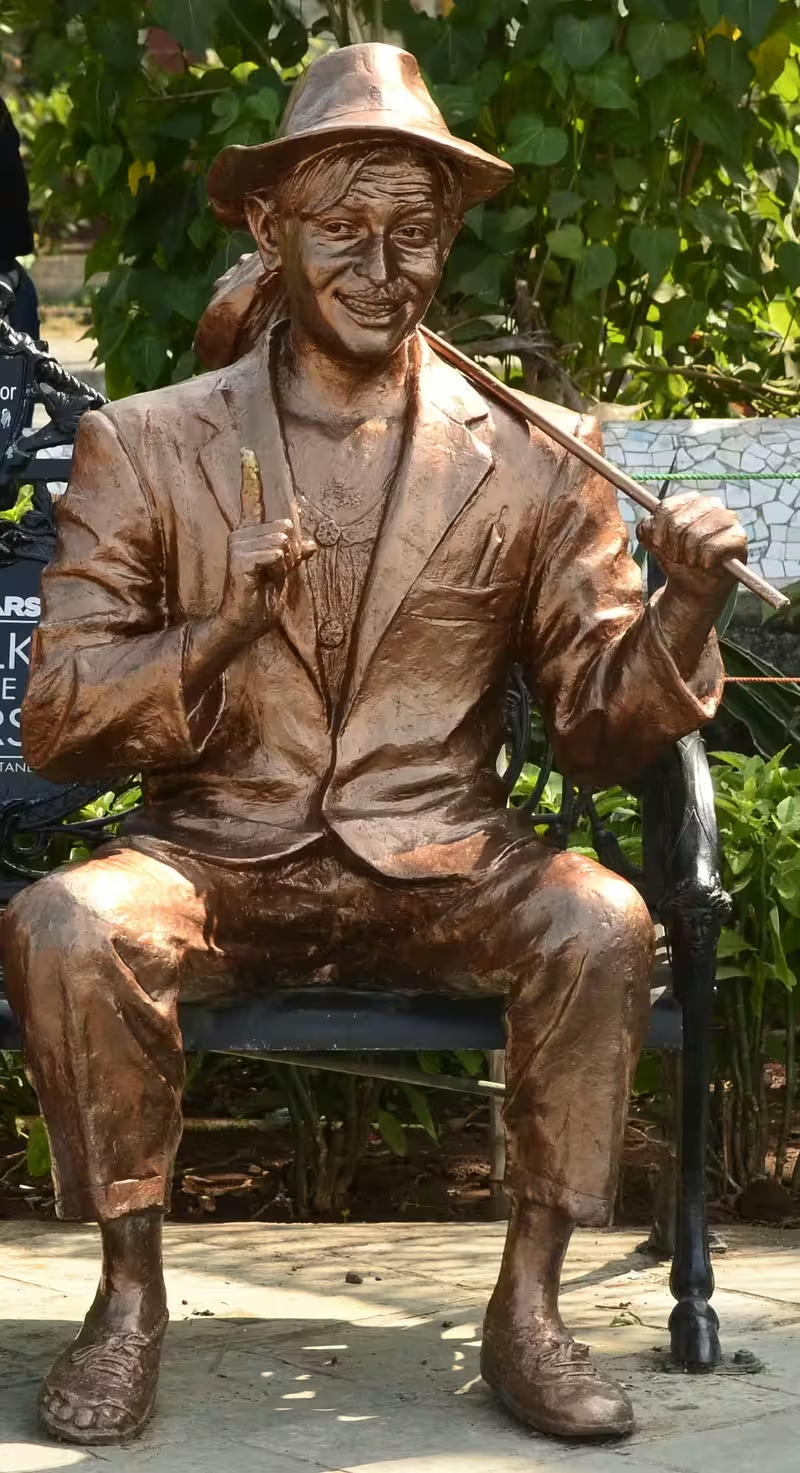
Raj Kapoor - The Showman of Indian Cinema
In the grand tapestry of Indian history, few figures have captured the nation's heart and imagination quite like Raj Kapoor. Born Ranbir Raj Kapoor on December 14, 1924, in Peshawar, British India (now in Pakistan), he was not merely an actor or a director; he was a visionary, an institution, and the quintessential 'Showman' of Indian cinema. Over a career spanning five decades, he crafted a cinematic language that was uniquely Indian yet universally understood, blending spectacle with soul, and entertainment with social conscience. His films were mirrors held up to a young, independent nation grappling with its identity, dreams, and disillusionments.
Early Life & Theatrical Roots
Raj Kapoor's destiny was intertwined with the performing arts from birth. He was the eldest son of Prithviraj Kapoor, a towering figure in Indian theatre and film, and Ramsarni Devi Kapoor. The Kapoor household was a crucible of creativity, and young Raj grew up amidst the scent of greasepaint and the sound of rehearsals. His formal education was brief and of little interest to him; his true schooling took place in the wings of his father's pioneering travelling theatre company, Prithvi Theatres.
Here, he learned every aspect of the craft from the ground up. He was a sweeper, a stagehand, a prompter, and eventually, an actor. This hands-on, immersive education instilled in him a profound understanding of storytelling, performance, and, most importantly, the pulse of the common Indian audience. He observed his father's dedication and his ability to connect with people from all walks of life, lessons that would become the bedrock of his own cinematic philosophy. His first foray onto the silver screen came as a child actor in the 1935 film Inquilab, but his journey as a leading man began with Neel Kamal in 1947, opposite another future legend, Madhubala.
The Birth of R.K. Films & The Rise of a Visionary
The year 1948 marked the most pivotal moment in Raj Kapoor's career and a turning point for Indian cinema. At the remarkably young age of 24, he established his own studio, R.K. Films. This was an act of audacious ambition, giving him complete creative control to bring his singular vision to life. The studio's first production, Aag (1948), which he also directed and starred in, was a bold, semi-autobiographical film that, while not a commercial success, announced the arrival of a distinctive new voice in filmmaking.
It was his next film, Barsaat (1949), that set the box office ablaze. A passionate love story, it established many of the hallmarks of the R.K. Films brand: soulful music, romantic idealism, and a keen visual aesthetic. The film's iconic poster, depicting Kapoor holding co-star Nargis in a passionate embrace, would later be immortalized as the studio's official logo—a symbol of cinematic romance for generations to come. Barsaat also marked the beginning of one of history's most celebrated creative collaborations. Kapoor assembled a dream team that would define his golden era: music directors Shankar-Jaikishan, lyricists Shailendra and Hasrat Jaipuri, and singers Lata Mangeshkar and Mukesh, whose voice became synonymous with Raj Kapoor's on-screen persona.
The Tramp: An Icon for a New India
Deeply influenced by the works of Charlie Chaplin, Raj Kapoor created his most enduring on-screen persona: 'The Tramp'. This was not a mere imitation but a brilliant Indian adaptation. His tramp was Raju, a symbol of the post-independence common man—an innocent, good-hearted vagabond navigating the complexities and corruptions of a rapidly urbanizing world. Clad in ill-fitting clothes, with a jaunty walk and a twinkle in his eye, he embodied the resilience and optimism of a nation finding its feet.
This persona was immortalized in two of his greatest masterpieces, Awaara (1951) and Shree 420 (1955). Awaara (The Vagabond) was a cinematic tour de force that explored the 'nature versus nurture' debate, questioning whether a man's destiny is determined by his birth or his circumstances. The film was a colossal success not just in India, but internationally. Its theme song, "Awaara Hoon" (I am a vagabond), became an anthem of freedom and defiance, resonating powerfully across the Soviet Union, China, Eastern Europe, and the Middle East. For millions, Raj Kapoor became the face of India.
Shree 420 (Mr. 420, referring to the Indian Penal Code section for fraud) continued this narrative, telling the story of an honest country boy who is seduced and corrupted by the city's promise of wealth. The film's song, "Mera Joota Hai Japani" (My shoes are Japanese), became another powerful anthem, a declaration of Indian identity and pride in a post-colonial world. These films, with their blend of pathos, comedy, and social commentary, cemented Raj Kapoor's status as a superstar and a filmmaker of profound social relevance.
The Showman's Grand Vision: Colour and Spectacle
As his career progressed, Raj Kapoor's canvas grew larger and more ambitious. He embraced Technicolor with Sangam (1964), a grand, emotionally charged love triangle shot lavishly in Europe. The film was a blockbuster, setting new standards for production values and cinematic spectacle in India.
His most personal and ambitious project, however, was Mera Naam Joker (1970). A sprawling, semi-autobiographical epic, the film told the story of a clown who must make the world laugh, no matter his own personal heartbreak. It was a deeply philosophical and poignant work, a meditation on the loneliness of the performer. The film took over six years to make and was a devastating commercial failure upon its release, pushing R.K. Films to the brink of bankruptcy. Yet, over the years, it has been re-evaluated and is now hailed as a cult classic, a testament to Kapoor's artistic courage.
Undeterred by the failure, Kapoor reinvented himself. He launched his son Rishi Kapoor in the teenage romance Bobby (1973). The film, a vibrant and youthful love story that challenged class barriers, was a phenomenal success, saving the studio and becoming a cultural touchstone for an entire generation. In his later years as a director, he turned his lens towards exploring female protagonists and critiquing social hypocrisy in films like Satyam Shivam Sundaram (1978), the powerful social drama Prem Rog (1982) on widow remarriage, and his final film, Ram Teri Ganga Maili (1985), a controversial but hugely successful commentary on the corruption of innocence.
Legacy and Enduring Influence
Raj Kapoor passed away on June 2, 1988, after receiving the Dadasaheb Phalke Award, India's highest cinematic honor. His death marked the end of an era, but his legacy is immortal.
The Complete Filmmaker: He was a master of his craft—an instinctive actor, a visionary director, a shrewd producer, and a brilliant editor. He understood the power of music like no other, weaving songs seamlessly into his narratives to heighten emotion and convey complex ideas.
India's First Global Star: Long before the term 'soft power' was coined, Raj Kapoor was India's greatest cultural ambassador. His films transcended borders and ideologies, finding adoring audiences in places as disparate as Moscow and Cairo. He proved that Indian stories and emotions had universal appeal.
The Institution Builder: R.K. Films was more than a studio; it was a film school and a creative family. He nurtured and launched the careers of countless artists, technicians, and musicians who went on to become legends in their own right.
The Social Commentator: Beneath the gloss and glamour of his films lay a deep-seated social conscience. He tackled themes of poverty, social justice, hypocrisy, and the clash between tradition and modernity. He made the common man the hero, giving voice to his struggles and aspirations.
Today, Raj Kapoor is remembered as the ultimate Showman, a man who dreamed on a grand scale and had the genius to translate those dreams onto celluloid. His films, with their unforgettable music, timeless stories, and the enduring charm of the 'tramp', continue to be watched and loved. He remains a benchmark for cinematic excellence and a shining star in the firmament of world cinema, a true patriarch of an art form he helped to define for a nation he so dearly loved.