The Prince of Painters: Raja Ravi Varma and the Birth of Modern Indian Art
In the prayer rooms and on the calendars of countless Indian homes, there exists a familiar, almost archetypal, image of divinity. A serene Lakshmi rising from a lotus, a scholarly Saraswati with her veena, a valiant Rama with his bow—these are not just religious icons, but cultural touchstones. For millions, these images are the definitive faces of the Hindu pantheon. The artist who envisioned and immortalized them, bridging the gap between the divine and the everyday, was a man from a small Travancore kingdom who would go on to define a new visual language for a nation: Raja Ravi Varma.
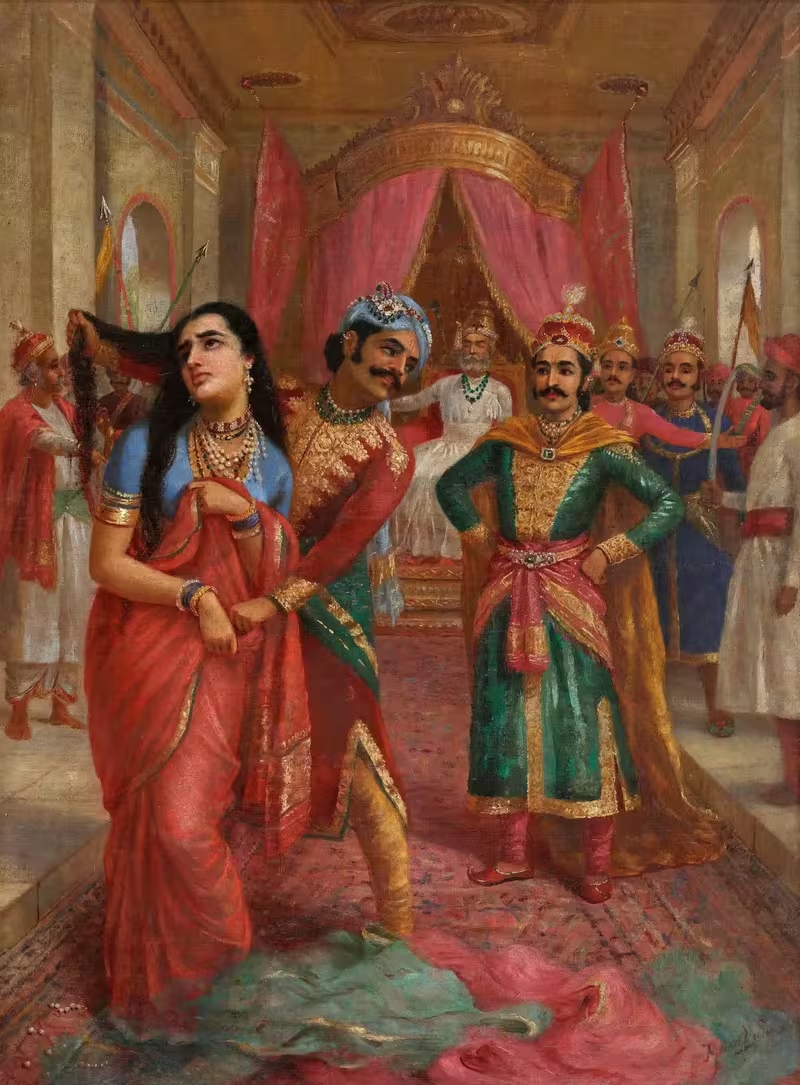
More than just a painter, Ravi Varma was a cultural phenomenon. He was a visionary who masterfully fused the dramatic realism of European academic art with the rich tapestry of Indian mythology and tradition. In an era of burgeoning national consciousness, he gave form to India's epics and legends, creating a pan-Indian aesthetic that transcended regional boundaries. His most revolutionary act, however, was not on canvas but on stone—the lithographic stone that allowed him to reproduce his art for the masses, taking it from the cloistered walls of palaces to the humble homes of ordinary people.
Early Life & A Royal Awakening
Raja Ravi Varma was born on April 29, 1848, into the aristocratic Koil Thampuran family at the Kilimanoor Palace in the princely state of Travancore, modern-day Kerala. His lineage was deeply connected to the Travancore royal family, and his environment was one of high culture and intellectual pursuit. His mother, Umayamba Thampurratti, was a poet of considerable talent, and his father was a scholar of Sanskrit and Ayurveda. This atmosphere of learning and creativity provided a fertile ground for the young Varma's prodigious talent.
From a very young age, his artistic inclinations were unmistakable. Legend has it that he filled the walls of his home with drawings of animals, people, and scenes from daily life, much to the exasperation and eventual awe of his elders. His formal training began under his uncle, Raja Raja Varma, himself a painter in the traditional Tanjore style. But the young artist’s ambition and curiosity yearned for a different mode of expression.
The court of Maharaja Ayilyam Thirunal of Travancore was his true university. A great patron of the arts, the Maharaja encouraged a vibrant cultural exchange. It was here that Ravi Varma first encountered the medium that would define his career: oil on canvas. He watched, fascinated, as visiting European artists like the Dutch painter Theodor Jenson captured the likenesses of royalty with a startling, three-dimensional realism. Eager to learn the technique, Varma approached Jenson, who, protective of his professional secrets, refused to teach him. Undeterred, the determined young man learned by sheer observation, mastering the subtleties of mixing colours, applying brushstrokes, and using light and shadow (chiaroscuro) to create depth and volume.
This self-taught mastery, combined with his innate genius, soon brought him to the attention of the Maharaja, who became his first and most important patron. His journey from a local prodigy to a nationally celebrated artist had begun.
Career & The Creation of an Iconic Style
Ravi Varma’s career was a steady ascent, marked by royal commissions, national acclaim, and international recognition. He travelled extensively across India, painting portraits for the royal courts of Mysore, Baroda, Udaipur, and others, meticulously observing the diverse cultures, costumes, and landscapes of the subcontinent. This exposure enriched his artistic palette and informed his grand mythological compositions.
His breakthrough on the international stage came in 1873, when his painting, Nair Lady Adorning Her Hair, won the Governor's Gold Medal at the Madras Fine Arts Exhibition and later an award at the International Exhibition in Vienna. This was a pivotal moment, validating his unique synthesis of Western technique and Indian subject matter. His fame was further cemented in 1893 at the World's Columbian Exposition in Chicago, where he exhibited ten paintings and was awarded two gold medals, introducing his vision of India to a global audience.
Major Works and Thematic Brilliance
Ravi Varma’s genius lay in his ability to humanize the divine and elevate the mortal. He painted Puranic deities not as remote, stylized icons, but as accessible, emotionally complex beings. His subjects, draped in luminous silks and adorned with intricate jewellery, were placed in lush, naturalistic Indian landscapes.
Shakuntala (1870): Perhaps his most famous narrative work, this painting captures a poignant moment from Kalidasa's classic play. Shakuntala, walking away from the hermitage, pretends to remove a thorn from her foot as a pretext to cast one last, longing glance at her lover, King Dushyanta. Varma masterfully conveys her delicate emotion—a mix of love, shyness, and sorrow—through her posture and expressive gaze.
Damayanti and the Swan: Depicting a scene from the Mahabharata, this work shows the lovelorn princess Damayanti conversing with a celestial swan, a messenger from her beloved Nala. The painting is a study in grace and yearning, with Damayanti’s rich red saree creating a vibrant contrast against the serene palace backdrop.
Jatayu Vadham (The Slaying of Jatayu) (1895): Showcasing his flair for drama and action, this painting captures the heroic and tragic battle between the demon king Ravana and the divine eagle Jatayu. The dynamic composition, the sense of violent motion, and the palpable desperation of Sita make it one of his most powerful works from the Ramayana.
Galaxy of Musicians (c. 1889): Commissioned by the Maharaja of Mysore, this magnificent group portrait depicts eleven women from different regions of India, each playing a traditional instrument. It is a celebration of India's cultural diversity and a testament to Varma's skill in capturing varied textures, textiles, and expressions in a single, harmonious composition.
The Ravi Varma Press: Art for the Millions
While his original paintings were masterpieces destined for the collections of the wealthy elite, Ravi Varma harboured a more democratic vision. He saw the immense popular appeal of his mythological works and sought a way to make them accessible to everyone. Encouraged by Sir T. Madhava Rao, the former Dewan of Travancore, and with the technical expertise of his brother Raja Raja Varma, he made a groundbreaking decision.
In 1894, he established a state-of-the-art lithographic printing press in Ghatkopar, Bombay (now Mumbai). The Ravi Varma Press began producing affordable oleographs—colour prints—of his most popular paintings. This was a revolution. Suddenly, images of Lakshmi, Saraswati, Krishna, and Rama, rendered with Varma's signature realism, could be owned by anyone. These prints travelled across the country, finding their way into middle-class homes, temples, shops, and even matchbox labels. Art was no longer a privilege; it was a part of popular devotion and daily life. Through the press, Raja Ravi Varma became the most influential artist in modern Indian history, single-handedly shaping the visual culture of an entire subcontinent.
Legacy & Enduring Influence
Raja Ravi Varma passed away on October 2, 1906, but his legacy was already immortal. He left behind a body of work that not only defined an era but continues to resonate deeply within the Indian cultural psyche.
A National Visual Language
In the late 19th and early 20th centuries, as the Indian nationalist movement gained momentum, Varma's art provided a powerful visual vocabulary. His depictions of epic heroes and heroines, classical literary figures, and idealized Indian women became potent symbols of a shared, glorious past. He created a standardized, pan-Indian iconography that helped foster a sense of collective identity in a deeply diverse nation.
Pioneer of Popular Culture
Varma's influence extends far beyond the gallery. He is rightly considered the father of Indian calendar art, as the mass-produced images of deities that adorn calendars today are direct descendants of his oleographs. His dramatic, tableau-like compositions heavily influenced the aesthetics of early Indian cinema. Dadasaheb Phalke, the “Father of Indian Cinema,” was a former employee of the Ravi Varma Press, and the framing, costumes, and mythological narratives of his films owe a clear debt to Varma's paintings.
Criticism and Context
Varma's legacy is not without its critics. The Bengal School of Art, led by figures like Abanindranath Tagore, emerged in direct reaction to his style. They argued that his European realism was an imported aesthetic, lacking the spiritual depth and indigenous quality of traditional Indian art forms like Mughal miniatures or Ajanta frescoes. Later, post-colonial and feminist critics have analyzed his portrayal of women as beautiful but passive subjects, reinforcing certain patriarchal ideals of the era.
These critiques are valid and vital for a complete understanding of his work. Yet, they do not diminish his monumental significance. Ravi Varma was a product of his time—an artist working at a cultural crossroads, navigating the complex interplay of colonialism, tradition, and modernity. He was a bridge, not just between East and West, but between classical art and popular culture.
Today, Raja Ravi Varma is remembered as the painter who gave the gods a human face and brought art to the people. His original canvases are priceless national treasures, but his true, living legacy is found in the millions of reproductions that continue to be objects of reverence and affection across India and the diaspora. He was a prince by birth, but he became a king in the world of art, whose reign over the Indian imagination has never truly ended.