Rajadhiraja Chola II: The Guardian of a Fading Sun
In the grand tapestry of the Chola dynasty, the threads of emperors like Rajaraja I and Rajendra I are woven in brilliant gold, chronicling an age of unparalleled conquest and cultural efflorescence. By the mid-12th century, however, the golden age was a memory. The Chola sun, though still luminous, was beginning its slow, inexorable descent. It was into this twilight that Rajadhiraja Chola II (1166–1178 CE) stepped, not as a conqueror destined to expand its borders, but as a guardian, tasked with the monumental challenge of holding the empire together against the powerful tides of internal decay and external ambition.
His reign was not one of glorious expansion but of desperate, brilliant preservation. It was a testament to the fact that sometimes, the greatest victory is not in conquering new lands, but in refusing to yield what is yours. The story of Rajadhiraja II is the story of a proxy war, of shrewd diplomacy, of military genius in the face of overwhelming odds, and of a king who understood that the survival of the empire was more important than his own direct lineage.
An Unconventional Ascension
The circumstances of Rajadhiraja II's rise to power were a clear sign of the changing times. He was not the son of his predecessor, the great builder Rajaraja II. In a departure from tradition, Rajaraja II, who had no male heir of his own to anoint, looked within his extended family to find a successor capable of steering the Chola state. He chose a grandson of the earlier emperor Vikrama Chola, a young prince named Edirilipperumal, who would ascend the throne as Rajadhiraja II.
This selection was a calculated political move. By anointing Rajadhiraja as his co-regent and heir apparent as early as 1163 CE, three years before his own death, Rajaraja II ensured a smooth, undisputed transition of power. It was a pragmatic decision that prioritized the stability of the realm over the convention of direct patrilineal succession. From the outset, Rajadhiraja II's claim to the throne was based not on birthright alone, but on his predecessor's faith in his ability to rule. He came to power with a mandate to protect and preserve, a charge that would come to define his entire reign.
The Pandyan Cauldron: A War for Suzerainty
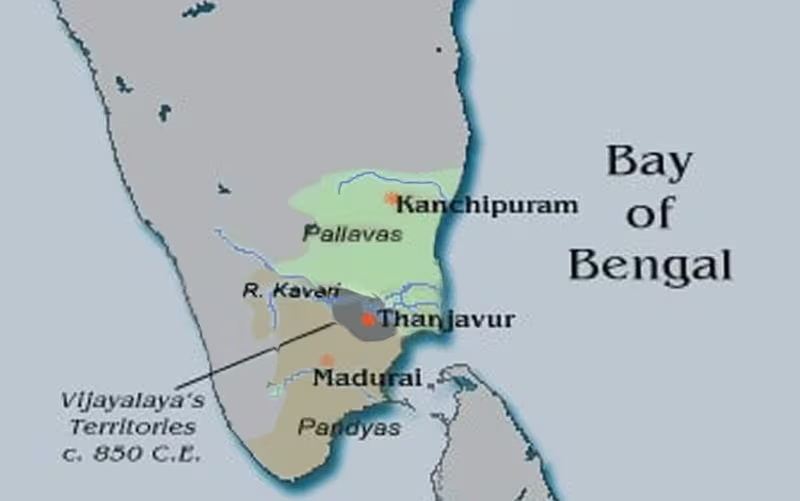
The defining event of Rajadhiraja II’s rule erupted not within the Chola heartland, but in the kingdom of their traditional vassals and rivals to the south—the Pandyas. For centuries, the Pandyas of Madurai had been subject to Chola overlordship, often chafing under the imperial yoke. By the 1160s, a dynastic dispute in the Pandyan kingdom provided the perfect opportunity for an external power to challenge Chola dominance in the southern peninsula.
The conflict began as an internal struggle between two Pandyan princes, Parakrama Pandya and Kulasekhara Pandya. As Kulasekhara besieged Madurai, the desperate Parakrama Pandya sent an appeal for aid not to his Chola overlord, but across the sea to the ambitious and powerful King Parakramabahu I of Polonnaruwa in Sri Lanka. Parakramabahu, eager to extend his influence and cripple his Chola rivals, readily agreed.
Before the Sinhalese forces could arrive, however, Kulasekhara stormed Madurai, executed Parakrama Pandya and his family, and seized the throne. But Parakramabahu’s army, led by the formidable general Lankapura Dandanatha, landed at Rameswaram regardless. Their mission now shifted: they would avenge the death of Parakrama Pandya, oust the usurper Kulasekhara, and install Parakrama's son, Vira Pandya, as a puppet ruler loyal to Sri Lanka.
What followed was a brutal invasion. The Sinhalese chronicle, the Mahavamsa, while glorifying its own army, provides a grim account of the campaign. The Sinhalese forces swept through the southern Pandyan lands, capturing key locations and leaving a trail of destruction. For Rajadhiraja II, watching from his capital at Gangaikonda Cholapuram, this was an existential threat. A Pandyan kingdom controlled by the Sinhalese would not only sever the Chola empire’s southern flank but would also create a permanent and hostile power on its doorstep.
Kulasekhara Pandya, the very man who had defied Chola authority, now turned to Rajadhiraja II in desperation. The Chola emperor faced a difficult choice: support a rebellious and untrustworthy vassal or allow a strategic rival to establish a foothold in the Tamil country. He chose the former. The preservation of Chola suzerainty trumped all other concerns.
Pallavarayar's Triumph and the Chola Response
Rajadhiraja II entrusted the critical mission to his most brilliant and loyal general, Perumanambi Pallavarayar. The Pallavarayanpettai inscription, a stone record commissioned by the general himself, gives a vivid, first-hand account of the Chola counter-offensive. It was a masterclass in military strategy and execution.
Pallavarayar marched his army south, not merely to defend, but to decisively eject the Sinhalese from the mainland. He engaged the forces of Lankapura in a series of pitched battles. The inscriptions speak of fierce encounters at locations like Erukkattur and Kilanilai. Pallavarayar’s strategy was methodical and relentless. He systematically dismantled the Sinhalese war machine, outmaneuvering and overwhelming them.
The climax of the campaign was a resounding Chola victory. Pallavarayar and his subordinate commanders defeated the Sinhalese generals, capturing and beheading Lankapura Dandanatha and Jagadraya Dandanatha. As a stark message to both the Sinhalese king and any wavering Pandyan feudatories, the heads of the defeated generals were nailed to the gates of Madurai. Kulasekhara Pandya was restored to the throne, now firmly indebted to his Chola saviors.
The war was not over. An enraged Parakramabahu I prepared a fleet for a direct invasion of the Chola coast. But the Cholas, anticipating this, launched a preemptive naval strike. A Chola fleet, reportedly led by Srivallabha, a rival Sinhalese prince who had taken refuge in the Chola court, crossed the straits and ravaged the northern coast of Sri Lanka, destroying landing craft and sowing chaos. This audacious counter-attack forced Parakramabahu to abandon his invasion plans and focus on his own domestic security.
Yet, the complexities of the Pandyan affair were far from resolved. Kulasekhara Pandya, once restored to power, proved to be an unreliable ally, secretly negotiating with the Sinhalese. When this betrayal was discovered, the Cholas acted with swift ruthlessness. They switched their allegiance to Vira Pandya—the very prince the Sinhalese had originally championed. In a stunning reversal of fortunes, Chola forces drove Kulasekhara into exile and installed Vira Pandya on the throne of Madurai, ensuring he ruled as a loyal Chola vassal. Rajadhiraja II had not only repelled an invasion but had successfully manipulated the Pandyan succession to secure Chola interests.
A Reign of Consolidation and Cultural Patronage
While the Pandyan war dominated his reign, Rajadhiraja II’s administration continued to function. Inscriptions from his time record numerous grants to temples, indicating that the machinery of state and religious patronage continued unabated. His reign saw the completion and consecration of one of the most exquisite jewels of Chola temple architecture: the Airavatesvara Temple at Darasuram.
Begun by his predecessor Rajaraja II, this magnificent temple, now a UNESCO World Heritage site, is a testament to the sophisticated aesthetics and engineering prowess of the later Chola period. Its intricate carvings, elegant proportions, and the famous stone chariot (ratha) mandapam stand as enduring symbols of the cultural vitality that persisted even as the empire’s political power began to wane. Rajadhiraja II’s patronage ensured that this architectural masterpiece was brought to fruition, securing his place in the cultural legacy of the Cholas.
Legacy: The Pragmatic Preserver
Rajadhiraja II died around 1178 CE, leaving behind a complex legacy. He was not a world-conqueror like Rajendra I, nor a temple-builder on the scale of Rajaraja I. His greatness lay in his pragmatism and his unwavering commitment to the empire's survival.
His intervention in the Pandyan war was a spectacular military and diplomatic success. He decisively defeated a major foreign invasion, prevented the establishment of a rival sphere of influence, and reaffirmed Chola authority over the south. It was a display of strength that momentarily halted the empire's decline and showed that the Chola tiger still possessed formidable claws.
However, this victory was, in many ways, a pyrrhic one. The long and costly war drained the imperial treasury and revealed a fundamental shift in the political landscape. The Cholas were no longer undisputed masters but were forced to engage in a protracted, reactive struggle to maintain their influence. The war inadvertently strengthened Pandyan identity and military capability, setting the stage for their eventual resurgence a few decades later, which would ultimately lead to the downfall of the Chola empire.
Perhaps Rajadhiraja II’s most profound act was his last. Just as he had been chosen for his ability, he looked for a successor who could truly lead. He bypassed his own sons and appointed a younger, more dynamic prince, who would become the formidable Kulothunga Chola III, as his heir. This final act of selfless statesmanship, prioritizing the strength of the empire over personal dynasty, was the ultimate expression of his character. He was a ruler who had inherited a weakening kingdom and, through sheer will and political acumen, held it together, passing on a still-viable, powerful empire to a successor he believed could restore its former glory.
Rajadhiraja Chola II is remembered not for the lands he conquered, but for the empire he saved. His reign was a crucial, if temporary, buttress against the forces of disintegration, a moment of fierce defiance in the long twilight of a glorious dynasty.