The Twilight of an Empire: Rajaraja Chola III
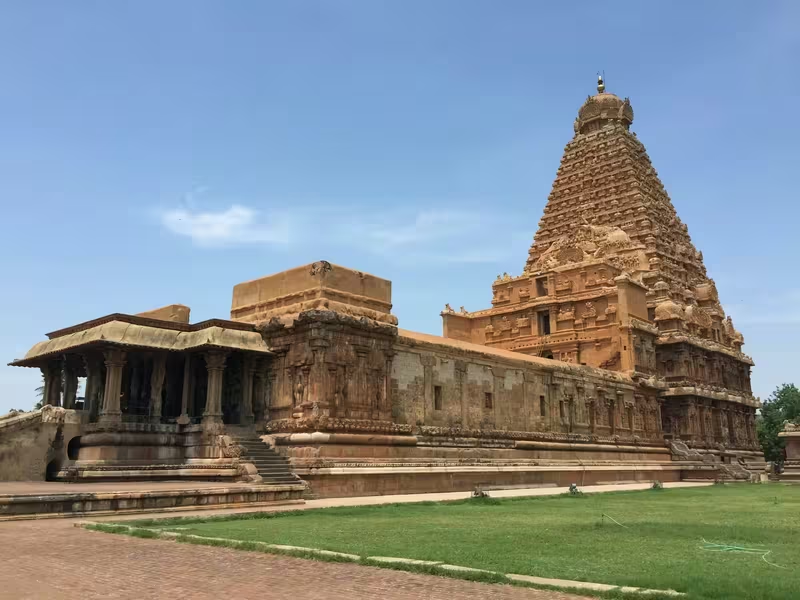
In the grand tapestry of Indian history, few dynasties command the same reverence as the Imperial Cholas. For over three centuries, they were the architects of a South Indian golden age, their power radiating from the fertile Kaveri delta across the seas to Southeast Asia. Their temples, soaring monuments to faith and power, still dominate the landscape. Their administration was a marvel of efficiency, their navy a master of the Indian Ocean. Yet, every great empire faces its twilight. For the Cholas, that long, painful sunset began under the reign of Rajaraja Chola III, an emperor whose name is inextricably linked not with conquest and glory, but with defeat, humiliation, and the beginning of the end.
An Inheritance of Cracks
Rajaraja III ascended the Chola throne in 1216 CE, succeeding his father, the formidable Kulothunga Chola III. On the surface, the empire he inherited was vast and imposing. Kulothunga III had been a warrior king, a whirlwind of energy who had successfully beaten back the rising power of the Pandyas of Madurai, sacking their capital and celebrating his victories in grand style. He had maintained Chola dominance over a network of feudatories and left behind an empire that, to the casual eye, seemed as invincible as ever.
But beneath this veneer of strength, deep cracks were forming. The constant warfare had drained the treasury. More importantly, the very feudatories that Kulothunga III had subdued were seething with resentment. The Pandyas, in particular, nursed a burning desire for vengeance. The Hoysalas, a powerful kingdom to the west in the Deccan plateau, were watching the shifting dynamics with keen interest, ready to play the role of kingmaker. The political climate of the 13th-century Deccan was a complex chessboard of shifting alliances, and Rajaraja III, unlike his predecessors, lacked the political acumen and military prowess to navigate it.
The First Storm: The Pandya Vengeance
The storm broke almost immediately after Rajaraja III’s accession. Maravarman Sundara Pandya I, who had ascended the Pandya throne in 1216 CE, was a man driven by a singular purpose: to avenge the humiliation inflicted upon his people by Kulothunga III. He wasted no time. In 1217-18 CE, Pandya forces swept into the Chola heartland, the fertile Kaveri basin.
The invasion was swift and brutal. The Chola armies, perhaps complacent or poorly led, were unable to mount an effective defence. The Pandya forces sacked the ancestral Chola capital of Uraiyur and the imperial capital of Thanjavur. In a symbolic act of ultimate vengeance, Maravarman Sundara Pandya conducted a virabhisheka (anointment of heroes) in the Cholas' own coronation hall at Ayirattali. The message was clear: the age of Chola supremacy was over.
Rajaraja III was forced to flee, his crown and kingdom lost. However, Sundara Pandya did not annex the Chola lands entirely. In a calculated political move, likely influenced by his Hoysala ally Vira Ballala II who wished to maintain a balance of power, he agreed to restore the kingdom to Rajaraja III. But the restoration came at a staggering price. The Chola emperor, the descendant of the mighty Rajaraja I and Rajendra I, was forced to accept the suzerainty of the Pandyas. He was no longer an independent emperor, but a feudatory to his once-vassals. It was a humiliation from which the Chola psyche would never fully recover.
The Humiliation at Tellaru
For over a decade, Rajaraja III reigned as a subordinate ruler. The empire was held together not by his strength, but by the careful machinations of the Hoysalas. The Hoysala king, Vira Narasimha II, saw a strategic advantage in a weakened, but not destroyed, Chola kingdom. A pliant Chola state could serve as a buffer against the now-dominant Pandyas. This Hoysala intervention became a defining feature of Rajaraja’s reign; he was a king propped up by a foreign power.
Perhaps emboldened by this Hoysala support, or perhaps simply misjudging the political reality, Rajaraja III made a fateful decision around 1231 CE. He attempted to reassert his independence by ceasing to pay his annual tribute to the Pandyas. This act of defiance was a catastrophic miscalculation.
The response was not from the Pandyas directly, but from a powerful and ambitious Chola feudatory: the Kadava chieftain Kopperunchinga I. A formidable warlord based in Sendamangalam, Kopperunchinga had been steadily growing his power and saw the Chola weakness as his opportunity. As Rajaraja III marched his forces, ostensibly to confront his enemies, he was intercepted by Kopperunchinga at a place called Tellaru.
The result was a disaster. The Chola army was defeated, and in an event that sent shockwaves across the southern peninsula, Rajaraja Chola III, the Chola Emperor, was captured and thrown into prison in Kopperunchinga’s capital at Sendamangalam. An emperor being imprisoned by his own vassal was an unprecedented dishonour, a sign of the absolute collapse of imperial authority.
Rescued, But Not Redeemed
News of the Chola emperor's imprisonment reached the Hoysala court. Vira Narasimha II could not allow his strategic pawn to be eliminated. He immediately dispatched a massive army under his generals Appanna and Samudra-gopayya. The Hoysala force marched into the Tamil country, their mission twofold: to liberate Rajaraja III and to punish Kopperunchinga.
The Hoysala campaign was ruthless and effective. They advanced deep into Chola territory, pushing back Pandya-allied forces and establishing a firm military presence. To exert maximum pressure on the Kadava chieftain, Narasimha II established a parallel capital at Kannanur Koppam, near Srirangam, effectively governing the northern part of the Chola country himself. He then laid siege to Sendamangalam, sending a chilling message to Kopperunchinga that he was prepared to destroy his city and his lineage if the Chola emperor was not released.
Facing annihilation, Kopperunchinga capitulated. He released Rajaraja III from his prison. The Chola emperor was restored to his throne in 1231 CE, but his authority was shattered beyond repair. He was now a king in name only, a puppet whose strings were pulled by his Hoysala “protectors.” The Hoysala presence at Kannanur Koppam was a clear signal that the Cholas no longer controlled their own destiny. The empire continued to crumble from within, with local chieftains and governors asserting their independence, knowing the central authority was powerless to stop them.
The Final Years: A King in the Shadows
The last two decades of Rajaraja III’s reign were a period of slow, inexorable decline. His incompetence was so apparent that by 1246 CE, a more capable and aggressive successor, Rajendra Chola III, was appointed as co-regent. Rajendra III was everything Rajaraja III was not—ambitious, energetic, and a skilled military commander. He immediately began a campaign to reclaim Chola glory, even achieving some notable, albeit temporary, victories against the Pandyas.
For several years, inscriptions from the period mention both rulers, suggesting a joint rule. However, it is clear that Rajendra III held the real power. Rajaraja III faded into the background, a figurehead presiding over the final dismemberment of the empire he had failed to protect. His last known inscription is dated around 1246, but he appears to have lived on, a shadow king, until around 1260 CE. His death went largely unremarked, a quiet end to a calamitous reign.
Legacy of a Collapse
Rajaraja Chola III left no great temples, no celebrated conquests, no administrative reforms. His legacy is a tragic and cautionary one. He is remembered as the emperor who inherited a superpower and oversaw its collapse into a third-rate power, dependent on others for its very survival.
His reign marks a pivotal turning point in South Indian history. The vacuum created by the Chola collapse fundamentally reshaped the political map. It allowed the Pandyas to emerge as the premier Tamil power for the next century, and it cemented the Hoysalas as a decisive force in the region's politics. The glorious artistic and administrative traditions of the Cholas were not lost, but were instead inherited and continued by these successor states.
Today, Rajaraja Chola III stands as a stark contrast to his illustrious namesake, Rajaraja I, the empire builder. His story is not one of glory but of failure—a lesson in how a combination of weak leadership, internal dissent, and powerful external rivals can bring even the mightiest of empires to its knees. He was the unfortunate emperor who reigned during the twilight, forever remembered as the king who watched the sun set on the Chola empire.