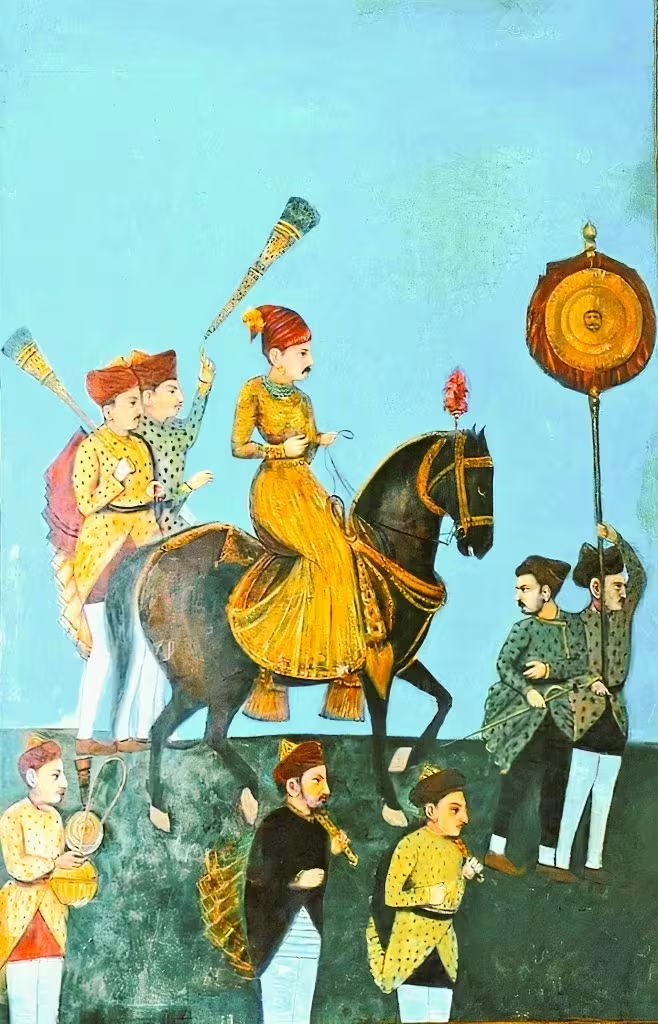
A King in the Eye of the Storm: The Saga of Chhatrapati Rajaram I
In the grand tapestry of Maratha history, woven with threads of legendary valour and epic struggle, the reign of Chhatrapati Rajaram I Bhonsale stands as a testament to unparalleled resilience. He was a king who inherited not a stable throne, but a raging inferno. Ascending to power in the darkest hour of the Maratha Swarajya, following the brutal execution of his elder brother, Chhatrapati Sambhaji, Rajaram was tasked with the near-impossible: to hold together a crumbling empire against the full, overwhelming might of the Mughal Emperor Aurangzeb.
His story is not one of grand conquests, but of tenacious survival; not of building new empires, but of saving a precious legacy from annihilation. It is the saga of a strategic retreat that became a war-winning strategy, of a court held in a distant southern fortress, and of a leader who, through diplomacy and determination, kept the flame of Maratha independence burning against a hurricane.
Early Life & A Throne of Thorns
Born on February 24, 1670, at the formidable Raigad fort, Rajaram was the younger son of the visionary founder of the Maratha Empire, Chhatrapati Shivaji Maharaj, and his wife, Soyarabai. He grew up in the monumental shadow of his father and his formidable, battle-hardened elder half-brother, Sambhaji. His childhood was one of privilege and education, where he would have been trained in the arts of war, diplomacy, and administration, the essential curriculum for a Maratha prince.
However, his first taste of real power was bitter and divisive. Upon Shivaji's sudden death in April 1680, a faction at court, led by his mother Soyarabai and several influential ministers, attempted to bypass the designated heir, Sambhaji, and place the ten-year-old Rajaram on the throne. This ill-fated move plunged the nascent empire into a brief but intense succession crisis. Sambhaji, with the support of the larger Maratha army, swiftly crushed the conspiracy, claimed his rightful throne, and placed the young Rajaram under house arrest. This early, traumatic exposure to the harsh realities of court politics and the loss of his mother left an indelible mark on the young prince.
For the next nine years, during Sambhaji's turbulent reign, Rajaram lived a life of quiet confinement at Raigad. While his brother valiantly fought a multi-front war against the Mughals, the Portuguese, and the Siddis, Rajaram remained a prince in waiting, a silent observer of the epic struggle for Swarajya.
The Catastrophe and the Crown
The year 1689 delivered a devastating blow to the Marathas. Chhatrapati Sambhaji, through an act of betrayal, was captured by Mughal forces at Sangameshwar. He was subjected to horrific torture and executed in March 1689 on the orders of a triumphant Aurangzeb, who believed that with the death of their king, the Maratha spirit would be extinguished forever.
The Mughal army, led by the capable general Zulfiqar Khan, marched on the Maratha capital, Raigad. The empire was headless, its treasury vulnerable, and its people in shock. It was in this moment of existential dread that the remaining Maratha leaders displayed incredible foresight. Yesubai, Sambhaji's courageous wife, stood firm within the besieged fort. Understanding that the survival of the royal line was paramount, she made a selfless and strategically brilliant decision. She insisted that her own young son, Shahu, remain within Raigad with her, while Rajaram should be crowned the next Chhatrapati and smuggled out to continue the fight.
On March 12, 1689, amidst the looming threat of Mughal cannons, Rajaram was declared the third Chhatrapati of the Maratha Empire. His was not a throne of comfort, but a crown of thorns, bestowed upon him with the singular duty of saving the kingdom from obliteration.
The Great Escape and the Southern Bastion
With Raigad's fall imminent, Rajaram’s escape was a matter of national survival. On April 5, 1689, he slipped out of the besieged fort in disguise, accompanied by a small band of loyal followers. What followed was one of the most perilous journeys in Indian history. For months, the 19-year-old king traversed hundreds of kilometres of hostile territory, constantly hunted by Mughal spies and patrols. He moved through Panhala, Pratapgad, and finally southwards, towards the distant Carnatic region.
His destination was the fortress of Gingee (also known as Jinji) in modern-day Tamil Nadu. Acquired by his father during his southern campaigns, Gingee was a masterstroke of strategic foresight. A massive complex of three fortified hills, it was considered one of the most impregnable forts in India. Far from the primary theatre of war in Maharashtra, it offered a secure base from which to command the Maratha resistance.
After a harrowing journey, Rajaram arrived at Gingee in November 1689. There, he set about a monumental task: rebuilding the Maratha state in exile. He established a fully functioning court, appointed ministers like Ramchandra Pant Amatya and Prahlad Niraji, and gathered his most trusted commanders. Gingee became the de-facto Maratha capital, a beacon of defiance deep within enemy-held territory.
The War from Gingee: A Strategy of Genius
Aurangzeb, infuriated by Rajaram's escape, dispatched Zulfiqar Khan to capture Gingee and extinguish this southern flame. The great Siege of Gingee began in September 1690 and would last for nearly eight excruciating years. This siege became the centerpiece of Rajaram's reign and his most significant contribution to the Maratha cause.
While the Mughals poured immense resources into capturing the fort, Rajaram and his council executed a brilliant two-front war strategy. He became the political and symbolic anchor at Gingee, rallying his forces and managing the administration. Simultaneously, he unleashed his most formidable generals in Maharashtra to wage a relentless campaign of guerrilla warfare.
Commanders of genius, Santaji Ghorpade and Dhanaji Jadhav, became the terror of the Deccan. They led lightning-fast raids on Mughal supply lines, ambushed imperial armies, and collected revenue (chauth) from Mughal territories to fund the war. They never allowed the Mughal forces a moment of peace, tying down hundreds of thousands of imperial troops and bleeding Aurangzeb's treasury dry. The Mughals were caught in a strategic trap: their main army was stuck in a frustratingly long siege hundreds of miles to the south, while their control over the Maratha heartland was being systematically dismantled.
From Gingee, Rajaram played the role of a unifying statesman. He was known for his calm temperament and conciliatory nature, a stark contrast to his brother's fiery disposition. He skillfully managed the egos of his powerful sardars, empowering them with land grants (jagirs) and titles, ensuring their loyalty and commitment to the collective cause. He held the fractured Maratha confederacy together through sheer force of diplomacy and shared purpose.
As the years dragged on, the siege of Gingee became a symbol of Maratha tenacity. Finally, in late 1697, with the fort's resources dwindling, Rajaram executed another daring escape. Just before Gingee fell to the Mughals in January 1698, he slipped through the enemy cordon and made his way back to Maharashtra.
The Final Resurgence and Untimely End
Rajaram's return to his homeland in 1698 electrified the Maratha forces. He established his new capital at Satara and began to personally lead military campaigns, a visible and inspiring commander-in-chief. The war entered a new, aggressive phase. The Marathas, now on the offensive, began recapturing forts and territories, pushing the exhausted Mughals back.
The tide of the 27-Year War was finally beginning to turn. Rajaram's strategy had paid off spectacularly. The Maratha state had not only survived but was emerging stronger and more unified.
Tragically, just as victory seemed within grasp, the years of relentless hardship, constant movement, and the stress of war took their toll on the young king's health. While campaigning, Chhatrapati Rajaram I died of a lung illness at Sinhagad fort on March 3, 1700. He was only 30 years old.
Legacy & Influence
Chhatrapati Rajaram I is often remembered as the king who presided over the Maratha state's most desperate hour. His reign was not defined by glorious expansion, but by the far more difficult task of preservation. His legacy is profound and multifaceted:
The Saviour of Swarajya: His greatest achievement was ensuring the survival of the Maratha kingdom. When faced with total collapse, he provided the calm, strategic leadership that allowed the state to weather the storm and fight back.
The Master Strategist: The decision to move to Gingee was an act of strategic genius. It transformed a desperate retreat into a calculated manoeuvre that bogged down the enemy and created the space for a guerrilla war to flourish in the Deccan.
A Unifying Diplomat: He successfully united the powerful and often fractious Maratha sardars, creating a collective leadership model that was essential for the decentralized war effort. His ability to delegate and inspire trust was a key factor in the Maratha success.
The Bridge to Victory: Rajaram's decade of resistance laid the crucial groundwork for final victory. Upon his death, his brilliant and formidable wife, Tarabai, took the reins as regent for her young son, Shivaji II. She continued the war with even greater ferocity, building upon the military and administrative structures that Rajaram had so carefully preserved. It was this unbroken chain of leadership that ultimately outlasted Aurangzeb himself, who died in the Deccan in 1707, a broken man who had failed to conquer the Maratha spirit.
Chhatrapati Rajaram I may not have had the revolutionary vision of his father or the fierce martial prowess of his brother, but he possessed the one quality the Marathas needed most at that time: unbreakable resilience. He was the quiet anchor in a raging storm, a king who ruled from exile but never lost his kingdom, ensuring that the dream of Swarajya would survive to see the dawn.