Rajendra I - The Chola Emperor Who Ruled the Waves
In the grand tapestry of Indian history, few figures cast as long a shadow as Rajendra Chola I. He was more than a conqueror; he was a visionary who inherited one of South India’s greatest empires and transformed it into a dominant thalassocracy, a maritime power whose influence stretched from the Gangetic plains to the bustling ports of Southeast Asia. Son of the legendary Rajaraja the Great, Rajendra I not only consolidated his father's vast conquests but expanded them with breathtaking ambition. His reign, from 1014 to 1044 CE, represents the zenith of Chola power—a period marked by audacious military campaigns, unprecedented naval expeditions, and magnificent architectural patronage that left an indelible mark on the subcontinent and beyond.
Early Life & Background
Born around 971 CE to the formidable Chola emperor Rajaraja I and his queen, Vanavan Mahadevi, Prince Rajendra was destined for greatness. He grew up in the thriving imperial capital of Thanjavur, a city buzzing with the energy of a newly consolidated empire. His father, Rajaraja I, was a masterful administrator and military strategist who had already subdued the Pandyas and Cheras, conquered parts of Sri Lanka, and established the Cholas as the paramount power in Southern India.
Rajendra’s education was not confined to palace halls. From a young age, he was immersed in the arts of war and governance. He was a direct witness to his father’s statecraft and accompanied him on several military campaigns. This practical, hands-on training was the cornerstone of his formative years. By participating in the ongoing wars against the Western Chalukyas and the campaigns in Sri Lanka, he gained invaluable experience in battlefield tactics, logistics, and the command of a large, diverse army.
In 1012 CE, two years before his father's death, Rajaraja I formally appointed Rajendra as co-regent. This was a politically astute move, ensuring a seamless and undisputed succession. It allowed Rajendra to actively participate in the administration of the empire, familiarizing himself with the complexities of revenue, justice, and provincial governance. By the time he ascended the throne in 1014 CE, Rajendra Chola I was not an untested prince but a seasoned commander and administrator, fully prepared to build upon the magnificent foundation his father had laid.
Career & Major Contributions
Rajendra I’s reign was one of relentless activity and expansion. He did not simply rest on his inheritance but immediately set out to secure and expand the empire's frontiers, driven by a vision of Chola supremacy that knew no geographical bounds.
Consolidation and Southern Conquests
His first years as sole emperor were dedicated to consolidating Chola authority. He quashed rebellions in the Pandya and Chera territories, reaffirming his dominance over the southern tip of the subcontinent. In a significant administrative move, he appointed one of his sons as a viceroy over the Pandya lands with the title Chola Pandya, integrating the region more directly into the imperial structure.
He then turned his attention to Sri Lanka (known then as Ila-mandalam). While his father had conquered the northern part of the island, Rajendra launched a full-scale invasion around 1017 CE to subjugate the entire kingdom. He successfully captured the Sinhalese king, Mahinda V, and seized the priceless crown jewels of the Sinhala monarchy. This complete conquest brought the whole of Sri Lanka under Chola rule for several decades, making it a vital province of the empire.
The Northern Conquest: March to the Ganges
Perhaps the most audacious land campaign of his reign was the northern expedition, launched around 1019 CE. This was not a war of annexation but a campaign of immense symbolic power. The objective was to march to the sacred River Ganges, defeat the northern kings who stood in the way, and bring back holy water from the river to sanctify his new capital.
A massive Chola army, commanded by a trusted general, marched northwards, crossing the Godavari and advancing through Kalinga (modern-day Odisha) and Vengi. The campaign culminated in the defeat of Mahipala, the powerful Pala king of Bengal and Bihar. The Chola inscriptions, such as the Tiruvalangadu plates, vividly describe how the victorious army collected the sacred water of the Ganges in pots and carried it south.
Rajendra himself is said to have met the returning army at the Godavari River to receive the holy water. To commemorate this unprecedented victory, he assumed the title Gangaikonda Chola—'The Chola who Conquered the Ganges'. This title would forever be associated with his name, a testament to an achievement that no southern dynasty had ever before accomplished.
The Oceanic Triumph: The Srivijaya Campaign
While the Ganges expedition was a feat of land-based power, Rajendra’s campaign against the Srivijaya empire around 1025 CE was a stunning display of naval might that reverberated across Asia. The Srivijaya empire, a powerful maritime federation based in Sumatra, controlled the vital Strait of Malacca and other key sea lanes that were the arteries of trade between India, China, and the Spice Islands.
While the exact reasons for the conflict are debated by historians—ranging from trade disputes to a Srivijayan attempt to obstruct Chola commerce with Song China—the result was unequivocal. Rajendra assembled a formidable naval fleet and launched a swift, devastating attack across the Bay of Bengal. This transoceanic expedition was a logistical and military marvel for its time.
His forces struck at the heart of the Srivijayan kingdom. The Chola inscriptions list a series of stunning victories, including the capture of the Srivijayan capital of Kadaram (likely modern-day Kedah in Malaysia), Pannai in Sumatra, and Malaiyur on the Malay peninsula. The Srivijayan king, Sangrama Vijayatunggavarman, was captured. Rajendra’s victory earned him another famous title: Kadaram Kondan—'The Conqueror of Kadaram'.
This was not a campaign of permanent occupation. Rather, it was a strategic punitive raid designed to shatter Srivijayan naval supremacy, secure the sea routes for Tamil merchant guilds like the Ainnurruvar and Manigramam, and establish the Cholas as the undisputed protectors of the Indian Ocean trade. For a time, the Bay of Bengal was effectively a 'Chola Lake'.
Architectural and Cultural Patronage: Gangaikonda Cholapuram
To celebrate his victorious northern campaign, Rajendra Chola I founded a new imperial capital, a city built to rival his father’s Thanjavur. He named it Gangaikonda Cholapuram—'The City of the Chola who Conquered the Ganges'. This city served as the Chola capital for the next 250 years.
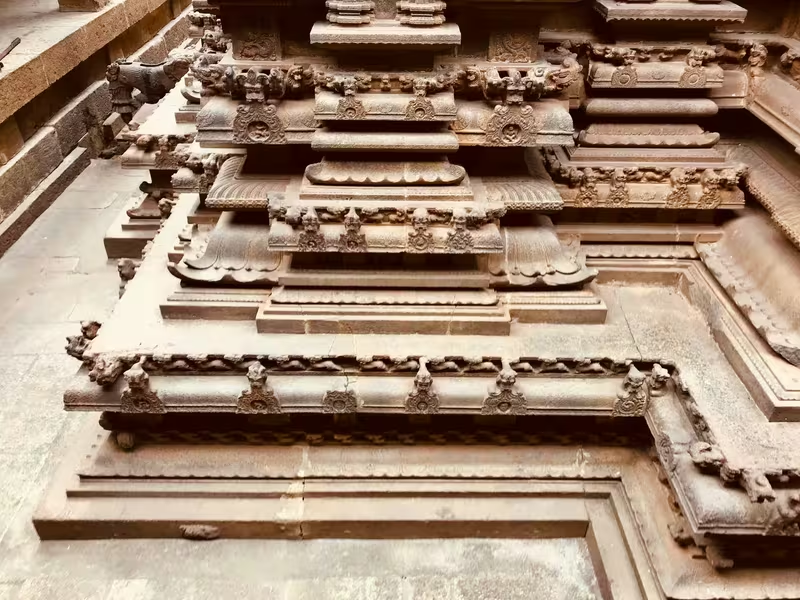
At its heart, he consecrated a magnificent temple to Shiva, the Brihadisvara Temple. While inspired by his father’s great temple in Thanjavur, it is a unique masterpiece in its own right. The temple’s main tower, or vimana, is slightly shorter but more graceful, with a distinctive concave contour that lends it a feminine elegance in contrast to the stern, masculine tower at Thanjavur. The temple complex is renowned for its exquisite and powerful sculptures, including a celebrated panel of a dancing Ganesha, a serene Ardhanarishvara (the androgynous form of Shiva and Parvati), and a powerful depiction of Shiva bestowing grace upon his devotee, Chandesha.
Beside the city, Rajendra also commissioned a colossal man-made reservoir, the Cholagangam. Fed by the Kollidam and Vellar rivers, this vast lake was an engineering marvel that served as a vital source of irrigation for the surrounding lands. Inscriptions proudly refer to it as a jalamayam jayasthambham—a 'liquid pillar of victory', filled with the water of the Ganges.
Legacy & Influence
Rajendra Chola I’s reign ended with his death in 1044 CE, but his legacy endures. He is remembered as one of the most powerful and influential rulers in Indian history, a monarch whose achievements reshaped the political and economic map of his era.
Military and Naval Legacy: Rajendra’s greatest contribution was the transformation of the Chola kingdom into a true maritime empire. His naval expeditions were unprecedented in scale and success, establishing a tradition of Indian naval power that projected influence far beyond the subcontinent's shores. He demonstrated that control of the seas was essential for both economic prosperity and military dominance.
Political and Economic Impact: By shattering the Srivijayan monopoly and securing the sea lanes, Rajendra’s policies fostered a golden age of trade for South Indian merchants. This brought immense wealth into the Chola empire, funding its magnificent temples, extensive irrigation networks, and powerful military. His administrative reforms, such as the viceroyalty system, helped manage a vast and complex empire.
Cultural and Architectural Heritage: The city of Gangaikonda Cholapuram and its stunning temple (now a UNESCO World Heritage Site) stand as his most visible legacy. They are enduring symbols of the artistic and engineering prowess of the Chola civilization at its absolute peak. They reflect not just imperial power, but also a sophisticated aesthetic and deep spiritual devotion.
Today, Rajendra Chola I is revered as a national hero, particularly in Tamil Nadu. He is celebrated in literature, folklore, and popular culture as the emperor who took the Chola tiger banner to the banks of the Ganges and across the eastern seas. His story is a powerful reminder of a time when a South Indian empire commanded the waves and played a pivotal role on the world stage.