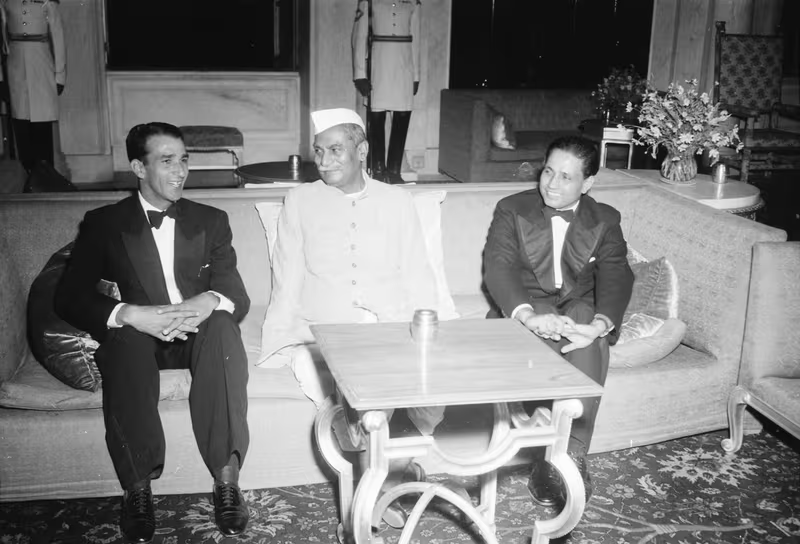
The Gentle Architect: Rajendra Prasad, First President of India
On the morning of January 26, 1950, as India awoke to its new life as a sovereign republic, a man of profound humility and quiet strength took the oath of office as its first President. Rajendra Prasad, clad in a simple white khadi churidar and achkan, embodied the very soul of the new nation he was now tasked to lead—a nation born from ancient traditions yet striding towards a modern, democratic future. His journey from the rustic lanes of Ziradei in Bihar to the hallowed halls of the Rashtrapati Bhavan was not just the story of one man's ascent, but a reflection of India's own struggle for freedom, identity, and self-governance. Known affectionately as 'Desh Ratna' (Jewel of the Country), Prasad was a scholar, a lawyer, a Gandhian stalwart, and the steady hand that guided the framing of India's Constitution.
Early Life & Background
Birth in the Heart of Bihar
Rajendra Prasad was born on December 3, 1884, in the village of Ziradei, in the Siwan district of Bihar. His father, Mahadev Sahai Srivastava, was a respected scholar of both Persian and Sanskrit, while his mother, Kamleshwari Devi, was a deeply religious woman who nurtured her youngest son with stories from the Ramayana and Mahabharata. Growing up in a large joint family, young Rajendra was immersed in a world of traditional values, cultural syncretism, and intellectual curiosity. His earliest education, as was common then, came from a Maulvi who taught him Persian, Hindi, and arithmetic, laying the foundation for a multilingual and multicultural worldview.
A Scholar's Ascent
Prasad's academic brilliance was evident from a young age. After his initial schooling, he moved to the Chapra District School and later to Calcutta for higher education. In 1902, he secured admission to the prestigious Presidency College, having stood first in the entrance examination for the University of Calcutta. His intellectual prowess was so remarkable that it gave rise to a legendary anecdote: upon reviewing his examination paper, an invigilator was said to have written, "The examinee is better than the examiner."
Calcutta, then the epicentre of the British Indian administration and a crucible of nationalist thought, profoundly shaped his consciousness. He joined the Dawn Society, a hub of nationalist activity founded by Satish Chandra Mukherjee, which instilled in him a deep sense of service and patriotism. While excelling in his studies—completing his M.A. in Economics in 1907 and later a Doctorate in Law—he was increasingly drawn to the burgeoning freedom movement. He began his career as a highly successful lawyer, first in Calcutta and later at the Patna High Court, but his heart was set on a larger purpose.
Career & Major Contributions
The Call of Champaran
The turning point in Rajendra Prasad's life arrived in 1917. Mahatma Gandhi had come to Bihar to investigate the plight of indigo farmers in Champaran, who were being brutally exploited by British planters. Initially hesitant, Prasad, a successful lawyer accustomed to a comfortable life, met Gandhi. He was captivated by the Mahatma's simplicity, unwavering resolve, and method of Satyagraha. Witnessing Gandhi's work firsthand, Prasad underwent a profound transformation. He abandoned his lucrative legal practice, simplified his lifestyle, and dedicated himself completely to the cause of independence. The Champaran Satyagraha was his baptism by fire into the Gandhian way of life and struggle.
A Pillar of the Freedom Movement
From that moment on, Prasad became one of Gandhi's most trusted lieutenants. He was at the forefront of the Non-Cooperation Movement (1920-22) in Bihar, encouraging people to boycott British institutions and goods. His commitment to the cause saw him imprisoned multiple times.
His true mettle as a leader and organizer was showcased during the devastating Bihar earthquake of 1934. While in prison, he was released to lead the relief efforts. He established the Bihar Central Relief Committee and worked tirelessly, raising funds and organizing aid with such efficiency and integrity that his committee's collection far surpassed the fund raised by the Viceroy. This monumental effort earned him the love and respect of millions and cemented his reputation as a leader of the people.
His stature within the Indian National Congress grew steadily. He was elected its President for the first time in 1934. He would again take the helm in 1939, following the resignation of Subhas Chandra Bose, and once more in 1947, during the critical year of independence. During the Quit India Movement of 1942, he was arrested along with other senior leaders and spent nearly three years in Bankipur Jail in Patna.
Architect of the Constitution
Perhaps Rajendra Prasad's most enduring contribution to the Indian nation was his role as the President of the Constituent Assembly. Elected to this crucial position on December 11, 1946, he was tasked with steering the creation of the Constitution of India. For nearly three years, he presided over the complex and often contentious debates with extraordinary patience, wisdom, and impartiality.
In an assembly of brilliant minds and strong personalities—from Jawaharlal Nehru to Sardar Vallabhbhai Patel and Dr. B.R. Ambedkar—Prasad was the calming, unifying force. He ensured that every voice was heard, every perspective was considered, and that the final document was a product of collective consensus. His non-partisan conduct and deep understanding of law and governance were instrumental in navigating the intricate process of drafting a constitution for a diverse and newly independent nation. His concluding address to the Assembly on November 26, 1949, remains a masterclass in humility and democratic vision.
The First President of India
With the adoption of the Constitution on January 26, 1950, the Constituent Assembly unanimously elected Rajendra Prasad as the first President of the Republic of India. He was re-elected in 1952 and again in 1957, making him the only Indian President to have served two full terms.
As President, he was far from a mere ceremonial head of state. He established important precedents for the office, interpreting his role with a blend of constitutional propriety and moral authority. While he shared a relationship of deep respect with Prime Minister Nehru, he did not shy away from expressing his own views, most notably on the Hindu Code Bill. Prasad felt that such a fundamental social reform required a broader public mandate, a stance that led to a principled, though respectful, disagreement with the Prime Minister. This demonstrated his independent mind and his commitment to democratic processes.
He brought a spirit of Gandhian austerity to the magnificent Rashtrapati Bhavan, voluntarily accepting only a fraction of his salary and advocating for simplicity. He served as India's foremost diplomat, a symbol of its ancient heritage and modern aspirations, leaving an indelible mark of dignity and grace on the highest office of the land.
Legacy & Influence
The Unassuming Giant
Rajendra Prasad's historical significance lies in his role as a bridge—between tradition and modernity, between the struggle for freedom and the responsibilities of governance. He was the quiet anchor in the turbulent sea of nation-building, a leader whose strength lay not in fiery rhetoric but in his unwavering integrity, intellectual depth, and moral clarity. He was the perfect embodiment of the Gandhian ideal of a 'Satyagrahi' in public office.
His legacy is etched into the very fabric of the Indian Republic. As the President of the Constituent Assembly, he was the chief architect who oversaw the laying of its democratic foundations. As the first President, he infused the office with a sense of dignity and purpose that has guided his successors ever since. His writings, including his autobiography Atmakatha and India Divided, provide invaluable insights into the freedom struggle and the challenges of Partition.
A Timeless Ideal
Rajendra Prasad passed away on February 28, 1963, a few months after retiring from the presidency. He had returned to his humble abode at the Sadaqat Ashram in Patna, the same place from where he had guided the freedom movement in Bihar. His memorial, Mahaprayan Ghat, stands on the banks of the Ganga, a simple tribute to a man of profound simplicity.
Today, he is remembered as 'Ajatshatru'—one who has no enemies. In an age often defined by political polarization, his life remains a powerful reminder that leadership can be gentle yet firm, humble yet resolute. Rajendra Prasad was more than just the first President of India; he was the conscience of the new republic, a true 'Desh Ratna' whose light continues to guide the nation he helped build.