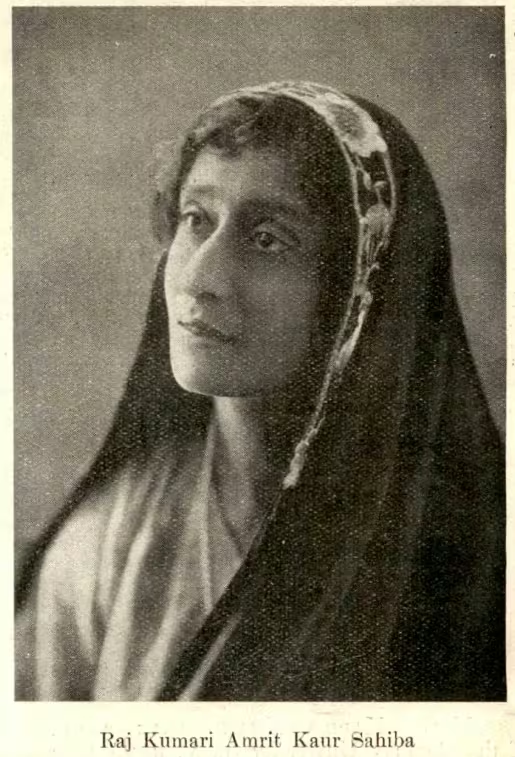
Rajkumari Amrit Kaur - Pioneering Health Minister
In the annals of modern Indian history, few figures embody the confluence of royalty, sacrifice, and nation-building as profoundly as Rajkumari Bibiji Amrit Kaur. Born into the gilded world of a princely state, she chose to forsake a life of privilege for the spartan rigours of the freedom struggle and dedicated her life to a singular, monumental task: building a healthy India. As the nation's first Health Minister and the only woman in Jawaharlal Nehru’s inaugural cabinet, she was not merely a politician but a visionary architect who laid the very foundations of India’s public health infrastructure, her legacy immortalised in the institution she willed into existence: the All India Institute of Medical Sciences (AIIMS).
Early Life & Background
Amrit Kaur was born on February 2, 1887, in Lucknow, then part of the United Provinces of British India. Her lineage was royal; she was a princess of the Kapurthala state in Punjab. Her father, Raja Harnam Singh, was the younger son of the Raja of Kapurthala. In a move that set the family on a unique path, Raja Harnam Singh converted to Christianity, which, while allowing him to retain his royal title, removed his branch of the family from the line of succession. This gave Amrit Kaur and her siblings an upbringing that was a rare blend of Indian aristocratic heritage and Western education and values, overseen by her mother, Rani Priscilla Kaur Sahiba.
The youngest of ten children and the only daughter, Amrit Kaur’s formative years were spent away from the cloistered confines typical for Indian princesses of the era. After being educated at home by English governesses, she was sent to England for her formal education at the Sherborne School for Girls in Dorset. This was an extraordinary step for the time, reflecting her family's progressive outlook. She excelled both academically and in sports, developing a lifelong passion for tennis and becoming the captain of the school’s team. She continued her education at University College London, before returning to India in 1918 at the age of 30, her worldview shaped by both the liberalism of her English education and a burgeoning sense of national identity.
Her return to India coincided with a period of intense political awakening. The brutalities of the colonial regime were being laid bare, and the air was thick with calls for self-determination. For a woman of her sensitivity and intellect, the insulated life of a princess in Punjab was no longer tenable. The turning point came with the horrific Jallianwala Bagh massacre in Amritsar in 1919. The cold-blooded killing of hundreds of unarmed civilians by British troops shattered any remaining faith she might have had in the benevolence of the Empire and ignited in her a fierce desire to work for her country's freedom. It was in this charged atmosphere that she found her political and spiritual anchor: Mahatma Gandhi.
Career & Major Contributions
Amrit Kaur's life can be viewed as two distinct but interconnected acts: her role as a freedom fighter and social reformer under Gandhi's mentorship, and her later role as a stateswoman and institution-builder in independent India.
A Disciple of Gandhi and a Voice for Freedom
Drawn to Gandhi’s philosophy of non-violence, truth, and service, Amrit Kaur sought him out. He became her mentor, and she, one of his most devoted followers. In a profound act of personal sacrifice, she left behind the silks and palaces of her youth for the coarse khadi and austere life of Gandhi's Sabarmati Ashram. For 16 years, she served as one of his secretaries, transcribing his articles and letters, and absorbing his vision for a free and equitable India. This long apprenticeship instilled in her a deep sense of discipline and an unwavering commitment to serving the most marginalised.
Her involvement in the freedom struggle was not confined to the ashram. She was a woman of action. During the Dandi March and the Salt Satyagraha of 1930, she was at the forefront, actively participating in the civil disobedience movement and was subsequently arrested and imprisoned by the British authorities. In 1942, she answered the call for the Quit India Movement, leading processions in the face of brutal police repression. She was arrested again for her role, demonstrating a courage that belied her genteel upbringing.
Parallel to her work in the independence movement, she became a formidable champion for women's rights. In 1927, she co-founded the All India Women's Conference (AIWC), a pioneering organisation that became a powerful voice for social reform. As its secretary and later its president, she campaigned tirelessly against the oppressive practices of child marriage, the purdah system, and the dedication of girls as Devadasis. She was a staunch advocate for universal suffrage, women's education, and equal inheritance rights, arguing that the liberation of India would be incomplete without the liberation of its women.
The Architect of a Healthy Nation
With India's independence in 1947, Prime Minister Jawaharlal Nehru looked for individuals of integrity and vision to build the new nation. He found both in Amrit Kaur. She was appointed as the first Minister of Health, a position she held for a decade, from 1947 to 1957. She was the first woman to hold a cabinet portfolio in India and remained the only female member of the cabinet for its entire ten-year term.
She inherited a healthcare system in shambles. The country was ravaged by communicable diseases, infant and maternal mortality rates were sky-high, and there was a desperate shortage of doctors, nurses, and hospitals. Undaunted, she approached the task with missionary zeal. Her tenure was marked by a series of ambitious, nationwide public health campaigns. She launched a massive assault on malaria, a disease that afflicted millions. She also spearheaded the world's largest BCG vaccination program to combat the scourge of tuberculosis, and worked relentlessly through the Hind Kusht Nivaran Sangh to eradicate leprosy and, crucially, the social stigma attached to it.
However, her most monumental and enduring contribution was the establishment of the All India Institute of Medical Sciences (AIIMS) in New Delhi. The 1946 Bhore Committee had recommended the creation of a national medical centre to set a high standard for medical education and research in India. Amrit Kaur made this recommendation her life's mission. The project, however, faced immense financial obstacles in a newly independent nation grappling with the economic aftermath of partition and colonialism.
Amrit Kaur proved to be a masterful and relentless fundraiser. She travelled the world, using her stature and persuasive powers to secure aid. She secured significant support from the governments of New Zealand, Australia, and West Germany, as well as from international bodies like the Ford Foundation and the Rockefeller Foundation. In a gesture of supreme personal commitment, she donated her ancestral home and property in Shimla, a sprawling mansion named 'Manorville', to the cause. It was in this very house that she had once hosted Mahatma Gandhi. In 1956, she piloted the AIIMS Act through Parliament, ensuring the institute's autonomy and establishing it as an 'institution of national importance'. Her vision was not merely to build a hospital, but to create a hub of excellence that would train generations of healthcare professionals and pioneer medical research tailored to India's unique needs.
Beyond AIIMS, she was instrumental in establishing the Indian Council of Child Welfare and the Amrit Kaur College of Nursing in Delhi, recognizing that a robust healthcare system needed a strong cadre of well-trained nurses.
Legacy & Influence
Rajkumari Amrit Kaur passed away on October 2, 1964, on the anniversary of her mentor Mahatma Gandhi's birth. Her legacy is not just etched in policy documents or foundation stones; it is alive in the millions of lives saved by the public health initiatives she launched and in the corridors of the world-class institution she built from scratch.
Her historical significance lies in her unique ability to bridge worlds. She was a princess who embraced Gandhian austerity, an aristocrat who fought for the rights of the common person, and a Western-educated woman who dedicated her life to building a modern, self-reliant India. As the first woman in the Indian cabinet, she shattered glass ceilings and became a role model for generations of women aspiring to public life.
Today, AIIMS stands as the most visible testament to her vision. It is consistently ranked as India's top medical college and hospital, a beacon of hope for millions and a symbol of medical excellence. The nationwide campaigns she initiated against malaria and tuberculosis laid the groundwork for India's primary healthcare system and provided a model for public health interventions across the developing world.
In 2020, in a project that revisited its past covers, TIME magazine posthumously named Rajkumari Amrit Kaur its 'Woman of the Year' for 1947. The recognition was a belated but fitting tribute to a stateswoman whose contributions during a pivotal moment in history were as profound as they were transformative. Rajkumari Amrit Kaur is remembered not as a princess of Kapurthala, but as a true servant of the Indian people—a woman of royal birth who became the chief architect of a nation's health.