The Silent Sage of Arunachala
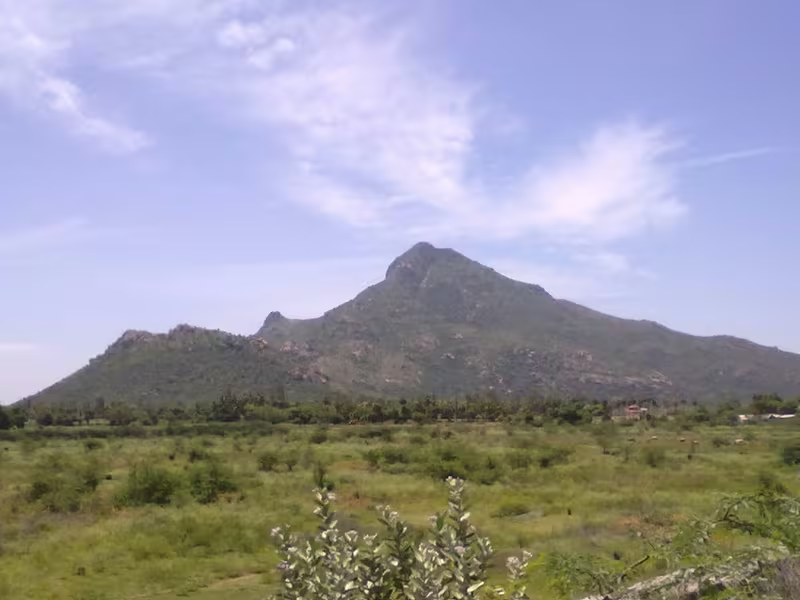
In the grand tapestry of India's spiritual history, few figures of the modern era radiate a presence as profound and universally accessible as Bhagavan Sri Ramana Maharshi. He was not a preacher who traveled the land, nor a scholar who penned complex philosophies. He was a silent anchor, a still point of profound peace seated at the foot of the sacred mountain Arunachala in Tamil Nadu. From this humble abode, his presence alone became a powerful sermon, drawing seekers of truth—from simple villagers to sophisticated Western intellectuals—into the orbit of his grace. Ramana Maharshi was a jivanmukta, one liberated while still in the body, who offered not a new doctrine, but a direct path to experiencing the ultimate reality within oneself through the simple, yet revolutionary, question: 'Nan Yar?'—'Who am I?'.
Early Life & The Great Awakening
Born Venkataraman Iyer on December 30, 1879, in the village of Tiruchuli, Tamil Nadu, the boy who would become the Maharshi showed few signs of his future spiritual stature. He was the second son of Sundaram Iyer, a respected pleader, and his wife, Azhagammal. By all accounts, Venkataraman was an ordinary boy, robust and athletic, known more for his deep sleep and occasional mischievousness than for any religious inclination. He attended school first in Tiruchuli and Dindigul, and later, after his father's death, moved with his family to Madurai, where he was enrolled in Scott's Middle School and the American Mission High School.
Life was unremarkable until a pivotal moment in July of 1896. At the age of sixteen, Venkataraman was suddenly overcome by a violent and inexplicable fear of death. It was not a mere intellectual anxiety but a visceral, all-consuming terror that he was about to die. In that moment of crisis, instead of panicking or seeking help, an extraordinary impulse arose within him. He decided to meet death head-on, to witness it consciously.
He lay down on the floor, stiffened his limbs, and held his breath, mimicking the state of a corpse. He then turned his full attention inward, asking the fundamental question: “Now death has come. What does it mean? What is it that is dying? This body dies.” He dramatized the death scene, yet he was aware of a force or current, the true ‘I’, that was entirely separate from the dying body. He experienced, with startling clarity, that this consciousness was not the body, which was inert and perishable. The ‘I’ was the deathless, formless, spiritual reality. The fear of death vanished instantly and permanently, replaced by a flood of blissful awareness that never again left him.
This was not a gradual process but an instantaneous, irreversible awakening. The world he had known was forever altered. The playful schoolboy Venkataraman dissolved, and in his place was a being absorbed in the effulgence of the Self. His interest in studies, friends, and worldly affairs evaporated. He would sit for hours, eyes closed, lost in a state of profound meditation, while his family grew increasingly concerned by his radical transformation.
The Journey to Arunachala
About six weeks after this experience, on August 29, 1896, while struggling with an English grammar lesson, the futility of his secular education became unbearable. A relative, who had just returned from a pilgrimage, mentioned he had been to Tiruvannamalai. The name ‘Arunachala’ had held a mystical resonance for Venkataraman since childhood, though he never knew it was a physical place. Hearing it now acted as a powerful catalyst. Realizing his destiny lay there, he left a note for his family, stating he was embarking on a journey commanded by his Father, and surreptitiously left home with a few rupees for his train fare.
His journey was an ordeal, but his focus was unwavering. After a few days, on September 1, 1896, the young sage arrived in Tiruvannamalai. He walked directly to the great Arunachaleswara Temple, a place he had been drawn to his entire life. Entering the inner sanctum, he addressed the divine, reporting his arrival and surrendering himself completely.
From that day forward, he never left the sacred precincts of Arunachala. He discarded his remaining money, his clothes, and even the sacred thread that marked his Brahmin heritage, symbolizing his transcendence of all social and religious identities. He shaved his head and took up a life of utter renunciation. For years, he remained in a state of deep meditative absorption, often in total silence, in various parts of the temple complex and later in caves upon the slopes of the holy mountain, most notably Virupaksha Cave and Skandashram. He was so oblivious to his body and surroundings that insects gnawed at his flesh without him noticing, and he had to be cared for by a small band of early devotees who recognized the divine presence shining through the silent youth.
The Sage of Arunachala: Teachings and Contributions
Word of the silent young swami on the mountain began to spread. His profound stillness and the palpable peace that emanated from him were his primary teachings. He did not preach or seek disciples, yet they came. Among the earliest was the brilliant Sanskrit scholar and poet, Kavyakantha Ganapati Muni. A master of the Vedas and a respected spiritual figure in his own right, Ganapati Muni came to the young swami in 1907 with a spiritual doubt. In a rare break of his long silence, the sage gave him a succinct and powerful instruction. Overwhelmed by the clarity and authority of the youth, Ganapati Muni declared him Bhagavan Sri Ramana Maharshi (The Blessed, Exalted Ramana, the Great Seer), and the name became known throughout India.
The Path of Self-Inquiry (Atma-Vichara)
Ramana Maharshi’s most significant contribution to modern spirituality is the direct path of Atma-Vichara, or Self-Inquiry. When seekers asked him how to attain liberation, he would turn the question back upon them, instructing them to find the source of the questioner—the ‘I’ itself.
His method was deceptively simple: to hold constant attention on the inner feeling of ‘I’ and to ask the question, “Who am I?”. It was not a mantra to be repeated but a method of investigation. Whenever other thoughts arose, the instruction was to ask, “To whom has this thought occurred?” The answer would be, “To me.” Immediately, one was to return to the primary inquiry, “Who am I?”. By relentlessly pursuing this inquiry, the individual ‘I’ or ego, which is merely a bundle of thoughts, begins to lose its hold. As the focus deepens, the I-thought subsides into its source: the spiritual Heart, the true Self, which is pure, undifferentiated Being-Consciousness-Bliss (Sat-Chit-Ananda).
Silence, Surrender, and Written Works
While he championed the path of knowledge (Jnana), the Maharshi affirmed that the path of devotion and surrender (Bhakti) was equally effective. To completely surrender one’s ego and will to God or the Guru achieves the same end as Self-Inquiry: the annihilation of the ego, leaving only the Self.
However, his most potent teaching was often delivered in Mouna, or sacred silence. In the darshan hall of his ashram, he would sit for hours, radiating a powerful stillness that calmed the minds of those present and offered them a direct taste of the peace he embodied. For him, silence was the purest form of instruction, conveying the truth beyond the limitations of language.
Though he wrote very little, the works attributed to him are considered spiritual masterpieces, composed at the request of his devotees:
- Nan Yar? (Who am I?): A concise prose summary of his teachings, originating from answers he wrote in the sand for the devotee Sivaprakasam Pillai.
- Ulladu Narpadu (Forty Verses on Reality): A profound and condensed exposition of Advaitic truth, composed to guide seekers in their practice.
- Upadesa Saram (The Essence of Instruction): Thirty verses outlining the paths of action, devotion, yoga, and knowledge, showing their interrelation and culminating in Self-abidance.
Life at Sri Ramanasramam and Final Years
In 1922, following the passing of his mother Azhagammal, who had come to live with him as a devotee, a samadhi shrine was built for her at the southern foot of Arunachala. Ramana moved down from the mountain to be near her tomb, and this spot organically grew into the institution known as Sri Ramanasramam. The ashram became a spiritual haven for seekers from every corner of the globe.
Life there was a model of simplicity and equality. The Maharshi made no distinctions between people based on caste, creed, or nationality. He actively participated in the daily life of the ashram, from cutting vegetables in the kitchen to binding notebooks. His compassion extended to all living beings; animals, including the famous cow Lakshmi, were treated with love and respect, and he knew their individual personalities intimately.
His days were spent in the Old Hall, and later the New Hall, seated on a simple couch, accessible to all. Visitors like the British author Paul Brunton, whose book A Search in Secret India introduced the Sage to a wide Western audience, came and were transformed by his presence. Ramana answered questions with profound wisdom and patience, but always pointed the seeker back to the source of their own being.
In 1949, a cancerous sarcoma appeared on his left arm. Despite immense pain and several surgeries, his equanimity remained untouched. When devotees wept, he would gently ask, “Where can I go? I am here.” He treated the disease of the body as an event happening to the body, not to the Self he knew himself to be. On the evening of April 14, 1950, as his devotees sat chanting, Bhagavan Sri Ramana Maharshi attained mahasamadhi. At the exact moment of his passing, many, including the French photographer Henri Cartier-Bresson who was present in Tiruvannamalai, reported seeing a brilliant star or meteor trail slowly across the sky, moving towards the peak of the holy Arunachala.
Legacy and Influence
Ramana Maharshi left behind no mission, no formal organization, and no designated successor. His legacy is not an institution, but a living truth. He demonstrated that the ultimate state of enlightenment described in ancient scriptures was not a myth or a historical artifact, but an attainable, living reality for modern humanity. He demystified spirituality, stripping it of esoteric dogma and complex rituals, and presented a path that was direct, practical, and available to anyone willing to sincerely look within.
Today, Sri Ramanasramam continues to be a vibrant center of spiritual practice, and the teachings of the Sage of Arunachala inspire millions worldwide. He is remembered as a perfect embodiment of Advaita Vedanta, a silent teacher whose life was his message. Bhagavan Sri Ramana Maharshi stands as a timeless beacon, forever reminding humanity that the ultimate peace and liberation they seek is not in some distant heaven or future time, but in the ever-present reality of the Self, waiting to be discovered within their own heart.