A Beacon of Devotion: The Life and Legacy of Sri Ramanujacharya
In the grand tapestry of Indian philosophy, few threads shine as brightly as that of Sri Ramanujacharya. Living in an era of intense intellectual debate and rigid social structures, he emerged as a monumental figure—a philosopher of the heart, a theologian of profound insight, and a social reformer of radical compassion. His life, spanning an extraordinary 120 years from 1017 to 1137 CE, was a testament to his mission: to build a philosophical and spiritual framework that reconciled the transcendent reality of the divine with the immanent world of human experience, all through the sublime path of devotion (Bhakti). He was not merely an academic; he was an Acharya, a guide who sought to make the highest spiritual truths accessible to all, irrespective of birth or station. His philosophy, Vishishtadvaita or 'qualified non-dualism', provided the intellectual bedrock for the burgeoning Bhakti movement that would sweep across India, transforming its religious and cultural landscape forever.
Early Life & Formative Years
Ramanuja was born in 1017 CE in the village of Sriperumbudur, a temple town not far from modern-day Chennai in Tamil Nadu. Born into a respected Brahmin family to Asuri Kesava Somayaji and Kantimathi, his early life was steeped in Vedic learning and Vaishnava tradition. From a young age, he displayed a precocious intellect and a deeply inquisitive and compassionate nature, qualities that would define his life's work.
His formal education began in the great temple city of Kanchipuram, a major center of learning. He became a student of Yadava Prakasha, a renowned scholar of the Advaita Vedanta school, which posits a strictly impersonal, attributeless, and non-dual Ultimate Reality (Brahman). It was under Yadava Prakasha's tutelage that the young Ramanuja's distinct philosophical path began to emerge. The relationship between guru and disciple was intellectually charged and ultimately untenable.
Deep fissures appeared during their study of the Upanishads. In one famous instance, while interpreting a verse from the Chandogya Upanishad describing the eyes of the Supreme Being as 'kapyasam pundarikam', Yadava Prakasha offered a crude translation comparing them to the red hindquarters of a monkey. Ramanuja, deeply pained by this interpretation, could not contain himself. With tears in his eyes, he offered an alternative, poetic explanation: the Lord's eyes were as lovely as a lotus that has blossomed in the morning sun ('Kam'-water, 'pibati'-drinks, thus 'sun'; 'asa'-blossoms). His interpretation was not just a linguistic alternative; it was a theological statement, asserting a divine reality that was beautiful, personal, and full of auspicious qualities, a stark contrast to the abstract Brahman of Advaita.
This intellectual rebellion, along with other similar disagreements, led to a complete break with Yadava Prakasha. These formative conflicts were crucial, steeling Ramanuja's resolve and clarifying his own burgeoning philosophical vision. He saw the world not as an illusion (Maya) to be negated, but as the glorious body of a personal, loving, and infinitely benevolent God.
Career & Major Contributions
Following his departure from Yadava Prakasha's school, Ramanuja's life took a pivotal turn. He was drawn to the teachings of the Alvars, the Tamil poet-saints whose ecstatic hymns of devotion to Vishnu had nourished the soul of South India for centuries. He found a spiritual home in the Sri Vaishnava tradition, which was then led by the revered acharya Yamunacharya (Alavandar) from the great temple center of Srirangam.
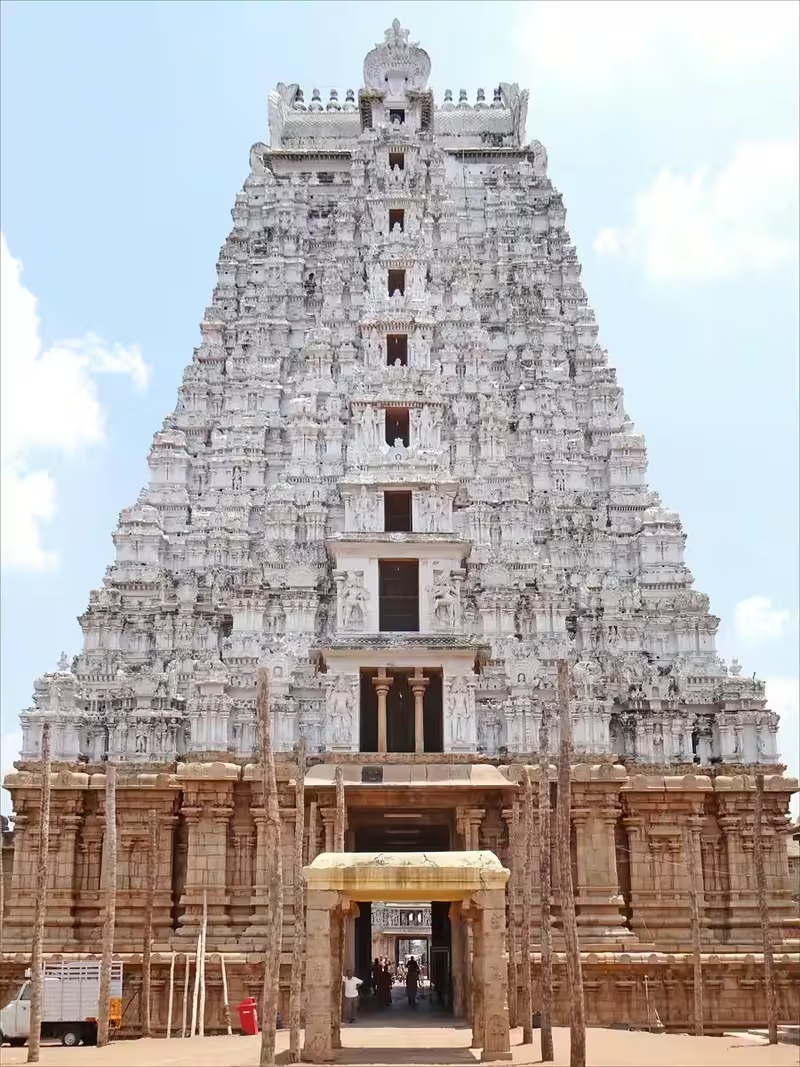
Though Ramanuja never met Yamunacharya in person, he was considered his spiritual heir. Upon Yamunacharya's passing, Ramanuja was invited to Srirangam to assume leadership of the Sri Vaishnava community. It was here, amidst the vibrant spiritual life of the Ranganathaswamy Temple, that Ramanuja would systematize his philosophy, reform temple administration, and launch his mission to spread the message of devotionalism.
The Philosophy of Vishishtadvaita
Ramanuja's most significant contribution to Indian thought is his philosophical system of Vishishtadvaita (Qualified Non-dualism). It was a masterful synthesis, aiming to reconcile the seemingly contradictory statements within the Upanishads—some describing a singular, unified reality, and others describing a God with attributes and a world of multiplicity.
In his magnum opus, the Sri Bhasya, a detailed commentary on the Brahma Sutras, Ramanuja mounted a formidable critique of Shankara's Advaita Vedanta. He argued:
Brahman is Saguna (With Attributes): The Ultimate Reality, Brahman, is not an impersonal, attributeless consciousness. Brahman is Ishvara (the Supreme Lord), identified with Vishnu-Narayana, who is the abode of infinite auspicious qualities like truth, knowledge, bliss, compassion, and beauty.
Reality of the World and Souls: The universe and individual souls (Jivas) are not illusions or superimpositions on Brahman. They are real, eternal, and distinct entities. They form the 'body' (sharira) of God, who is their 'soul' (shariri). Thus, while they are inseparable from and utterly dependent on Brahman, they retain their individual existence. This relationship preserves both the oneness of the whole and the reality of the parts.
Bhakti as the Path to Moksha: While acknowledging the importance of knowledge (Jnana) and action (Karma), Ramanuja championed Bhakti (devotion) as the primary means to liberation (Moksha). Moksha is not the dissolution of the individual soul into an impersonal Brahman, but the attainment of a state of eternal, blissful communion with God in his celestial abode, Vaikuntha, while retaining one's individuality.
His other major works, known collectively with the Sri Bhasya as the Navaratnas (Nine Gems), include the Vedartha Sangraha (a summary of his philosophy), a commentary on the Bhagavad Gita, and the deeply moving prose-poems of the Gadyatrayam. Through these texts, he provided a robust intellectual foundation for a theism that was both philosophically rigorous and emotionally satisfying.
A Crusader for Social Inclusion
Ramanuja's philosophy was not confined to ivory-tower intellectualism; it was a lived reality that translated into radical social action. His assertion that all souls were part of God's body had profound social implications. He challenged the rigidities of the caste system that barred access to spiritual knowledge and salvation.
One of the most powerful episodes from his life occurred at Tirukoshtiyur. His guru, Gosthipurna, imparted to him a sacred and secret mantra, "Om Namo Narayanaya," with the strict injunction that he should share it with no one, for it was a guaranteed path to liberation. Ramanuja, however, was overcome with compassion. He climbed to the top of the temple tower and proclaimed the mantra to the entire town, for all to hear, regardless of their caste or status. When his furious guru confronted him, asking if he was not afraid of the hell reserved for one who disobeys his master, Ramanuja replied with profound humility that he would gladly suffer eternal damnation if it meant that so many others could find liberation. Struck by his selfless compassion, his guru embraced him, calling him Emberumanar—'my lord'.
In another significant act, at the Cheluvanarayana Swamy Temple in Melkote, Karnataka, he championed the rights of the lower-castes. He gave them a new name of dignity, Tirukulattar ('people of the noble lineage'), and instituted a practice allowing them entry into the temple for worship during certain festivals—a revolutionary act in his time.
Legacy and Enduring Influence
Sri Ramanujacharya's impact on Indian history and culture is immense and far-reaching. He passed away in 1137 CE in Srirangam, leaving behind a legacy that continues to thrive.
Architect of Sri Vaishnavism: He is revered as the foremost Acharya of the Sri Vaishnava tradition. He not only provided its definitive philosophical framework but also organized its community, reformed its temple rituals, and established 74 pontifical centers (simhasanadhipatis) to ensure the propagation of his teachings for generations to come.
Inspiration for the Bhakti Movement: While devotional traditions existed before him, Ramanuja's work gave the Bhakti movement a powerful philosophical legitimacy and intellectual coherence. His emphasis on a personal God, the emotional path of devotion, and social inclusivity resonated across India. His ideas flowed northward, influencing later Bhakti saints like Ramananda, Kabir, Surdas, and Tulsidas, who carried the message of love and devotion to every corner of the subcontinent.
A Lasting Philosophical Alternative: Vishishtadvaita stands today as one of the three most influential schools of Vedanta philosophy. It continues to offer a compelling worldview for millions, one that affirms the reality of the world, the value of the individual, and the possibility of an intimate, loving relationship with the Divine.
In the 21st century, Sri Ramanujacharya is remembered not just as a philosopher but as an icon of equality and social justice. His life's work stands as a powerful testament to the idea that true spirituality lies not in world-rejection, but in compassionate action and the unwavering belief in the divine spark within all beings. This legacy was magnificently honored in 2022 with the unveiling of the Statue of Equality, a towering 216-foot monument near Hyderabad, dedicated to the 11th-century saint who championed the timeless ideal that all of humanity is one family, equal in the eyes of God.