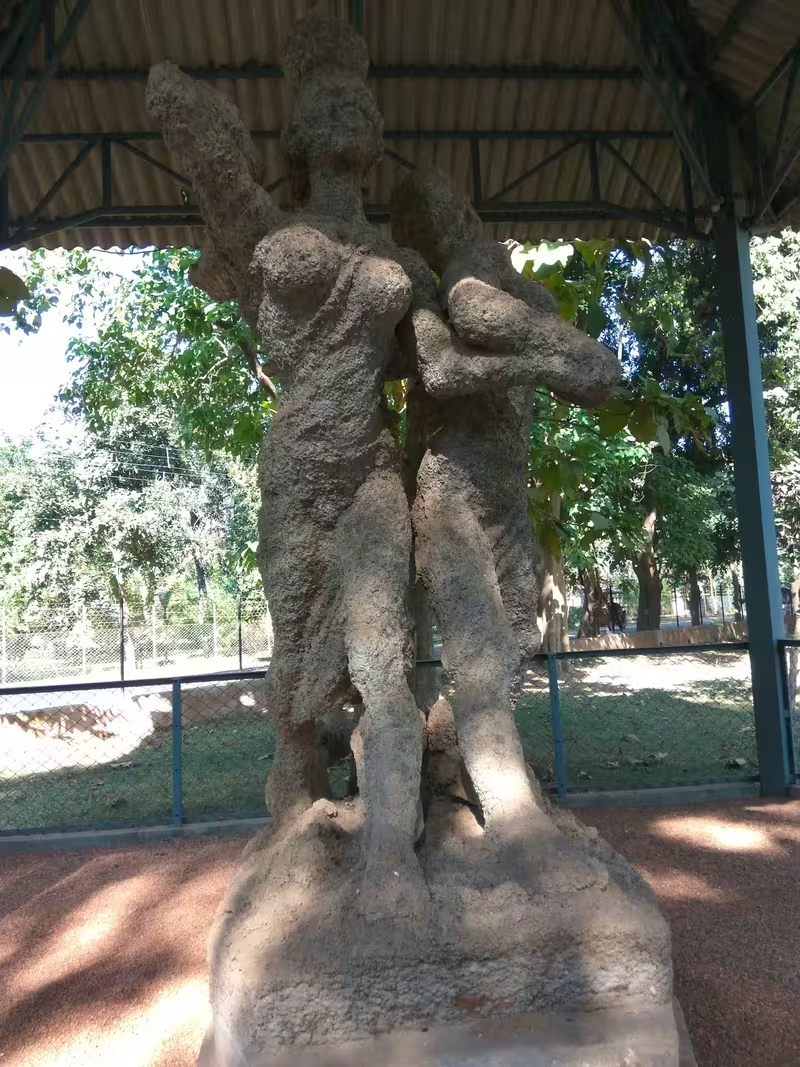
Ramkinkar Baij: The Elemental Force of Modern Indian Sculpture
In the grand theatre of 20th-century Indian art, where narratives were being reshaped by the currents of nationalism, modernism, and a quest for identity, one figure stands apart—not on a pedestal of polished marble, but firmly planted in the red soil of Bengal. Ramkinkar Baij was more than a sculptor; he was an elemental force. With hands that seemed to draw strength directly from the earth, he molded concrete, gravel, and laterite into forms that pulsated with the raw, untamed energy of life itself. He was the artist who gave a voice to the subaltern, a monumental presence to the Santhal tribesman, and a modern dynamism to ancient Indian forms, forever changing the language of sculpture in the subcontinent.
Early Life: An Artist Forged in the Soil of Bankura
Ramkinkar Baij was born in 1906 in the town of Jugipara in the Bankura district of West Bengal, a region known for its terracotta temples and vibrant folk art traditions. His family was of modest economic means. From a young age, Baij displayed an irrepressible creative urge, a talent that could not be contained by the lack of formal training or expensive materials. The world around him was his studio and his source of inspiration.
He would watch the local potters (kumbhakars) shape clay on their wheels, mesmerized by the magical emergence of form from a formless lump. He sketched voraciously, painted theatrical backdrops for local troupes, and modeled small figures from the clay of his surroundings. His early life was a lesson in resourcefulness; he learned to see artistic potential in the mundane, a philosophy that would define his life's work.
His prodigious, albeit untutored, talent did not go unnoticed. A pivotal moment came when his work caught the eye of Ramananda Chatterjee, the influential editor of the Calcutta-based journal Modern Review. Chatterjee, a prominent nationalist and cultural figure, recognized the spark of genius in the young man from Bankura. He became Baij's patron and guide, and in 1925, he brought the 19-year-old Ramkinkar to the crucible of Indian modernism: Visva-Bharati University in Santiniketan.
Santiniketan: The Crucible of a Revolutionary Vision
Arriving at Santiniketan was a profound turning point. Founded by Rabindranath Tagore, Santiniketan was not merely an educational institution; it was a philosophical experiment. It rejected the rigid, colonial model of education in favor of a holistic learning environment where art, nature, and humanity were inextricably linked. Its art school, Kala Bhavana, headed by the master artist Nandalal Bose, was the epicenter of this new cultural renaissance.
Here, Ramkinkar's raw talent found the perfect environment to flourish. Nandalal Bose, a visionary teacher, understood that Baij's genius was intuitive and primal. Instead of forcing him into a rigid academic mould, Bose gave him the freedom to experiment, to fail, and to find his own unique voice. Baij was exposed to a world of ideas—from classical Indian temple sculpture and folk art to Western modernists like Rodin and Expressionism—but he was encouraged to synthesize these influences through his own direct experience of life and nature.
At Santiniketan, Baij began his revolutionary experiments with materials. While established sculptors worked with expensive marble or bronze, Baij, driven by both economic necessity and artistic instinct, turned to humble, industrial materials. He pioneered the use of concrete, mixing it with sand, pebbles, and laterite gravel (moram) to create textures that were as rugged and honest as the subjects he depicted. This was not just a technical innovation; it was a philosophical statement. He proved that great art did not depend on expensive materials but on the power of the artist's vision.
Major Contributions: Sculptures that Breathe
Ramkinkar Baij's sculptures are not static objects to be admired from a distance; they are living, breathing entities that seem to emerge from the very landscape they inhabit. He became the Head of the Department of Sculpture at Kala Bhavana, and under his influence, the Santiniketan campus was transformed into an open-air gallery, a testament to his belief that art should be an integral part of public life.
Santhal Family (1938) Considered his magnum opus, Santhal Family is a landmark in the history of modern art. Created directly on-site with a metal armature and a cement-laterite mix, it depicts a Santhal family—a man carrying his belongings on a shoulder pole, a woman with a child in a basket, another child, and their dog—in a determined, forward stride. The sculpture is a powerful ode to the dignity of labor and the resilience of tribal communities displaced in the wake of industrialization. Its rough, textured surface and dynamic composition convey an incredible sense of movement and unyielding spirit. It is not a frozen moment but a continuous journey, capturing the very essence of human migration and survival.
Sujata (1935) If Santhal Family represents Baij's raw, expressionistic power, Sujata showcases his lyrical grace. This life-sized sculpture depicts the village girl who offered a bowl of rice pudding to a starving, ascetic Buddha. Rendered in cast concrete, the figure is elongated and slender, her form echoing the elegant Yakshis of ancient Indian sculpture. Yet, her presence is distinctly modern. Standing tall and poised under a tree on the Santiniketan campus, she embodies a quiet dignity and a connection to nature that was central to Tagore's philosophy.
Mill Call (1956) Another monumental work, Mill Call captures the socio-economic transformations of post-Independence India. It portrays two Santhal women and a child rushing towards a factory at the sound of the mill's siren. The sculpture is a whirlwind of motion; the women's sarees fly behind them, their bodies lean forward with urgency, and their faces are a mixture of hope and anxiety. Baij masterfully conveys the dramatic shift from a pastoral, agrarian life to the regimented, demanding world of industrial labor. The work is a poignant social commentary rendered with breathtaking dynamism.
Yaksha and Yakshi (1954) In the early 1950s, Baij received a major national commission to create two monumental sculptures for the new Reserve Bank of India building in New Delhi. He chose the ancient figures of Yaksha (a male nature spirit, a symbol of wealth) and Yakshi (his female counterpart). Hewn from massive sandstone blocks, these figures are a brilliant synthesis of classical inspiration and modern sensibility. They possess the monumental weight and authority of Mauryan-era statues but are imbued with Baij's characteristic robustness and vitality. This commission placed his unique artistic language at the heart of the new, independent Indian nation's capital.
Beyond these iconic works, Baij was also a prolific painter and a sensitive portraitist, creating powerful busts of figures like Rabindranath Tagore that captured not just their likeness, but their inner spirit.
Legacy and Influence: A New Language for Indian Art
Ramkinkar Baij's legacy is immeasurable. He fundamentally altered the course of sculpture in India, liberating it from the staid conventions of academic realism and the purely revivalist tendencies of the Bengal School.
A Pioneer of Modernism: He is universally regarded as the father of modern Indian sculpture. He introduced a form of expressionism that was deeply personal yet universally resonant, focusing on the internal energy and movement of his subjects rather than on polished, superficial beauty.
Material and Method: His innovative use of concrete and local materials made large-scale public sculpture economically viable and aesthetically relevant for a new India. His practice of direct carving and in-situ modeling broke the confines of the studio, integrating art directly with the environment and community.
The Poet of the People: Perhaps his most significant contribution was his subject matter. At a time when art was often preoccupied with mythology or the elite, Baij turned his gaze to the marginalized—the Santhal tribes, the laborers, the famine-stricken peasants. He sculpted them not as victims, but as heroes, imbuing their everyday struggles with epic grandeur.
Known affectionately as 'Kinkar-da' by his students and peers, he was a bohemian figure, an eccentric genius who lived for his art. His life was a whirlwind of creative energy, unconcerned with fame or fortune. He was awarded the Padma Bhushan, India's third-highest civilian honor, in 1970.
Ramkinkar Baij passed away in 1980, leaving behind a body of work that continues to inspire awe and reverence. His sculptures in Santiniketan have weathered over the decades, their rugged surfaces becoming one with the landscape, just as he intended. They stand as powerful reminders of an artist who listened to the rhythms of the earth and the heartbeats of its people, and translated them into a sculptural language that was, and remains, profoundly, elementally, and modernly Indian.