Ramprasad Sen: The Poet-Saint Who Sang to the Mother
In the turbulent heart of 18th-century Bengal, a period marked by the decline of the Mughal Empire and the rise of British colonial power, a voice of profound spiritual intimacy arose. It was a voice that did not speak of kings or conquests, but of a deeply personal, often tumultuous, and endlessly loving relationship with the Divine Mother, Kali. This was the voice of Ramprasad Sen (1723-1775), a poet, saint, and mystic whose songs would forever change the spiritual landscape of Bengal and redefine the worship of one of Hinduism's most formidable deities.
Early Life & The Seeds of Devotion
Ramprasad was born in Halisahar, a village on the banks of the river Ganga in what is now West Bengal, into a Tantric family of the Vaidya caste. His father, Ramram Sen, was an Ayurvedic physician and a Sanskrit scholar, and the household was one steeped in learning and spiritual practice. From a young age, Ramprasad displayed a remarkable aptitude for language, mastering Bengali, Sanskrit, and even Persian—the administrative language of the time.
While his family intended for him to follow a traditional path of worldly success, young Ramprasad’s inclinations were decidedly different. He was drawn not to medicine or administration, but to poetry and the inner world of devotion. He spent hours composing hymns and poems dedicated to the Goddess Kali, the powerful, dark-skinned deity who was the family's tutelary goddess (kuldevi). His early life was a quiet prelude to the spiritual storm that was gathering within him, a period of absorbing the rich Shakta traditions that permeated the soil of his homeland.
Forced by family circumstances and financial need after his father's death, Ramprasad had to seek employment. He moved to Calcutta, the burgeoning center of commerce, and took up a position as an accountant in the household of a wealthy landlord, Durga Charan Mitra.
From Accountant's Ledger to Divine Verse
It was in this mundane setting that one of the most celebrated events of Ramprasad's life unfolded. Tasked with maintaining financial records, Ramprasad found his mind wandering from ledgers of debit and credit to the divine accounts of his soul. His heart, filled with an overwhelming longing for the Mother, could not be contained by columns of numbers. He began to fill the pages of his account book not with figures, but with devotional songs to Kali.
One day, his employer discovered the ledger filled with poetry. Instead of the expected anger, Durga Charan Mitra was moved by the profound devotion and lyrical genius he read. One of the songs famously began with a plea that masterfully blended the spiritual with the mundane:
"Amay de Ma tabil-dari, Ami nimokharam নই shonkori..." (Give me the stewardship, Mother; I am not ungrateful, O Shankari...)
In this verse, Ramprasad used the language of his profession—'tabil-dari' (stewardship or accounting)—to ask the Divine Mother to make him Her spiritual accountant. He was not asking for wealth, but for the responsibility of managing Her divine treasury. Recognizing that Ramprasad's true calling was not of this world, Mitra released him from his duties. He granted him a monthly stipend and sent him back to his village, urging him to dedicate his life entirely to his spiritual practice and singing.
This event was the turning point. Freed from worldly obligations, Ramprasad immersed himself completely in his sadhana (spiritual practice). He spent his days in a panchavati (a grove of five sacred trees) near his home, meditating, composing, and singing his heartfelt compositions. His fame as a poet-saint began to spread throughout Bengal.
The Poet of the Divine Mother
Ramprasad's genius soon caught the attention of Maharaja Krishnachandra Roy of Nadia, a great patron of arts and culture in 18th-century Bengal. The Maharaja became his patron, bestowing upon him land and the prestigious title "Kaviranjana" (Entertainer of Kings). Yet, Ramprasad remained a humble devotee, his wealth measured not in land but in his intimacy with the Divine Mother.
His primary contribution was his body of work known as Shyama Sangeet (Songs to the Dark One) or Ramprasadi Sangeet. These were not formal, classical hymns written in lofty Sanskrit. They were composed in simple, rustic Bengali, using metaphors drawn from everyday life that resonated with everyone, from the scholar to the farmer.
Ramprasad’s Kali was not a distant, terrifying deity of the cremation grounds. She was Ma—Mother. He approached her with a startling intimacy, a filial love that was by turns pleading, complaining, argumentative, and utterly surrendered. This was his unique contribution: the humanization of the divine.
In his songs, he depicted life as a game of kites ("Shongsharer Majhe Mon Pelo Chhar..."), where humans are the kites and the Mother holds the string, sometimes letting it out, sometimes pulling it back. He portrayed the final judgment as a courtroom drama, challenging the Mother to a legal battle where he would prove his devotion. He complained to her like a neglected child:
"Mago, anonder bazare, shudhu bishaderi poshora..." (Oh Mother, in this market of joy, why is my stall filled only with sadness?)
This blend of profound Tantric and Vedantic philosophy with simple, heartfelt emotion (bhakti) was revolutionary. He saw Kali not just as a personal goddess but as Brahman, the ultimate, formless reality. Yet, he insisted on approaching this absolute reality through the tender relationship of a child to its mother. He made the highest spiritual truths accessible, wrapping them in the familiar emotions of love, longing, and even frustration.
Beyond his devotional lyrics in Shaktigiti, he also authored other works like Vidyasundar and Kalikirtan, but it is his collection of over three hundred songs to Kali that cemented his immortal place in Indian spirituality.
Legacy & The Everlasting Song
Ramprasad Sen’s impact was immediate and enduring. His songs transcended religious and social barriers, spreading through the villages and cities of Bengal like a divine fire. They created a new wave of Shakta bhakti, one centered on love rather than fear.
His most significant spiritual successor was the 19th-century mystic, Sri Ramakrishna Paramahamsa. Ramakrishna saw in Ramprasad's songs the perfect expression of divine truth. He would often sing Ramprasad's compositions at the Dakshineswar Kali Temple, frequently entering states of deep spiritual ecstasy (samadhi) while doing so. For Ramakrishna, Ramprasad was not just a poet but a realized soul who had truly conversed with the Mother. The frequent citation of Ramprasad's verses in The Gospel of Sri Ramakrishna introduced the poet-saint's wisdom to a global audience.
Today, Ramprasad's legacy is woven into the very fabric of Bengali culture. Ramprasadi Sangeet is a living musical tradition, an essential part of Kali Puja and Durga Puja celebrations. His songs are sung in temples and homes, a constant reminder of the intimate, personal connection one can have with the divine.
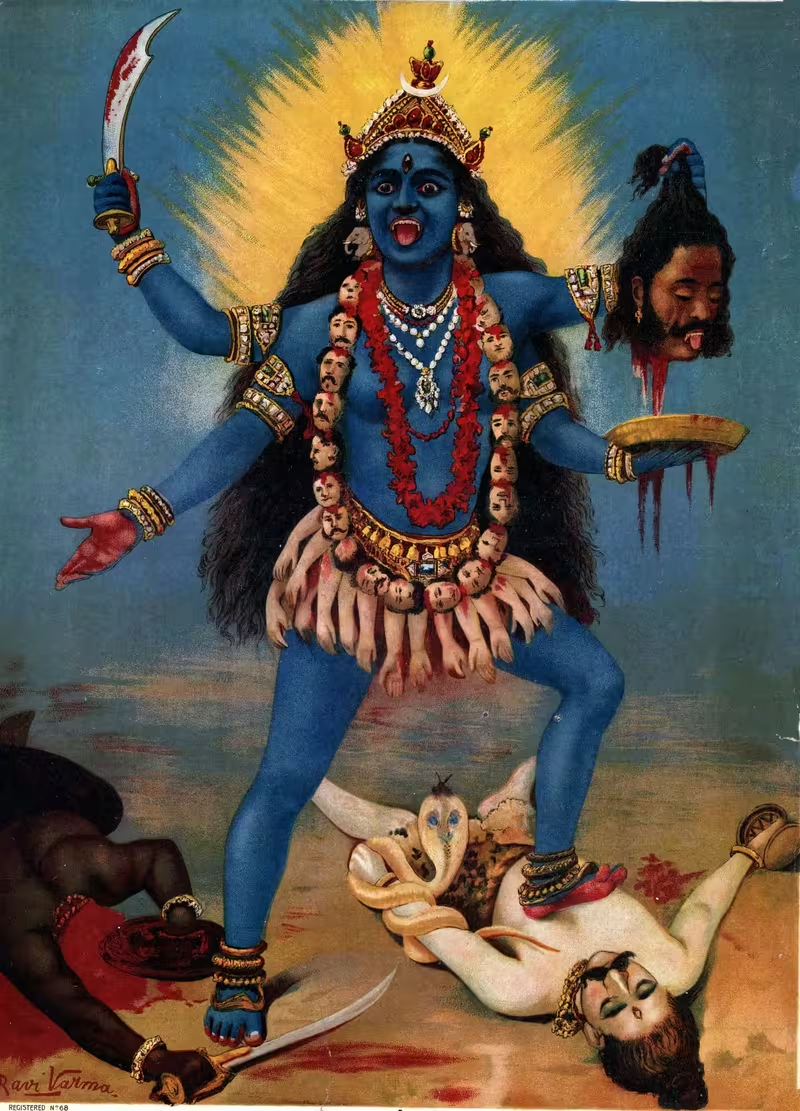
His greatest legacy, however, is the transformation of the image of Kali. Before him, she was often perceived primarily in her fierce, destructive aspect—the slayer of demons, clad in a garland of skulls, dancing on the body of Shiva. Ramprasad pulled back the fearsome veil to reveal the compassionate, loving face of a mother who, though powerful, cares deeply for her children. He taught generations to see the love behind the terror, the grace behind the formidable form.
The end of Ramprasad's life is as poetic as his songs. According to tradition, on the night of Kali Puja in 1775, during the immersion ceremony of the Kali idol, the 52-year-old saint waded into the sacred waters of the Ganga. Singing his final song to the Mother, he walked deeper and deeper until the river claimed him, a final, perfect union of the devotee with his beloved deity. His life was his song, and his death was its final, sublime note.