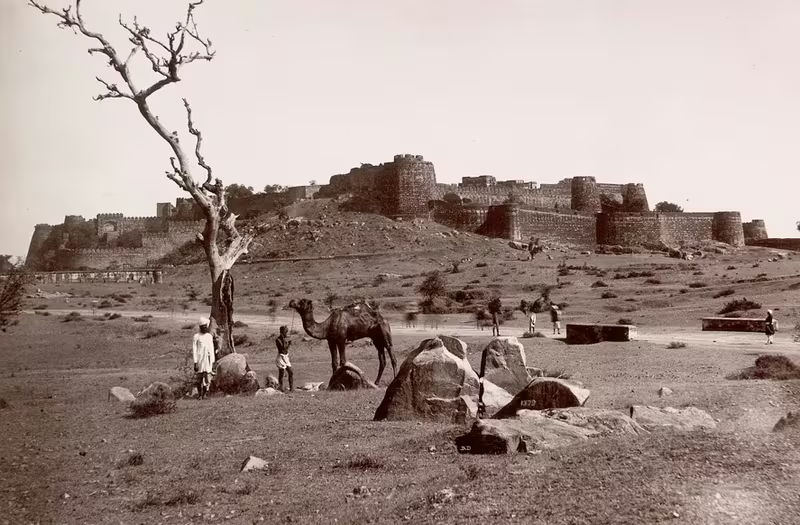
Rani Lakshmibai: The Fearless Queen of Jhansi
In the grand tapestry of Indian history, few figures shine with the incandescent brilliance of Rani Lakshmibai of Jhansi. More than a queen, she was a warrior, a strategist, a mother, and an indomitable symbol of resistance against the might of the British Empire. Her name is etched into the soul of India, a testament to a spirit that refused to bow to injustice. Her cry, “Main apni Jhansi nahi doongi” (I will not surrender my Jhansi), was not merely a defense of a kingdom; it was a defiant roar for sovereignty, dignity, and freedom that would echo through the ages, inspiring generations to fight for the motherland.
Early Life & Background: Forging a Warrior
Rani Lakshmibai was born as Manikarnika Tambe around November 19, 1828, in the holy city of Varanasi. Her father, Moropant Tambe, was a court advisor to the exiled Maratha Peshwa, Baji Rao II, who resided in Bithoor. Her mother, Bhagirathi Bai, passed away when Manikarnika was merely four years old. This early loss placed the young girl under the direct care of her father, who ensured her upbringing was anything but conventional for a woman of her era.
Raised in the politically charged environment of the Peshwa's court, a crucible of displaced Maratha pride and simmering resentment against British encroachment, Manikarnika absorbed the principles of statecraft and warfare. Unlike girls who were traditionally confined to domestic education, she was educated at home and received rigorous training alongside the Peshwa's adopted son, Nana Sahib, and his general, Tatya Tope. She became a proficient equestrian, an expert swordswoman, and a skilled markswoman. This unique upbringing shaped her into a confident, independent, and fiercely intelligent young woman, unknowingly preparing her for the monumental destiny that awaited.
In 1842, at the age of fourteen, Manikarnika was married to Gangadhar Rao Newalkar, the Maharaja of the princely state of Jhansi. Upon her marriage, she was given a new name, Lakshmibai, in honour of the Hindu goddess of wealth and prosperity. As the Rani of Jhansi, she quickly demonstrated her acumen, involving herself in the administration of the state and earning the respect of her husband and subjects. In 1851, the royal couple was blessed with a son, Damodar Rao, but their joy was tragically short-lived as the infant died at just four months old.
Devastated by the loss, the ailing Maharaja, on the day before his death in November 1853, adopted a young boy named Anand Rao, a cousin's son, and renamed him Damodar Rao in a formal ceremony witnessed by British political officers. The Maharaja handed a letter to the British representative, entrusting the care of his kingdom to his wife until their adopted son came of age. Little did they know, this act of succession, a time-honoured Indian tradition, would set them on a direct collision course with the British East India Company.
Career & Major Contributions: From Queen to Rebel Leader
The Doctrine of Lapse
The mid-19th century was a period of aggressive expansion for the British East India Company. The Governor-General, Lord Dalhousie, was the architect of the infamous Doctrine of Lapse. This policy stipulated that any princely state under British paramountcy would be annexed if its ruler died without a “natural” or biological male heir. The British refused to recognize the rights of adopted sons, conveniently ignoring a deeply ingrained Indian custom to justify their territorial acquisitions.
Following Maharaja Gangadhar Rao's death, Lord Dalhousie applied the Doctrine of Lapse to Jhansi. He declared the adoption of Damodar Rao invalid and ordered the annexation of the state. Rani Lakshmibai, now a 25-year-old widow, was offered an annual pension of ₹60,000 and ordered to vacate the Jhansi Fort.
This was a moment of profound injustice. The Rani refused to accept the British decree. She sought legal counsel and sent a passionate appeal to the Governor-General, meticulously arguing her case and citing precedent and Hindu law. When her pleas were dismissed, she sent a petition to the Court of Directors in London. Her arguments were logical, her tone firm yet respectful. But the decision was final. In March 1854, the British flag was hoisted over the Jhansi Fort. It was then that Rani Lakshmibai uttered her historic vow, a quiet promise of defiance that would soon ignite into a raging fire.
The Rebellion of 1857
For three years, the Rani lived under British surveillance, her spirit unyielding. The storm broke in May 1857. The Great Rebellion—India's First War of Independence—erupted across northern India. Beginning with a mutiny of sepoys in Meerut, it spread like wildfire, fueled by years of economic exploitation, social insensitivity, and political disenfranchisement.
In June 1857, the rebellion reached Jhansi. The sepoys of the British garrison mutinied, and while historical accounts debate the extent of her initial involvement, events quickly forced her hand. To restore order and protect her people from anarchy, she took command of the administration. The British, quick to find a scapegoat, held her responsible for a massacre of British officers and civilians by the mutineers, a charge she vehemently denied and for which modern historians have found no credible evidence against her.
From August 1857 to March 1858, Rani Lakshmibai ruled Jhansi as regent for her son. In this brief period, she proved herself an exceptional administrator and military leader. She assembled a formidable army, including a cavalry of 14,000 and an infantry of 1,500. She fortified the city, established a foundry to cast cannons, and organized her defenses with brilliant strategic foresight. Her force included women, who were trained not only in providing medical aid but also in combat.
The Siege of Jhansi
Her resolute independence was a direct challenge to British authority. In March 1858, a powerful British force under the command of General Sir Hugh Rose arrived to reclaim Jhansi. The siege that followed is a saga of extraordinary heroism. For two weeks, the small state of Jhansi held out against the might of the British army. The Rani was the soul of the defense. Dressed as a soldier, she moved along the ramparts, inspecting the defenses, directing cannon fire, and inspiring her soldiers with her own fearless presence. The city's defenders, men and women alike, fought with a desperate courage born of loyalty to their queen and their land.
But the odds were insurmountable. The British eventually breached the city walls, and a brutal battle ensued in the streets. With defeat imminent, Lakshmibai decided she would not be captured. In an act that has become legendary, she tied her young son Damodar Rao to her back, mounted her horse, and, with a small band of guards, galloped through the enemy lines under the cover of night, leaping her horse over the ramparts to safety.
The Final Campaign
Escaping Jhansi, the Rani rode to Kalpi, where she joined forces with other key rebel leaders, including the brilliant tactician Tatya Tope and Rao Sahib, the Peshwa's nephew. Though they were defeated at the Battle of Kalpi, the Rani’s spirit was unbroken. It was she who proposed a daring plan: to march on Gwalior, a powerful neighboring state whose ruler was a British ally.
In a stunning move, the rebels captured the city and the formidable Gwalior Fort in June 1858, as the Maharaja's army defected to the rebel cause. This victory breathed new life into the rebellion. The Rani hoped to use Gwalior as a new base to rally support and continue the fight.
However, Sir Hugh Rose and his forces pursued them relentlessly. The final battle took place on the outskirts of Gwalior at Kotah-ki-Serai on June 17, 1858. Dressed in a sowar's uniform, Lakshmibai led a cavalry charge against the British 8th Hussars. She fought with breathtaking courage, a whirlwind of steel and fury. In the heat of the battle, she was struck by a saber and then shot by a soldier who did not recognize her. Mortally wounded, she was carried from the field by her loyal guards. Her last wish was that her body not fall into enemy hands. Her followers hastily built a funeral pyre and performed her last rites, ensuring her final wish was honored just as the British cavalry overran the area.
Legacy & Influence
Rani Lakshmibai died at the age of 29, but her martyrdom ensured her immortality. Even her enemy, Sir Hugh Rose, who had pursued her with such single-minded determination, was moved to pay tribute. He later wrote that the Rani was the "most dangerous of all the rebel leaders," a remarkable testament to her character and capability.
In the decades following the rebellion, as the Indian nationalist movement began to take shape, the story of the Rani of Jhansi was resurrected. She was transformed from a regional queen fighting for her kingdom into a national heroine, a proto-nationalist who laid down her life for the freedom of India. Poets and balladeers sang of her valor. The most famous of these is Subhadra Kumari Chauhan's epic Hindi poem, Jhansi ki Rani, whose refrain is known to millions of Indians: “Bundele harbolon ke munh humne suni kahani thi, khoob ladi mardani woh toh Jhansi wali Rani thi” (From the bards of Bundelkhand we heard this story, she fought like a man, she was the Queen of Jhansi).
Her legacy became a powerful source of inspiration for future generations of freedom fighters. Subhas Chandra Bose, when he formed the Indian National Army (INA) to fight the British during World War II, named its all-female infantry unit the "Rani of Jhansi Regiment." For him and countless others, she represented the pinnacle of patriotism, sacrifice, and fearlessness.
Today, Rani Lakshmibai is remembered not just as a warrior queen but as a feminist icon. In an age when women's roles were severely restricted, she shattered every patriarchal convention. She was an educated ruler, a brilliant military strategist, and a battlefield commander who led men into battle and commanded their unwavering loyalty. Her life stands as a powerful statement that courage, leadership, and patriotism know no gender.
Equestrian statues of her, with her son on her back and sword held high, adorn city squares across India. Her story is a staple of school textbooks, films, and folklore. Rani Lakshmibai of Jhansi remains an enduring symbol of a nation's struggle for freedom—a queen who chose a warrior's death over a life of subjugation, and in doing so, achieved eternal life in the heart of India.