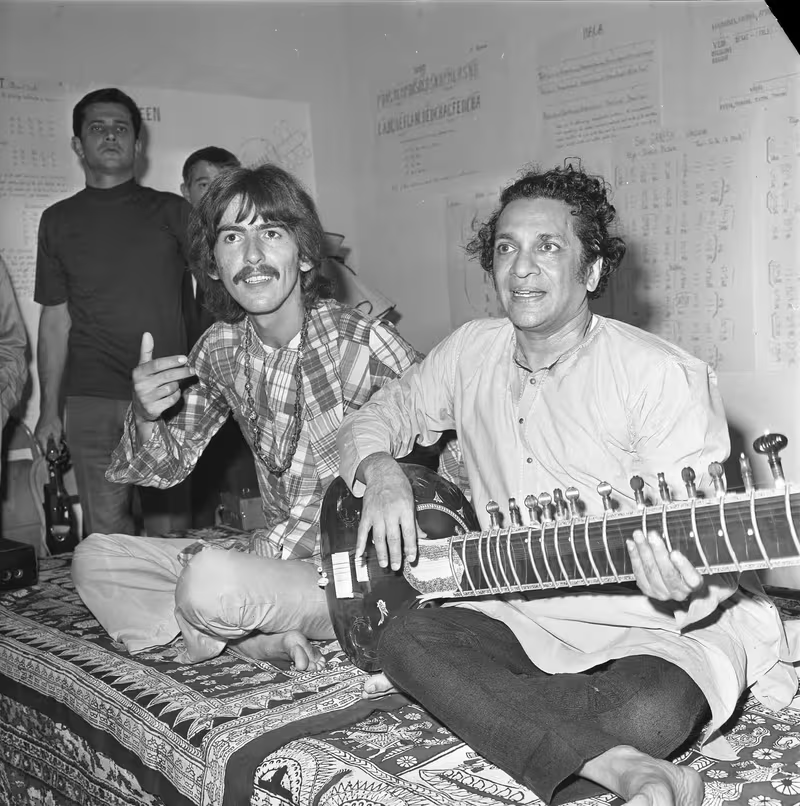
Ravi Shankar - Sitar Maestro and Composer
In the grand tapestry of global music, few threads are as vibrant, intricate, and influential as that of Pandit Ravi Shankar. A virtuoso of the sitar, a composer of profound depth, and a cultural diplomat of unparalleled grace, Shankar was more than a musician; he was a phenomenon. He single-handedly carried the sublime complexity of Indian classical music from the hallowed halls of Benares to the world's most iconic stages, transforming the sonic landscape of the 20th century and becoming India's first and greatest global musical ambassador.
Early Life & Background: A Tale of Two Worlds
Born Robindro Shaunkor Chowdhury on April 7, 1920, in the ancient, sacred city of Benares (now Varanasi), Ravi Shankar's life was destined for a unique trajectory. He was the youngest of seven brothers in a Bengali Brahmin family steeped in arts and scholarship. His father, Shyam Shankar Chowdhury, was a respected barrister and scholar, and his elder brother, Uday Shankar, was already on his way to becoming a pioneering figure in modern Indian dance.
Shankar’s early childhood was spent in Benares, but his world expanded dramatically at the age of ten when he moved to Paris to join his brother Uday's celebrated dance troupe, the "Compagnie de Danse et Musique Hindou." This was not merely a change of address; it was an immersion into a completely different universe. The Paris of the 1930s was a dazzling hub of artistic innovation. Here, the young Ravi Shankar toured Europe and America, performing as a dancer and learning to play various Indian instruments, including the sitar, sarod, and flute. He was exposed to Western classical music, jazz, and cinema, developing a cosmopolitan perspective that would later become a hallmark of his artistic identity.
Despite the glamour of this international life, a deeper calling began to stir within him. The turning point came during a tour when he encountered the legendary Ustad Allauddin Khan, a revered multi-instrumentalist and the patriarch of the Maihar gharana of Hindustani classical music. Khan, who was briefly touring with Uday Shankar's troupe, saw a spark in the young Ravi. He offered him a choice: a life of worldly success as a performer or a life of deep, spiritual dedication to mastering a single instrument.
In 1938, at the age of 18, Ravi Shankar made the momentous decision to abandon his burgeoning career as a dancer and return to India. He travelled to the small, dusty town of Maihar in Madhya Pradesh to become a formal disciple of Allauddin Khan, whom he affectionately called 'Baba'. This marked the beginning of a period of intense, rigorous training under the traditional guru-shishya parampara. The transition was stark. He traded the opulence of Paris for an austere, disciplined life, dedicating himself entirely to the sitar. For nearly seven years, he lived and breathed music, practicing for hours on end, absorbing the vast, intricate knowledge of his guru. It was here, alongside fellow disciples like Baba's own son, the sarod maestro Ali Akbar Khan, and daughter, the surbahar virtuoso Annapurna Devi (whom Shankar would later marry), that he forged the formidable technical mastery and profound musical understanding that would become his foundation.
Career & Major Contributions: The Sitar Heard 'Round the World
After completing his training in 1944, Ravi Shankar emerged as a musician of extraordinary calibre. He moved to Bombay (now Mumbai) and began to carve out his professional path. From 1949 to 1956, he served as the music director for All India Radio (AIR) in Delhi, where he founded the Vadya Vrinda (National Orchestra) and composed for it, blending Indian and Western instrumentation in innovative ways.
This period also saw the beginning of his celebrated work as a film composer. His most enduring contribution to cinema is the hauntingly beautiful score for Satyajit Ray's masterpiece, the Apu Trilogy (Pather Panchali, Aparajito, and Apur Sansar). His music did not just accompany the visuals; it became the soul of the films, articulating the unspoken emotions of its characters with sublime grace.
However, it was on the international stage that Ravi Shankar would make his most historic impact. Armed with his Parisian experiences and a deep desire to share the richness of his heritage, he began touring Europe and America in the mid-1950s. He was not just a performer; he was an educator, patiently explaining the complex structures of ragas (melodic frameworks) and talas (rhythmic cycles) to audiences unfamiliar with Indian classical music.
His collaboration with the renowned classical violinist Yehudi Menuhin, which began in 1952, was a watershed moment. Their mutual respect and musical synergy resulted in the groundbreaking 1967 album West Meets East, which won a Grammy Award and demonstrated to the world that the musical traditions of India and the West could converse with elegance and integrity.
This laid the groundwork for the cultural explosion of the 1960s. In 1966, a fateful meeting in London with George Harrison of The Beatles changed the course of popular music forever. Harrison, deeply fascinated by the sitar's sound after hearing it on the set of the film Help!, sought out Shankar to become his student. This friendship catapulted Ravi Shankar from the world of classical connoisseurs to global superstardom. Harrison's use of the sitar on the Beatles' track "Norwegian Wood (This Bird Has Flown)" introduced the instrument's distinctive sound to millions.
Shankar soon found himself at the epicentre of the 1960s counter-culture, performing at landmark events like the Monterey Pop Festival in 1967 and the Woodstock Festival in 1969. While he appreciated the genuine interest in Indian spirituality and music, he was often dismayed by the hippie culture's casual association of his art with drug use. He was a classicist at heart and firmly stated that his music was a path to spiritual consciousness that required discipline and clarity, not psychedelic distortion. In 1971, he and Harrison co-organized the legendary Concert for Bangladesh at Madison Square Garden, one of the first major benefit concerts, raising awareness and funds for the refugee crisis. His opening performance with Ali Akbar Khan set a tone of profound solemnity and artistic brilliance for the historic event.
Beyond his role as a performer, Shankar was a prolific composer. He composed two concertos for sitar and orchestra, collaborating with figures like conductor André Previn and the London Symphony Orchestra. He continued his work in film, earning an Academy Award nomination for his score for the 1982 epic Gandhi. He was a tireless creator, always seeking new avenues for his art while remaining deeply anchored in its classical roots.
Legacy & Influence: A Bridge Between Worlds
Pandit Ravi Shankar's legacy is monumental and multi-faceted. He passed away on December 11, 2012, but his influence resonates as powerfully as ever. His greatest achievement was building a permanent, respected bridge between the musical worlds of the East and West. He did not dilute his music for Western consumption; instead, he elevated the audience's understanding, commanding their respect through his sheer virtuosity and dignified presentation.
His influence on Western music is immeasurable. Beyond The Beatles, his work inspired jazz legends like John Coltrane, who named his son Ravi, and minimalist composers like Philip Glass, with whom he collaborated. He fundamentally altered the palette of sounds available to Western musicians and opened the door for the concept of "world music."
In India, he was a national treasure. He was awarded the Bharat Ratna, India's highest civilian honour, in 1999, one of a multitude of accolades that included multiple Grammy Awards (including a Lifetime Achievement Award), the French Legion of Honour, and an honorary British knighthood (KBE).
He is remembered today not just as the world's most famous sitar player, but as a cultural icon who embodied the grace, depth, and intellectual rigour of Indian civilization. He was a guru to thousands, both directly through his teaching at institutions like the Kinnara School of Music, and indirectly through his recordings and performances. His legacy is carried on by his immensely talented daughters: sitarist Anoushka Shankar, whom he trained extensively and who continues to push the boundaries of the instrument, and the Grammy-winning singer-songwriter Norah Jones.
Pandit Ravi Shankar's life was a symphony in itself—a harmonious blend of ancient tradition and modern innovation, of Eastern discipline and Western curiosity. He took a sound that was born on the banks of the Ganges and made it a universal language, proving that the deepest expressions of one culture could touch the hearts of all humanity.