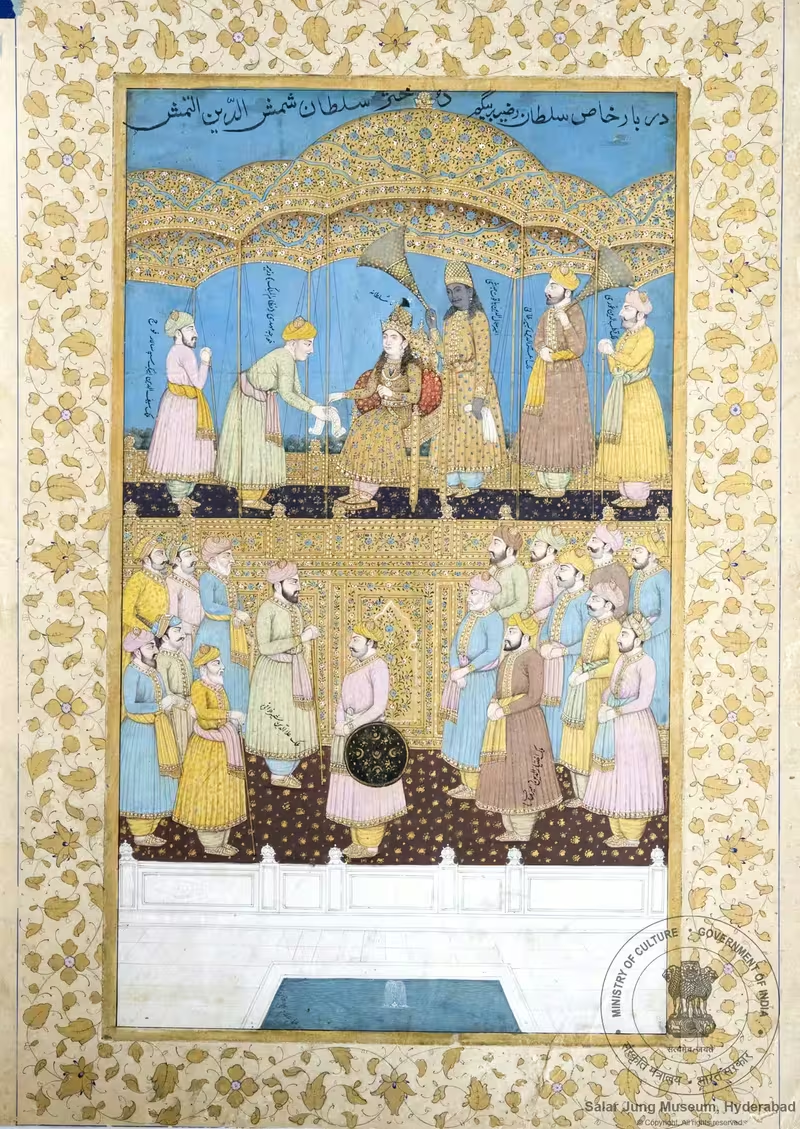
The Queen of the Times: The Reign of Razia Sultan
In the grand, turbulent theatre of the 13th-century Delhi Sultanate, a period dominated by formidable warlords and scheming courtiers, one figure stands apart—a beacon of defiance and unprecedented authority. Her name was Raziyyat-Ud-Dunya Wa Ud-Din, but history remembers her simply as Razia Sultan. For a brief, incandescent period of just under four years, from 1236 to 1240, she held the throne of Delhi, not as a regent or a queen consort, but as the Sultan in her own right. She was the first, and only, female Muslim ruler to preside over the vast territories of the Sultanate, a story of staggering ambition, political genius, and ultimate tragedy.
Early Life & Background: Forged for the Throne
Born around 1205, Razia was the daughter of Shams-ud-din Iltutmish, the third and arguably the greatest ruler of the Mamluk (Slave) Dynasty. Iltutmish himself had risen from slavery to become the Sultan, consolidating the fledgling empire founded by his predecessor, Qutb al-din Aibak. This was a world built on merit and military might, yet one still rigidly bound by patriarchal tradition. Razia’s mother was Turkan Khatun, Iltutmish's chief wife and the daughter of Qutb al-din Aibak, giving Razia a direct lineage to the dynasty's founder.
From an early age, Iltutmish recognized in his daughter a spark that was conspicuously absent in his sons. While the princes were often engrossed in the leisurely pursuits of the court, Razia displayed a keen intellect and an avid interest in the affairs of the state. Her father, a revolutionary thinker for his time, decided to cultivate her talents. She was not confined to the zenana (women's quarters) like other royal women. Instead, she received a rigorous education in statecraft, administration, diplomacy, and warfare. She learned to ride horses with expert skill and became proficient in archery and combat, training alongside her brothers.
Iltutmish’s faith in his daughter’s abilities was not merely paternal affection; it was a calculated assessment of competence. In 1231, when he led a military campaign against the fortress of Gwalior, he took the extraordinary step of leaving Razia in charge of Delhi's administration. She performed her duties as regent with such sagacity and efficiency that upon his victorious return, Iltutmish was convinced. He had found his true heir.
In a move that stunned the court, he instructed his mushrif (officer), Tajul Mulk Mahmud, to prepare a decree naming Razia as his successor. When orthodox nobles and advisors questioned the wisdom of bypassing his adult sons to appoint a woman, Iltutmish is said to have retorted, “My sons are devoted to the pleasures of youth, and not one of them is qualified to be a king... After my death, you will find that there is no one more competent to guide the State than my daughter.” It was a prophetic declaration of her merit and a damning indictment of his sons' capabilities.
Career & Major Contributions: The Ascent and Rule of a Sultan
A Throne Usurped, A Throne Reclaimed
When Iltutmish died in April 1236, his will was immediately cast aside. The powerful clique of Turkish nobles, known as the Chihalgani or “The Forty,” could not stomach the idea of bowing to a woman. They conspired to place Razia’s half-brother, Rukn-ud-din Firuz, on the throne. Rukn-ud-din proved to be exactly as his father had predicted: a dissolute and incompetent ruler who squandered state funds on personal indulgence. The real power lay with his mother, Shah Turkan, a vindictive and cruel woman who used her influence to settle old scores, blinding and executing perceived rivals, including one of Iltutmish's other sons.
The Sultanate descended into chaos. The governors of major provinces like Badaun, Multan, Hansi, and Lahore rose in open rebellion. As law and order crumbled, Razia saw her opportunity.
In a masterstroke of political theatre, she seized the narrative. On a Friday in November 1236, she appeared before the congregation at the Jama Masjid in Delhi. According to the contemporary historian Minhaj-i-Siraj, she was dressed in red garments—the traditional attire of the aggrieved seeking justice. She appealed directly to the people, invoking her father's name and his decree. She highlighted the tyranny of Shah Turkan and the fecklessness of Rukn-ud-din, promising to establish peace and justice if they restored her to her rightful position. The citizens of Delhi and a significant portion of the army, weary of the chaos, rallied to her cause. They stormed the palace, deposing Rukn-ud-din and imprisoning Shah Turkan. Razia ascended the throne, her authority ratified not just by a royal decree, but by the will of the people.
The Reign of a Monarch
From the outset, Razia made it clear she would not be a puppet ruler. She adopted the masculine title Sultan, rejecting “Sultana,” which in Persian and Turkish connoted a consort or wife of a ruler. She was the sovereign, the king. To reinforce this, she abandoned the traditional veiled seclusion of Muslim noblewomen. She donned the male court attire—the qaba (tunic) and the kulah (cap)—and rode unveiled on an elephant in public processions, making herself visible and accessible to her subjects, just as her father had.
These actions were not mere whims; they were calculated political statements. By appearing in public as a ruler, not as a woman, she was breaking down the visual and symbolic barriers that had always separated a female from the exercise of direct power. Her coins were struck in her name, bearing titles like Umdat-ul-Niswan ("Pillar of Women") and "Queen of the Times, Sultan Razia, daughter of Shamsuddin Iltutmish."
Her short reign was marked by vigorous and effective governance. She worked tirelessly to restore order, quelling the initial rebellions with a shrewd mix of force and diplomacy. She won over some rebel governors and decisively defeated others. She focused on strengthening the administration, encouraging trade, building roads, digging wells, and ensuring the safety of highways. A patron of learning, she established schools, academies, and libraries, fostering a culture of scholarship and art.
Conspiracy and Downfall
Despite her competence, Razia’s reign was a constant battle against the entrenched prejudice of the Chihalgani. They viewed her not just as a woman but as a monarch who was dangerously independent. Her primary political objective was to break their stranglehold on power and create a new class of nobles loyal directly to the crown.
To this end, she began promoting non-Turkish officers to high positions. Her most significant, and ultimately fatal, appointment was that of Jamal-ud-Din Yaqut, an Abyssinian (Ethiopian) Siddi slave, to the prestigious post of Amir-i-Akhur (Master of the Royal Stables). This position was a powerful one, granting its holder close access to the monarch.
The Turkish nobles were incensed. They viewed the elevation of a non-Turk, and a former slave of African descent, as a grave insult. To discredit the Sultan, they began spreading malicious and scandalous rumors about an improper intimacy between Razia and Yaqut. While these rumors have been sensationalized over centuries, there is no credible historical evidence to support them. For the nobles, the rumors were a political weapon, a way to tarnish her reputation and incite rebellion by framing her as a woman of loose morals controlled by a low-born favorite.
The conspiracy finally coalesced around Malik Ikhtiyar-ud-din Altunia, the governor of Tabarhinda (modern-day Bathinda). In 1240, he raised the standard of revolt. Razia, ever the warrior-queen, marched from Delhi with her army to confront him. But the conspiracy ran deep. As she engaged Altunia’s forces, the Turkish nobles in her own camp betrayed her. They assassinated Jamal-ud-Din Yaqut and captured Razia, imprisoning her in the fortress of Qila Mubarak in Tabarhinda.
With Razia removed, the nobles in Delhi placed another of her brothers, Muizuddin Bahram Shah, on the throne, believing he would be a more pliable ruler. But they had underestimated Razia’s resilience. In a final, desperate gamble for power, she turned her captor into an ally. She agreed to marry Altunia, who had his own ambitions and was now being sidelined by the nobles in Delhi. Together, they raised a new army composed of Khokhars, Jats, and loyal soldiers and marched on Delhi to reclaim her throne.
However, the combined forces of the Delhi nobility under Bahram Shah proved too strong. In October 1240, Razia and Altunia were defeated near Kaithal (in modern-day Haryana). They fled the battlefield, exhausted and deserted by their remaining troops. A day later, they were discovered by local Jat villagers who, not recognizing the former Sultan, robbed and killed them. The reign of Raziyyat-Ud-Dunya Wa Ud-Din had come to a violent end.
Legacy & Influence: A Light Extinguished, A Legend Born
Razia Sultan's rule lasted less than four years, yet her legacy is one of the most powerful in the history of medieval India. She was a woman centuries ahead of her time, a ruler whose abilities were celebrated even by her detractors. Minhaj-i-Siraj, the court historian who chronicled her fall, wrote of her: “She was a great sovereign, and sagacious, just, beneficent, the patron of the learned, a dispenser of justice, the cherisher of her subjects, and of warlike talent, and was endowed with all the admirable attributes and qualifications necessary for a king. But, as she was a woman, all these virtues were worthless in the eyes of men.”
Her historical significance is immense:
A Trailblazer for Female Sovereignty: She remains the only female Sultan of Delhi. Her reign was a singular event that challenged the deep-seated political and religious norms that barred women from holding sovereign power.
A Symbol of Meritocracy: Her story is a testament to governance based on ability rather than gender or lineage. Her father chose her for her competence, and she, in turn, tried to build an administration based on loyalty and skill, a vision that ultimately threatened the established racial and aristocratic hierarchy of the Turkish elite.
A Study in Power Politics: Her downfall was not a result of administrative failure but of a successful conspiracy by an entrenched patriarchy that could not tolerate her authority. Her story vividly illustrates the brutal power dynamics of the Delhi Sultanate and the fatal consequences of challenging the status quo.
Today, Razia Sultan is remembered as a tragic hero—a brilliant, courageous, and capable ruler whose potential was cut short by the prejudices of her time. Her tomb is believed to be in a neglected corner of Old Delhi, a quiet, unassuming monument to a queen who once commanded an empire. Her life continues to inspire countless retellings in books, films, and television, often romanticized but always centered on the core truth of a woman who dared to rule as a king.