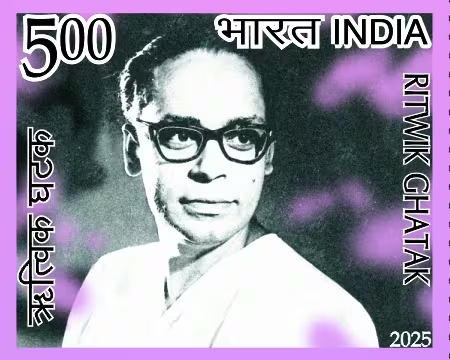
Ritwik Ghatak - Visionary Filmmaker
In the pantheon of Indian cinema, few figures blaze with the raw, chaotic, and tragic intensity of Ritwik Kumar Ghatak (1925-1976). A contemporary of Satyajit Ray and Mrinal Sen, he formed the third pillar of Bengal’s cinematic renaissance, yet his path was fiercely, often self-destructively, his own. Ghatak was more than a filmmaker; he was a cultural chronicler, a poet of displacement, and an artist whose celluloid frames bled with the anguish of a sundered homeland. His films, largely ignored and commercially unsuccessful in his lifetime, now stand as monumental testaments to the trauma of the 1947 Partition of India, particularly its devastating impact on the Bengali soul.
Early Life & Background
Ritwik Ghatak was born on November 4, 1925, in Dacca, in what was then East Bengal (now Dhaka, Bangladesh). He was born into a world steeped in culture and intellectualism. His father, Suresh Chandra Ghatak, was a district magistrate with a passion for poetry and playwriting, and his mother was Indubala Devi. Ritwik was the youngest of nine children, and the Ghatak household was a crucible of artistic and literary pursuits. His elder brother, Manish Ghatak, was a notable writer of the Kallol era of Bengali literature, and through him, Ritwik was the nephew of the celebrated writer and activist, Mahasweta Devi.
His early years were spent in the lush, riverine landscapes of East Bengal, a land whose sights, sounds, and folklore would become a primal, recurring motif in his work—a lost Eden, a cultural umbilical cord he would forever try to reconnect with. This idyllic existence, however, was set against a backdrop of immense historical turmoil. The Bengal Famine of 1943, a man-made catastrophe that claimed millions of lives, and the rising tide of the Indian independence movement, irrevocably shaped his young consciousness.
The most profound and cataclysmic event of his life, however, was the 1947 Partition. The drawing of the Radcliffe Line, which cleaved Bengal in two, turned millions into refugees overnight. The Ghatak family, like countless others, was forced to migrate from their ancestral home in East Bengal to Calcutta (now Kolkata). This forced exodus was not merely a change of address; it was a violent uprooting, a severing from history, culture, and identity. Ghatak became a refugee in his own land, and this deep, personal wound of displacement would become the central, obsessive theme of his entire artistic oeuvre.
In Calcutta, he enrolled at the University of Calcutta, but his true education took place in the politically charged atmosphere of the time. He was drawn to the Indian People's Theatre Association (IPTA), the cultural wing of the Communist Party of India. The IPTA was a vibrant movement that sought to use art—theatre, music, and literature—as a tool for social change. Here, Ghatak found his calling. He wrote, directed, and acted in plays, honing his skills as a storyteller and solidifying his Marxist ideological framework, which viewed art not as mere entertainment, but as a social responsibility.
Career & Major Contributions
Ghatak's journey into cinema was a natural extension of his work in theatre. He saw film as a more powerful, mechanical medium capable of reaching a wider audience. His first foray was the film Nagarik (The Citizen), which he completed in 1952. A starkly realistic portrayal of a family's struggle for survival in the unforgiving city of Calcutta, Nagarik was a pioneering work of Indian neo-realism. In a cruel twist of fate that would foreshadow the struggles of his entire career, the film failed to find a distributor and was only released in 1977, a year after his death. Had it been released on time, it would have preceded Satyajit Ray’s Pather Panchali (1955) and could have altered the narrative of Indian cinema's history.
His first theatrical release, Ajantrik (The Unmechanical, 1958), was a film of astonishing originality. It told the story of Bimal, a taxi driver in a small Bihar town, and his almost human relationship with his dilapidated 1920 Chevrolet jalopy, which he names Jagaddal. The film explored themes of animism and the blurred lines between man and machine, a philosophical inquiry that was decades ahead of its time. While it found admirers among critics, the film baffled mainstream audiences.
It was in the early 1960s that Ghatak created the three films that would seal his legacy—a searing, interconnected body of work often referred to as his Partition Trilogy.
Meghe Dhaka Tara (The Cloud-Capped Star, 1960): Widely considered his magnum opus, this film is a powerful and heart-wrenching melodrama. Based on a novel by Shaktipada Rajguru, it tells the story of Nita, the beautiful and self-sacrificing daughter of a refugee family from East Bengal. She shoulders the burden of her entire family, sacrificing her own health, love, and happiness until she is consumed by tuberculosis. Ghatak elevated the melodramatic form to the level of high art, using an expressive and often jarring sound design—whip-cracks, classical ragas, folk tunes—to punctuate the emotional turmoil. The film’s climax, where a dying Nita clings to the mountainside and screams, "Dada, ami baanchte chai!" ("Brother, I want to live!"), is one of the most iconic and devastating moments in cinema history. It is the cry of an entire generation crushed by history.
Komal Gandhar (E-Flat, 1961): This was Ghatak’s most personal and experimental film. It uses the metaphor of a divided theatre troupe to explore the division of Bengal itself. The protagonists, Anasuya and Bhrigu, are members of rival IPTA-like troupes who fall in love but are kept apart by political and personal schisms. The film is a complex tapestry of autobiography, political critique, and a yearning for cultural unity, woven through with Bengali folk songs and poetry. Its non-linear structure and intellectual rigor proved too much for audiences, and its commercial failure was a crushing blow to Ghatak, leading to a period of deep depression.
Subarnarekha (The Golden Line, 1965): The final and bleakest film of the trilogy, Subarnarekha is an epic tragedy that spans over a decade. It follows Ishwar and his younger sister Sita, two refugees who try to build a new life on the banks of the Subarnarekha river. But the ghosts of the past and the corruption of the present follow them relentlessly. The film culminates in a gut-wrenching climax of almost unbearable tragic irony, a final, brutal statement on how Partition destroyed not just homes, but the very moral fabric of a society. The film’s depiction of the human cost of displacement is unflinching and profound.
Beyond his filmmaking, Ghatak made a crucial contribution as an educator. During a hiatus from directing in the mid-1960s, he served as a professor and later Vice-Principal at the Film and Television Institute of India (FTII) in Pune. He was a tempestuous, unconventional, and brilliant teacher who inspired a generation of filmmakers who would go on to lead the Indian Parallel Cinema movement, including Mani Kaul, Kumar Shahani, and John Abraham. He instilled in them a rigorous, intellectual approach to cinema, urging them to find their own unique voice.
After a long struggle with alcoholism and creative frustration, Ghatak returned to filmmaking in the 1970s. He went to newly independent Bangladesh to make Titas Ekti Nadir Naam (A River Called Titas, 1973), an epic, sprawling ode to the fishing communities along the Titas river. It was a lament for a lost, pre-Partition culture being washed away by the relentless march of time, symbolized by the river itself drying up.
His final film, Jukti Takko Aar Gappo (Reason, Debate and a Story, 1974), was his swan song. Ghatak himself played the lead role of Nilkantha Bagchi, a washed-up, alcoholic intellectual, wandering through the politically volatile landscape of 1970s Bengal. It is a deeply autobiographical, chaotic, and brilliant work—part political treatise, part personal confession, and part cinematic last testament. It was a final, defiant roar from an artist who had given everything to his craft and his country.
Legacy & Influence
Ritwik Ghatak died on February 6, 1976, at the age of 50, his health ravaged by alcoholism and tuberculosis. He died in relative obscurity, a tragic figure who felt misunderstood and abandoned by the industry and audience he sought to provoke.
His historical significance, however, has only grown with time. He is now universally acknowledged as one of the most important and original filmmakers India has ever produced. While Ray was the classical humanist and Sen the political modernist, Ghatak was the epic myth-maker. His cinema was not one of quiet observation but of loud, passionate, and often painful engagement. He drew heavily on archetypes from Indian mythology, particularly the figure of the Jagatdhatri or the Great Mother, whom he saw as both a nurturing and a destructive force, a metaphor for Bengal itself.
His primary legacy is his unflinching documentation of the Partition's psychic wounds. No other artist has explored the theme of displacement—the loss of home, the severing of cultural roots, the refugee as the archetypal modern subject—with such visceral power and intellectual depth. His films are not historical documents of an event; they are emotional X-rays of its aftermath, revealing the fractures in the collective consciousness of a people.
His influence on subsequent generations of filmmakers is immense. His Brechtian techniques, his use of melodrama as a political tool, and his innovative sound design have been studied and emulated by directors in India and across the world. He proved that cinema could be both deeply personal and epically historical, a medium for confronting the most painful truths of a nation's past.
Today, Ritwik Ghatak is remembered as a titan of world cinema. Retrospectives of his films are held in major international festivals, and his work is a staple of film studies curricula. He is the archetypal tortured artist—a maverick genius whose personal demons were inextricably linked to his creative fire. His life was a testament to his belief, articulated by his alter-ego in his final film, that an artist must suffer and burn with the turmoil of his times. Through his handful of completed films, Ritwik Ghatak left behind a legacy that is as painful, challenging, and profoundly human as the history he so fiercely committed to the screen.