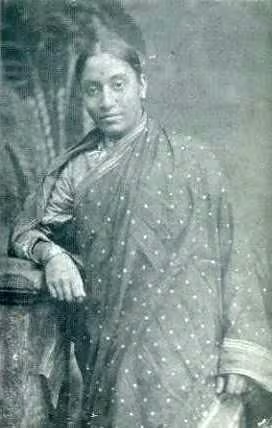
Rukhmabai: The Rebel Doctor Who Redefined a Woman's Place
In the late 19th century, in the bustling heart of colonial Bombay, a young woman stood at the confluence of two worlds. One was the world of ancient tradition, where a woman’s life was charted from birth by customs she could not question. The other was a world of emerging ideas—of education, individual rights, and self-determination. Rukhmabai Raut (1864-1955) did not just stand at this crossroads; she carved a new path through it, her journey taking her from the centre of a scandalous court case that shook British India to the corridors of a London medical school, and finally, to a long and distinguished career as one of India's first practicing female physicians. Hers is not just a story of personal triumph, but a chronicle of a rebellion that helped reshape the legal and social landscape for women across India.
Early Life & A Fateful Union
Rukhmabai was born in 1864 into the Suthar (carpenter) caste in Bombay. Her life took a progressive turn early on. After her father, Janardhan Pandurang, passed away, her mother, Jayantibai, made the unconventional choice to remarry. She married Dr. Sakharam Arjun, a renowned physician, botanist, and an active social reformer in Bombay. This act of widow remarriage, though permissible in their caste, was still a rarity and a bold statement against the prevailing orthodox norms.
Growing up in her stepfather's home, Rukhmabai was immersed in an environment that valued knowledge and reform. Dr. Arjun, a professor at Grant Medical College, believed in the importance of education for women and personally supervised Rukhmabai’s studies. She learned to read and write English fluently, a privilege afforded to very few girls of her time. However, even this progressive household could not entirely escape the grip of tradition.
In 1875, at the tender age of eleven, Rukhmabai was married to Dadaji Bhikaji, a cousin of her stepfather who was then nineteen. The marriage was conducted in her infancy, a common practice where the bride would continue to live with her parents until she reached puberty. Rukhmabai remained in her family home, continuing her education under Dr. Arjun's guidance, while her husband, Dadaji, lived separately. But as the years passed, the chasm between their worlds widened. Rukhmabai blossomed into an intelligent, educated young woman, while Dadaji, according to her supporters, had fallen into debt and “bad company,” showing little interest in education or self-improvement.
When Rukhmabai came of age, Dadaji Bhikaji demanded that she come and live with him, a standard expectation in a Hindu marriage. Supported by her stepfather, Rukhmabai refused. Her refusal was not just a personal preference; it was a radical act of defiance. She argued that she could not be bound by a marriage to which she, as a child, had not given any meaningful consent. This set the stage for a legal battle that would capture the attention of the entire nation.
The Landmark Case: Dadaji Bhikaji vs. Rukhmabai (1884-1888)
In March 1884, stung by her refusal, Dadaji Bhikaji filed a lawsuit in the Bombay High Court. He sought the “restitution of conjugal rights,” a legal remedy imported from English law that compelled a spouse to live with the other. The case of Dadaji Bhikaji vs. Rukhmabai became a flashpoint for a fierce national debate, pitting the authority of Hindu personal law against the English legal principles of individual consent and justice.
In a stunning initial verdict delivered in September 1885, Justice Robert Hill Pinhey ruled in Rukhmabai’s favour. He declared that he could not enforce such a claim on a woman married in her “helpless infancy.” He pointedly questioned the application of English law to a Hindu child marriage, stating, “It would be a barbarous, a cruel, a revolting thing to do to compel a young lady under those circumstances to go to a husband whom she dislikes.”
This verdict sent shockwaves through orthodox Hindu society. Nationalist leaders like Bal Gangadhar Tilak, writing in his newspapers Kesari and Mahratta, vehemently condemned the judgment as a colonial attack on Hindu traditions. He argued that Rukhmabai, by pursuing education, had become “un-Hindu” and that her defiance threatened the very fabric of Hindu society. The case was no longer about one woman; it was a symbolic battleground for culture, religion, and colonial law.
Under immense public pressure, the case went to an appellate court. In 1886, the decision was overturned. The court, led by Chief Justice Sir Charles Sargent, upheld the sanctity of the marriage contract under Hindu law. Rukhmabai was given an ultimatum: go to live with her husband within six months, or face imprisonment.
It was in this moment of crisis that Rukhmabai’s resolve shone brightest. In a clear, unwavering statement, she declared that she would rather face the maximum penalty of the law than submit to a union she considered a violation of her being. During this period, she also began to write a series of powerful and articulate letters to the Times of India under the pseudonym “A Hindu Lady.” In these letters, she laid bare the plight of Hindu women, railing against the injustices of child marriage and enforced widowhood. She wrote with a clarity and passion that galvanised support for her cause among social reformers in India and Britain, including Behramji Malabari, Pandita Ramabai, and many others.
The prospect of an educated, articulate woman being imprisoned for refusing to honour a child marriage created a scandal. Queen Victoria herself was informed of the case. The intense public scrutiny and the unwavering support from reformers finally led to a resolution. In July 1888, before the sentence could be carried out, an out-of-court settlement was reached. Dadaji Bhikaji agreed to relinquish his claim on Rukhmabai in exchange for a payment of two thousand rupees. At 24, after a harrowing four-year legal battle, Rukhmabai was finally free.
A New Chapter: The Journey to Becoming a Doctor
Her ordeal had not broken her; it had forged her purpose. Having witnessed the suffering of women, particularly during childbirth, without access to female doctors, Rukhmabai resolved to study medicine. Her cause was championed by Dr. Edith Pechey-Phipson, the pioneering British doctor in charge of the Cama Hospital for Women and Children in Bombay. A fund, the “Rukhmabai Defence Committee,” was established by her supporters to finance her medical education in England.
In 1889, Rukhmabai set sail for London. She enrolled at the prestigious London School of Medicine for Women, immersing herself in her studies. She qualified with a licentiate from the Conjoint Board of the Royal College of Physicians and Surgeons of Edinburgh and Glasgow in 1894, officially becoming a physician.
Upon her return to India the following year, she embarked on a long and impactful career. She first served as the Chief Medical Officer at the Zenana (women's) hospital in Surat, a position she held for over two decades. In a time when the practice of purdah (female seclusion) prevented many women from being treated by male doctors, the presence of a female physician like Rukhmabai was life-saving. She treated thousands of women, improved maternal and child health, and brought modern medical practices to communities that desperately needed them.
Later, she took charge of the Zenana State Hospital in Rajkot, where she worked tirelessly until her retirement around 1930. Even as she devoted her life to medicine, she never abandoned her role as a social reformer. She continued to write and speak out against the oppressive customs she had fought so hard to escape, publishing a pamphlet titled Purdah – the need for its abolition.
Legacy and Lasting Influence
Rukhmabai’s legacy is monumental and multifaceted. Her direct and most immediate impact was on the law itself. The intense public debate and controversy sparked by her court case were the primary catalysts for the passage of the Age of Consent Act, 1891. This landmark legislation raised the age of consent for sexual intercourse for all girls, married or unmarried, from ten to twelve. While a small step by today’s standards, it was a revolutionary intervention by the British-Indian government into religious personal law, establishing for the first time that custom could not override the basic protection of a child. Rukhmabai’s personal struggle had forced a national reckoning that led to a tangible legal change, saving countless young girls from the trauma of premature consummation.
Beyond the law, her life story became a powerful symbol of female empowerment. She demonstrated that a woman could defy patriarchal authority, pursue the highest levels of education, and build an independent, professional career of service. Her courage inspired a generation of women to challenge the status quo and aspire to lives beyond the confines of domesticity.
Today, Rukhmabai is celebrated as a pioneering Indian feminist. Her arguments in court and in her letters were not just emotional pleas but were rooted in the modern principles of individual liberty, consent, and human dignity. She fought not just for herself, but for the right of every woman to have a say in her own destiny.
Rukhmabai lived a long and quiet life after her retirement, passing away in Bombay in 1955 at the age of 90. For many years, her extraordinary story was largely forgotten by mainstream history. However, in recent decades, her contributions have been rightfully reclaimed and celebrated. She remains an enduring icon—a rebel who used the courtroom as her battlefield, a healer who dedicated her life to caring for others, and a true visionary who helped pave the way for a more just and equal future for the women of India.