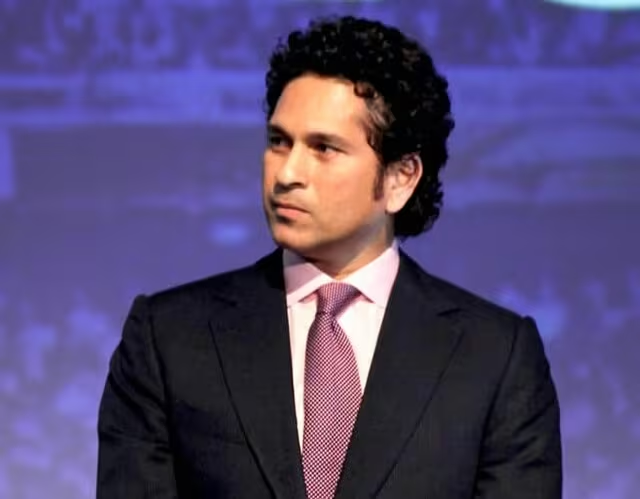
The Master Blaster: The Story of Sachin Tendulkar
In the vast and passionate landscape of Indian history, few figures from the modern era have captured the collective imagination of a billion people like Sachin Ramesh Tendulkar. For over two decades, he was not just a cricketer; he was an emotion, a symbol of hope, and a constant presence in the lives of Indians everywhere. When he walked out to bat, the nation paused. His triumphs were national celebrations, and his dismissals were met with a palpable, collective sigh. This is the story of the boy from Mumbai who became a living legend, the man they call the 'Master Blaster' and, for many, the 'God of Cricket'.
Early Life and Prodigious Beginnings
Sachin Tendulkar was born on April 24, 1973, in Bombay (now Mumbai) to a middle-class family. His father, Ramesh Tendulkar, was a well-respected Marathi novelist and poet, and his mother, Rajni, worked in the insurance industry. Named after his family's favourite music director, Sachin Dev Burman, young Sachin was an energetic and mischievous child.
His introduction to serious cricket came through his elder brother, Ajit. Recognizing Sachin's talent, Ajit took him to Ramakant Achrekar, a renowned and respected cricket coach in Mumbai. The first meeting, however, was underwhelming. A nervous Sachin, conscious of the coach's watchful eye, failed to play his natural game. Ajit pleaded with Achrekar to give his brother another chance, but this time to watch him from a hidden vantage point. Freed from the pressure of being observed, Sachin played with flair and confidence. Impressed, Achrekar immediately accepted him into his academy at Shivaji Park.
Achrekar's coaching methods were famously rigorous. He would make Sachin bat for hours on end, and in a well-documented practice, he would place a one-rupee coin on top of the stumps. If a bowler could dismiss Sachin, the coin was theirs. If Sachin survived the entire session without getting out, the coin belonged to him. Tendulkar's collection of 13 such coins remains one of his most cherished prizes, a testament to the discipline and concentration instilled in him from a young age.
His prodigious talent soon became the talk of Mumbai's cricketing circles. As a student at Sharadashram Vidyamandir, he began to dominate school-level cricket. The cricketing world at large, however, sat up and took notice in 1988. In an inter-school Harris Shield match, a 14-year-old Sachin and his childhood friend Vinod Kambli put on an astonishing, unbroken partnership of 664 runs. Tendulkar scored 326 not out, Kambli 349 not out, and the stand was, at the time, the highest in the history of organized cricket. The feat made national headlines, and it was clear that a once-in-a-generation talent had arrived.
A Baptism by Fire: The International Debut
On November 15, 1989, at the tender age of 16 years and 205 days, Sachin Tendulkar made his Test debut for India. The stage could not have been more intimidating: an away series against arch-rivals Pakistan, facing a bowling attack that included the legendary Imran Khan, the masterful Wasim Akram, and a fiery debutant pacer named Waqar Younis.
In the final Test in Sialkot, on a green, bouncy pitch, Tendulkar was struck on the nose by a vicious bouncer from Waqar Younis. He fell to the ground, bleeding. The team's physio rushed out, and non-striker Navjot Singh Sidhu urged the young boy to retire hurt. But in an act that would define his career, the 16-year-old waved away the medical help, wiped the blood from his face, and simply said, "Main khelega" (I will play). In the very next ball he faced, he hit a glorious boundary. This single moment of courage and resilience announced to the world that Sachin Tendulkar was not just a boy with talent; he was a warrior with unshakeable resolve.
While he didn't score a century on that tour, he showed immense promise. His first international hundred came the following year, in August 1990, against England at Old Trafford, Manchester. At just 17, he scored a magnificent 119 not out in the final innings to save the match for India. He was the second-youngest cricketer to score a Test century, an innings of remarkable maturity that proved his debut was no fluke.
The Rise of a Phenomenon (1990s)
Throughout the 1990s, as India navigated a period of transition, Sachin Tendulkar became the team's sole pillar of strength. He was the anchor, the aggressor, and often, the only hope. His batting style was a sublime blend of perfect balance, exquisite timing, and a complete repertoire of strokes. The straight drive, played with minimal effort and maximum grace, became his signature shot, a thing of beauty that left connoisseurs and casual fans in awe.
His performance in the 1996 Cricket World Cup, held in the subcontinent, was a masterclass. He emerged as the tournament's highest run-scorer, single-handedly carrying India to the semi-finals. However, his dismissal in the semi-final against Sri Lanka at Eden Gardens triggered a dramatic batting collapse, leading to a heartbreaking loss and crowd trouble—a stark illustration of how heavily the team depended on him.
Perhaps his most iconic rivalry was against the formidable Australian team and its legendary leg-spinner, Shane Warne. The contest between the two masters was billed as the ultimate showdown. In 1998, Tendulkar prepared for the Australian tour by simulating Warne's bowling in the nets. The preparation paid off spectacularly. His two centuries in the Test series were brilliant, but it was his performance in a one-day tournament in Sharjah that cemented his legendary status.
In two consecutive innings against Australia, Tendulkar played what are famously known as the 'Desert Storm' knocks. The first, a blistering 143, came amidst a sandstorm that interrupted play. Though India lost the match, his innings ensured they qualified for the final on net run rate. Two days later, on his 25th birthday, he scored another magnificent century (134) in the final, single-handedly winning the trophy for India. The Australian team, shell-shocked by the onslaught, admitted they were beaten by one man.
The Golden Era and a Dream Fulfilled (2000-2011)
The new millennium saw Tendulkar evolve as a batsman. He battled through injuries, including a career-threatening tennis elbow, but continued to break records. He was the undisputed star of the 2003 Cricket World Cup in South Africa, where he scored 673 runs—the most by any batsman in a single World Cup, a record that still stands. His 98 runs off 75 balls against Pakistan, an innings that included a breathtaking upper-cut for six off Shoaib Akhtar, remains one of the most memorable in World Cup history. India reached the final, and Tendulkar was named the Player of the Tournament.
On February 24, 2010, at the age of 36, he achieved a feat that was once considered impossible. In a One Day International (ODI) against South Africa in Gwalior, Sachin Tendulkar became the first batsman in history to score a double century (200 not out) in the 50-over format. He had once again breached a new frontier, reaffirming his greatness.
Despite all his personal accolades, one dream remained unfulfilled: winning the Cricket World Cup. He had been part of five previous campaigns, coming agonizingly close in 2003. The 2011 World Cup, co-hosted by India, was widely seen as his last chance. Playing in front of passionate home crowds, Tendulkar was in brilliant form, scoring two centuries. On April 2, 2011, at his home ground, the Wankhede Stadium in Mumbai, India defeated Sri Lanka in a thrilling final. The dream was realized. The image of his teammates carrying him on their shoulders for a victory lap is etched in the memory of every Indian. A young Virat Kohli summed up the team's feelings perfectly: "He has carried the burden of the nation for 21 years. It was time we carried him."
Records for the Ages and The Final Farewell
After the World Cup victory, the nation's attention turned to one final, monumental milestone: Tendulkar's 100th international century. The wait was long and filled with immense pressure, with every innings being scrutinized by millions. Finally, on March 16, 2012, he scored his 100th hundred against Bangladesh in an Asia Cup match.
He announced his retirement from ODIs later that year. In November 2013, he played his 200th and final Test match at the Wankhede Stadium, against the West Indies. The entire country came to a standstill to watch his final innings. After he was dismissed for 74, he delivered a poignant and emotional farewell speech that left a nation in tears. He thanked everyone who had been a part of his journey, from his family and coaches to his teammates and fans, concluding with the unforgettable chant of "Sachin! Sachin!" echoing around the stadium.
His statistical achievements are staggering and unlikely to be surpassed:
- Most runs in Test cricket: 15,921
- Most runs in ODI cricket: 18,426
- Most centuries in Test cricket: 51
- Most centuries in ODI cricket: 49
- The only player to have scored 100 international centuries.
- The only player to have played 200 Test matches.
Beyond the Boundary
Sachin Tendulkar's contributions have been recognized with India's highest civilian and sporting honours. He is a recipient of the Arjuna Award (1994), the Rajiv Gandhi Khel Ratna (1997), the Padma Shri (1999), and the Padma Vibhushan (2008). In 2014, immediately after his retirement, he was awarded the Bharat Ratna, India's highest civilian award, becoming its youngest recipient and the first-ever sportsperson to be conferred the honour.
He is married to Dr. Anjali Mehta, a paediatrician, and they have two children, Sara and Arjun. Arjun Tendulkar has followed in his father's footsteps and is a professional cricketer.
Post-retirement, Tendulkar has been involved in various philanthropic activities, notably as a UNICEF Goodwill Ambassador for South Asia. He was also a nominated member of the Rajya Sabha, the upper house of the Indian Parliament, from 2012 to 2018.
Legacy: The Man Who United a Nation
Sachin Tendulkar's legacy extends far beyond his incredible statistics. He was a unifying force in a country of immense diversity. In an era before social media, he was a shared passion that brought people together, regardless of their age, religion, or social class. He played the game with impeccable integrity and humility, becoming a role model for generations of aspiring cricketers and ordinary citizens alike.
He was more than a cricketer; he was the embodiment of a newly confident India, a nation finding its place on the world stage. For 24 years, he carried the hopes of a billion people on his shoulders, and he did it with unparalleled grace and dignity. The chant of "Sachin! Sachin!" is not just a cheer; it is the sound of a nation's love for its greatest sporting hero.