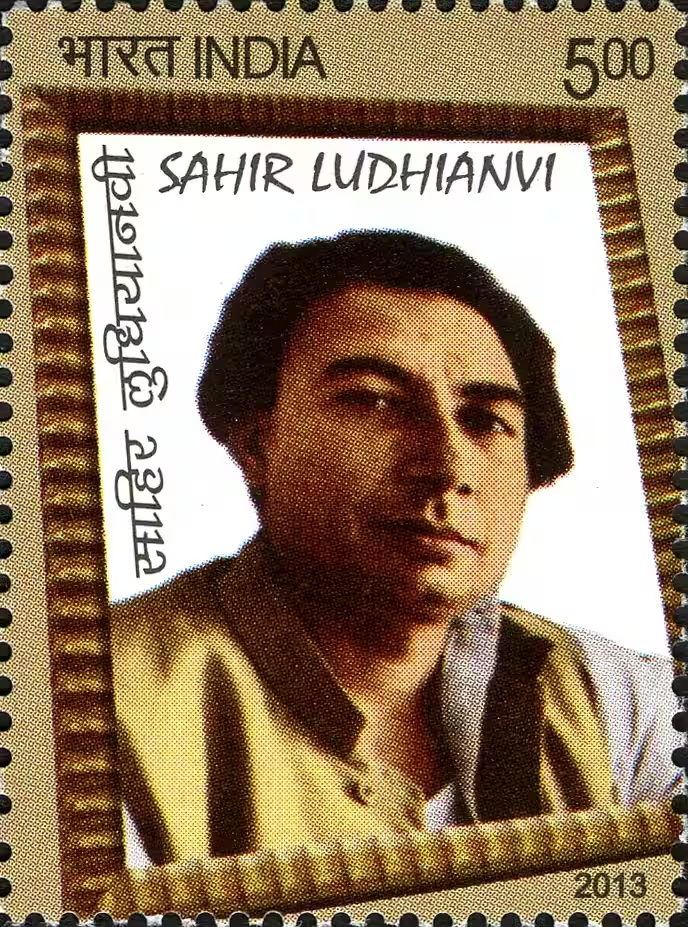
The Poet of the People: Sahir Ludhianvi
In the annals of Indian literature and cinema, few names resonate with the same blend of poetic gravitas and popular appeal as Sahir Ludhianvi. Born Abdul Hayee on March 8, 1921, he was a poet who refused to be confined to the gilded pages of literary journals. Instead, he chose the silver screen as his canvas, infusing the lyrics of Hindi films with a depth, social consciousness, and literary elegance that was unprecedented. He was more than a lyricist; he was a chronicler of the post-independence Indian dream, a critic of its failings, and a voice for the marginalized, the lover, and the philosopher, all at once.
Early Life: The Seeds of Bitterness (Talkhiyaan)
Abdul Hayee's story began not in the glamour of Bombay, but in the feudal confines of Ludhiana, Punjab. He was born into a wealthy family of zamindars (landlords), a world of privilege he would later spend his life critiquing. His childhood was profoundly shaped by the tumultuous relationship between his parents, Chaudhry Fazal Muhammad and Sardar Begum. The marriage ended in a bitter separation, and when the time came for a young Abdul Hayee to choose, he rejected his father's wealth and status, opting instead for a life of penury with his mother.
This singular decision was the crucible in which his character and worldview were forged. The ensuing custody battle and financial hardship instilled in him a deep-seated empathy for the oppressed and a fierce sense of justice, particularly regarding the rights of women. His mother became the central figure in his life, and his devotion to her was legendary. This early exposure to emotional and financial turmoil would later find voice in his first and most celebrated collection of poems, Talkhiyaan (Bitterness), published in 1943.
His formal education began at the Satish Chander Dhawan Government College in Ludhiana, where his poetic talents quickly blossomed. He became a popular figure on campus, known for his powerful ghazals and nazms. However, his time there was cut short by an expulsion, an event that pushed him towards Lahore, then the cultural and intellectual heart of undivided Punjab.
In Lahore, Sahir enrolled at Dayal Singh College and was drawn into the vibrant currents of the Progressive Writers' Movement. This association of left-leaning writers and intellectuals, which included stalwarts like Faiz Ahmed Faiz and Sajjad Zaheer, sharpened his political and social consciousness. He began editing Urdu magazines such as Adab-e-Lateef and Savera. It was his provocative, communist-leaning writings in Savera that, after the Partition of India in 1947, led the newly formed Government of Pakistan to issue a warrant for his arrest. In 1949, Sahir Ludhianvi, the poet, fled Lahore and made his way to a new life in India, first in Delhi and finally in Bombay, the city that would become the stage for his greatest triumphs.
The Bombay Years: Weaving Poetry into Film
Sahir arrived in Bombay with little more than his pen and his principles. He found a film industry where the songwriter was often a nameless functionary, expected to fit words into a pre-composed tune. Sahir, a poet of conviction, would change that forever.
His initial years were a struggle, but his breakthrough came in 1951 with the film Naujawan. Director S.D. Burman, a genius composer, was looking for fresh talent and gave Sahir a chance. The song "Thandi Hawayein Lehrake Aaye" became an instant hit, and one of Hindi cinema's most legendary partnerships was born.
The S.D. Burman Era: A Confluence of Geniuses
The collaboration between Sahir Ludhianvi and S.D. Burman defined the golden age of Hindi film music. Together, they created soundtracks that were not just collections of songs, but integral parts of the narrative. In Guru Dutt’s noir classic Baazi (1951), Sahir's words gave the film its cynical, yet romantic, edge with songs like "Tadbeer se bigdi hui taqdeer bana le." They continued to create magic in films like Jaal (1952), Taxi Driver (1954), and House No. 44 (1955).
Their partnership reached its zenith with Guru Dutt's magnum opus, Pyaasa (1957). The film, about a disillusioned poet struggling in a materialistic world, was a canvas for Sahir’s most profound and searing critiques. The lyrics were not just songs; they were the soul of the protagonist, Vijay. The bitter denunciation of society in "Yeh mehlon, yeh takhton, yeh taajon ki duniya" (This world of palaces, thrones, and crowns), the lament for a corrupted nation in "Jinhe naaz hai Hind par woh kahan hain?" (Where are those who are proud of India?), and the haunting existential questions in "Jaane woh kaise log the jinke pyaar ko pyaar mila" (I wonder what kind of people they were, whose love was met with love) elevated film lyricism to high art.
However, this brilliant collaboration ended abruptly over a matter of principle. Sahir, a staunch advocate for the rights of writers, demanded that he be paid one rupee more than the composer and that his name appear before Burman's in the credits. He believed the lyricist's contribution was paramount, as the words gave birth to the song. This was a revolutionary demand in an industry dominated by composers and music directors. The ego clash led to a permanent split, and the two legends never worked together again.
A Poet for All Seasons: Collaborations with Roshan, Ravi, and Khayyam
Sahir’s career, however, was far from over. He went on to form equally successful partnerships with other composers, proving that his poetic genius was versatile.
With Roshan, he created the timeless music for Taj Mahal (1963), winning his first Filmfare Award for Best Lyricist for the classic "Jo wada kiya woh nibhana padega." Their work in Barsaat Ki Raat (1960) produced some of the most celebrated qawwalis in cinematic history.
His association with composer Ravi for B.R. Chopra’s banner was immensely prolific. In Naya Daur (1957), he wrote anthems of nation-building like "Yeh desh hai veer jawanon ka." In Gumrah (1963), he penned the heartbreakingly mature "Chalo ek baar phir se ajnabi ban jayein hum dono" (Come, let's become strangers once again), a poem about the dignified end of a relationship. For Waqt (1965), he wrote the evergreen romantic ode, "Ae meri zohra jabeen."
Later in his career, he collaborated with Khayyam on Yash Chopra's Kabhi Kabhie (1976). The film's title poem, "Kabhi kabhie mere dil mein khayal aata hai," became a national sensation. It was pure poetry, a musing on love and destiny that Sahir had written years earlier, seamlessly woven into the film's fabric. The film also featured "Main pal do pal ka shayar hoon" (I am a poet of a moment or two), a song that served as Sahir's own artistic manifesto, reflecting on the transient nature of a poet's life and work. This film won him his second Filmfare Award.
Legacy & Influence: The Conscience of Cinema
Sahir Ludhianvi's contribution extends far beyond his hit songs. He fundamentally altered the landscape of Hindi cinema and Urdu poetry.
A Voice of Social Conscience: Sahir was a poet with a purpose. He used his platform to rage against social and economic inequality, religious dogma, and the futility of war. In Dhool Ka Phool (1959), his lines "Tu Hindu banega na Musalman banega, insaan ki aulad hai, insaan banega" (You will become neither Hindu nor Muslim; you are the child of a human, you will become human) became a powerful anthem for secularism in Nehruvian India. In Sadhna (1958), he wrote the powerful feminist anthem "Aurat ne janam diya mardon ko, mardon ne use bazaar diya" (Woman gave birth to men, and men gave her the marketplace), a scathing critique of patriarchy and the hypocrisy surrounding sex work.
His anti-war poem Parchhaiyan (Shadows) was a landmark work that condemned the glorification of violence and remains a significant piece of 20th-century Urdu literature.
Elevating the Lyricist: Sahir fought tirelessly for the recognition of writers. He insisted on writing the lyrics before the tune was set, ensuring that the music served the poetry, not the other way around. His demands for proper credit and remuneration, though controversial at the time, paved the way for future generations of lyricists like Javed Akhtar and Gulzar to be respected as artists in their own right.
The Poet of Melancholic Romance: While his revolutionary zeal is well-documented, Sahir was also a master of romantic verse. His love songs were rarely frivolous; they were imbued with a deep sense of melancholy, realism, and emotional complexity. Songs like "Abhi na jao chhod kar" (Hum Dono) or "Tere chehre se nazar nahin hat'ti" (Kabhi Kabhie) capture the delicate nuances of love with unmatched elegance. His personal life, marked by unfulfilled relationships with writer Amrita Pritam and singer Sudha Malhotra, seemed to seep into his poetry, lending it an air of authentic, lived-in sorrow and longing.
Sahir Ludhianvi passed away from a sudden cardiac arrest on October 25, 1980, at the age of 59. He left behind a legacy that is etched into the cultural memory of India. He was honoured with the Padma Shri in 1971. Today, he is remembered not just as a film lyricist, but as a formidable poet who brought literature to the masses. His words gave voice to the hopes, anxieties, and conscience of a young nation, and they continue to resonate, reminding us that a song can be more than just a melody—it can be a revolution.