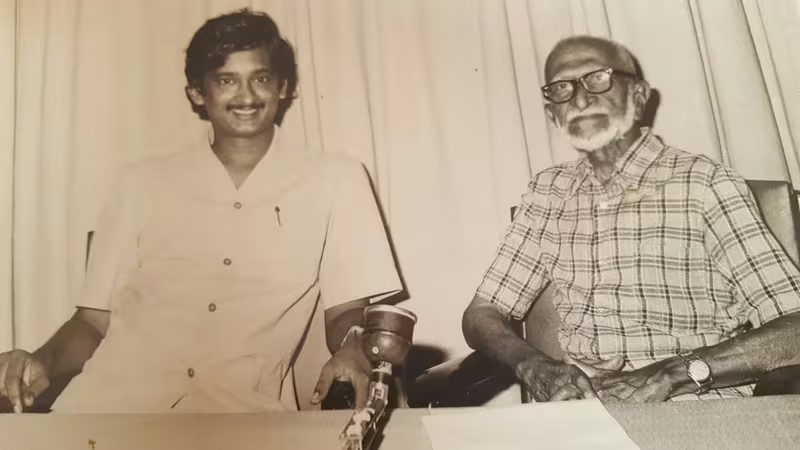
The Birdman of India: Sálim Ali
In the grand tapestry of modern Indian history, few figures cast as unique a shadow as Sálim Moizuddin Abdul Ali. He was not a statesman who redrew maps, nor a revolutionary who rallied masses, but a man whose quiet, meticulous observations of the feathered world fundamentally changed how India saw itself and its natural heritage. Known universally as the “Birdman of India,” Sálim Ali was a pioneering ornithologist, an intrepid explorer, and a powerful conservationist whose life’s work built the very foundations of Indian ornithology and inspired a national passion for the natural world.
Early Life & The Yellow-Throated Sparrow
Sálim Ali was born on November 12, 1896, into a Sulaimani Bohra family in Bombay. His early life was marked by tragedy; he lost his father at the age of one and his mother at three. He and his eight siblings were subsequently raised by his maternal uncle, Amiruddin Tyabji, and his childless aunt, Hamida Begum, in the Khetwadi locality of Bombay. Amiruddin was an avid hunter and naturalist, and the household was surrounded by an interest in the outdoors, a context that would prove profoundly influential.
Formal schooling, however, held little appeal for the young Sálim. He struggled with subjects like mathematics at St. Xavier's College, his mind already drawn to the wilder, less structured world of nature. The defining moment of his life, the spark that ignited a lifelong flame, came when he was just ten years old. Armed with a toy air gun given to him by his uncle, he shot a small bird in his garden. It resembled a common house sparrow, but with a peculiar yellow patch on its throat. His curiosity piqued, he took the bird to his uncle, who, unable to identify it, wisely directed him to the office of the Bombay Natural History Society (BNHS).
There, he met W.S. Millard, the honorary secretary of the BNHS. Millard not only identified the bird as a Yellow-throated Sparrow (now known as the Chestnut-shouldered Petronia) but, seeing the boy's keen interest, took him on a tour of the society’s remarkable collection of stuffed birds. For Sálim Ali, this was an epiphany. He wrote later that his “interest in birds was truly aroused” that day. The systematic arrangement of countless species, each with its own story and place in the ecosystem, opened up a new universe. The boy who had been an indifferent student had found his calling.
His formal education remained a meandering path. He dropped out of college and travelled to Tavoy, Burma (now Dawei, Myanmar) to assist with the family's tungsten and timber business. The dense, emerald forests of Burma, however, became his first true classroom. He spent his free time exploring the wilderness, observing its rich avian life, and honing his skills as a field naturalist. He returned to India in 1917, more certain than ever of his passion, and completed a B.A. in Zoology from St. Xavier's College.
Despite his newfound knowledge, the path to a professional career was not easy. He was rejected for a position as an ornithologist at the Zoological Survey of India because he lacked a postgraduate degree. Undeterred, he found a temporary role as a guide at the newly opened natural history section of the Prince of Wales Museum in Bombay. Realizing the need for formal training, he travelled to Germany in 1928 to study under the renowned ornithologist Professor Erwin Stresemann at the Berlin Zoological Museum. This period was transformative. In Berlin, he learned the rigorous techniques of taxonomy, museum curation, and, most importantly, bird ringing—a scientific method for studying migration that he would later pioneer in India.
A Life in the Field: Career & Contributions
Sálim Ali’s return to India coincided with the Great Depression, and his museum position had been eliminated due to lack of funds. Unemployed but armed with world-class training and an unshakeable resolve, he made a revolutionary decision. He decided to bypass traditional institutional employment and take his research directly to the source: the diverse landscapes of India. He approached the rulers of India’s princely states with an audacious proposal: in exchange for modest funding and logistical support, he would conduct the first-ever systematic ornithological surveys of their territories.
This marked the beginning of his life’s most significant work. From 1931 onwards, often accompanied by his steadfast wife, Tehmina, Sálim Ali embarked on a series of arduous expeditions. They travelled by bullock cart, on foot, and by any means necessary, camping in remote areas with minimal equipment. Tehmina was not merely a companion but the expedition manager, handling finances, logistics, and providing the crucial support that made his work possible. His meticulously detailed surveys of Hyderabad, Travancore, Cochin, Gwalior, Indore, and Bhopal were groundbreaking. Before Ali, Indian ornithology was largely a colonial pursuit focused on collecting skins for taxonomy. Ali shifted the paradigm to field-based observation, studying birds in their natural habitats, documenting their behaviour, ecology, and distribution with scientific precision.
His wife Tehmina’s untimely death in 1939 was a devastating personal blow, but he channelled his grief into his work with even greater intensity. The culmination of his early field experience was The Book of Indian Birds, first published in 1941. This was his masterstroke. Written in clear, accessible prose and beautifully illustrated, it was not a dry academic tome but a guide for the common person. It demystified the world of birds for an entire generation of Indians, making bird-watching a popular and accessible hobby. The book became an instant classic, going through numerous editions (the 13th edition was published in 2002) and remains an essential guide for amateur birders across the subcontinent.
While this book made him a household name, his scholarly ambition was far grander. In collaboration with the American ornithologist S. Dillon Ripley, he undertook the monumental task of creating a definitive account of the region's avifauna. The result was the 10-volume Handbook of the Birds of India and Pakistan (1964–1974). This encyclopedic work, the product of decades of fieldwork and research, is the single most important and comprehensive scholarly text on South Asian ornithology, a testament to his immense knowledge and tireless dedication.
Sálim Ali was more than just a scientist; he was a formidable advocate for conservation. He used his immense scientific credibility and personal influence to lobby for the protection of India’s wild spaces. Two campaigns stand out:
- Bharatpur Bird Sanctuary (Keoladeo National Park): He was instrumental in the establishment and protection of this world-famous wetland sanctuary in Rajasthan. In the post-independence era, he personally persuaded Prime Minister Jawaharlal Nehru to halt plans that would have damaged the habitat, ensuring its survival for generations to come.
- Silent Valley National Park: In the late 1970s and early 1980s, he became a powerful voice in the national movement to save the pristine Silent Valley rainforest in Kerala from a proposed hydroelectric project. His passionate letters to Prime Minister Indira Gandhi, outlining the valley's irreplaceable ecological value, were crucial in the government’s final decision to abandon the project and declare the area a national park.
Throughout his long career, the Bombay Natural History Society remained his institutional home. He was its guiding force for over half a century, transforming it from a colonial-era society into a premier Indian institution for research and conservation.
Legacy & The Birdman's Enduring Flight
Sálim Ali passed away on June 20, 1987, at the age of 90, leaving behind a legacy as vast and vibrant as the bird populations he studied. His historical significance lies in his singular role in decolonizing an entire field of science. He wrested Indian ornithology from the hands of British administrators and hobbyists and established it as a rigorous, Indian-led scientific discipline grounded in ecology and field observation.
His impact on Indian culture is profound. Through his popular writings, he fostered a national consciousness about the environment long before it became a global concern. He inspired countless individuals to pick up binoculars and look at their surroundings with new eyes, creating a nationwide community of bird-watchers and naturalists. He demonstrated that scientific inquiry could be pursued with passion and dedication outside the confines of a university laboratory.
His contributions were recognized with India’s highest civilian honors, including the Padma Bhushan in 1958 and the Padma Vibhushan in 1976. He was also the recipient of the prestigious J. Paul Getty Award for Conservation Leadership. Today, he is remembered not just through his books but through the institutions he helped build and inspire. The Sálim Ali Centre for Ornithology and Natural History (SACON) in Coimbatore is a leading research institute, and his birthday, November 12, is celebrated as National Birdwatching Day in India.
Sálim Ali was a man of spartan habits, immense discipline, and a famously direct, no-nonsense demeanor. He was often seen riding his motorcycle well into his later years, a symbol of his enduring energy and independent spirit. His life was a testament to the power of a single, focused passion. From a ten-year-old boy with an air gun to a national icon, Sálim Ali’s journey was an extraordinary flight that mapped the avian world of a subcontinent and, in doing so, taught a nation to cherish its natural treasures.