Salman Rushdie - Celebrated and Controversial Author
Born at the stroke of midnight—or, more accurately, just two months before the midnight hour of India’s independence—Ahmed Salman Rushdie’s life and work have been inextricably linked to the grand, tumultuous narrative of the modern Indian subcontinent. A literary titan whose name is synonymous with both breathtaking creative genius and the perilous fault lines of free expression, Rushdie is a writer who did not merely chronicle history but became a part of it. His sprawling, magical realist novels reimagined the very language of postcolonial identity, while his life became a testament to the enduring power and price of the written word.
Early Life & Background: A Midnight's Child
Ahmed Salman Rushdie was born on 19 June 1947 in Bombay (now Mumbai), into a prosperous, secular, Kashmiri Muslim family. His birthplace was a city brimming with the anxieties and aspirations of a nation on the cusp of freedom. His father, Anis Ahmed Rushdie, was a Cambridge-educated lawyer who became a successful businessman, and his mother, Negin Bhatt, was a teacher. The family name, Rushdie, was adopted by his father in honour of the 12th-century Andalusian philosopher Averroes (Ibn Rushd), a detail that foreshadowed the intellectual and often contentious path his son would tread.
Rushdie's childhood was spent in the Cumballa Hill neighbourhood of Bombay, a cosmopolitan enclave that exposed him to a rich tapestry of cultures, languages, and religions. This early immersion in a pluralistic world would become a foundational element of his literary universe. He received his early education at the Cathedral and John Connon School, a prestigious institution that grounded him in the English language and Western literary traditions.
At the age of 14, he was sent to England to attend the renowned Rugby School, an experience of displacement and cultural negotiation that would deeply inform his later explorations of migration and identity. From Rugby, he went on to King's College, Cambridge, where he studied history. His time at Cambridge was formative; it was here that he delved into the historical narratives that would underpin his fiction. His final thesis, focusing on the historical representation of Prophet Muhammad in India, was a scholarly inquiry that, in a twist of fate, anticipated the very themes that would later place him at the centre of a global firestorm.
Career & Major Contributions: From Advertising to Allegory
After graduating, Rushdie briefly worked as a copywriter for advertising agencies Ogilvy & Mather and Ayer Barker. This stint in the world of slogans and persuasion honed his linguistic precision and playful command of language, with him coining memorable lines like "irresistibubble" for Aero chocolate bars. However, his true ambition lay in fiction.
His first novel, Grimus (1975), a complex science fiction fantasy, received little attention. It was his second novel that would irrevocably alter the landscape of world literature.
Midnight's Children (1981)
In 1981, Salman Rushdie published Midnight's Children, a novel that exploded onto the literary scene with the force of a revelation. The book tells the story of Saleem Sinai, born at the precise moment of India's independence on 15 August 1947. Gifted with telepathy and an enormous, perpetually dripping nose, Saleem's life becomes a grand allegory for the journey of modern India itself. He is connected to 1,000 other "midnight's children," each born in that first hour of freedom, each endowed with a magical power.
Written in a dazzling, polyphonic style that blended history with myth, comedy with tragedy, and English with the cadences of Indian languages, the novel was a masterpiece of magical realism. It was a sprawling, ambitious, and deeply personal epic that captured the hopes, failures, and absurdities of post-colonial India. Midnight's Children was an immediate sensation, winning the prestigious Booker Prize in 1981. Its significance has only grown over time; it was later awarded the "Booker of Bookers" in 1993 and the "Best of the Booker" in 2008, recognizing it as the best novel to have won the prize in its history. More than just an award-winner, the novel gave a new, confident voice to Indian English writing, inspiring a generation of authors to tell their own stories on their own terms.
Shame (1983) and The Satanic Verses (1988)
Rushdie followed his success with Shame (1983), a fierce political allegory set in a country that is "not quite Pakistan." The novel explored the corrosive nature of political power, shame, and violence, drawing on figures and events from Pakistani history. It was shortlisted for the Booker Prize and cemented Rushdie's reputation as a fearless political writer.
It was his fourth novel, however, that would change his life forever. Published in September 1988, The Satanic Verses was a complex, multi-layered work of fiction exploring themes of migration, doubt, and the nature of good and evil. The central narrative follows two Indian actors, Gibreel Farishta and Saladin Chamcha, who miraculously survive a plane explosion over the English Channel. The controversy stemmed from a series of dream sequences experienced by Gibreel, which contained passages re-imagining moments from early Islamic history. The title itself referred to a disputed tradition concerning a set of verses allegedly spoken by the Prophet Muhammad.
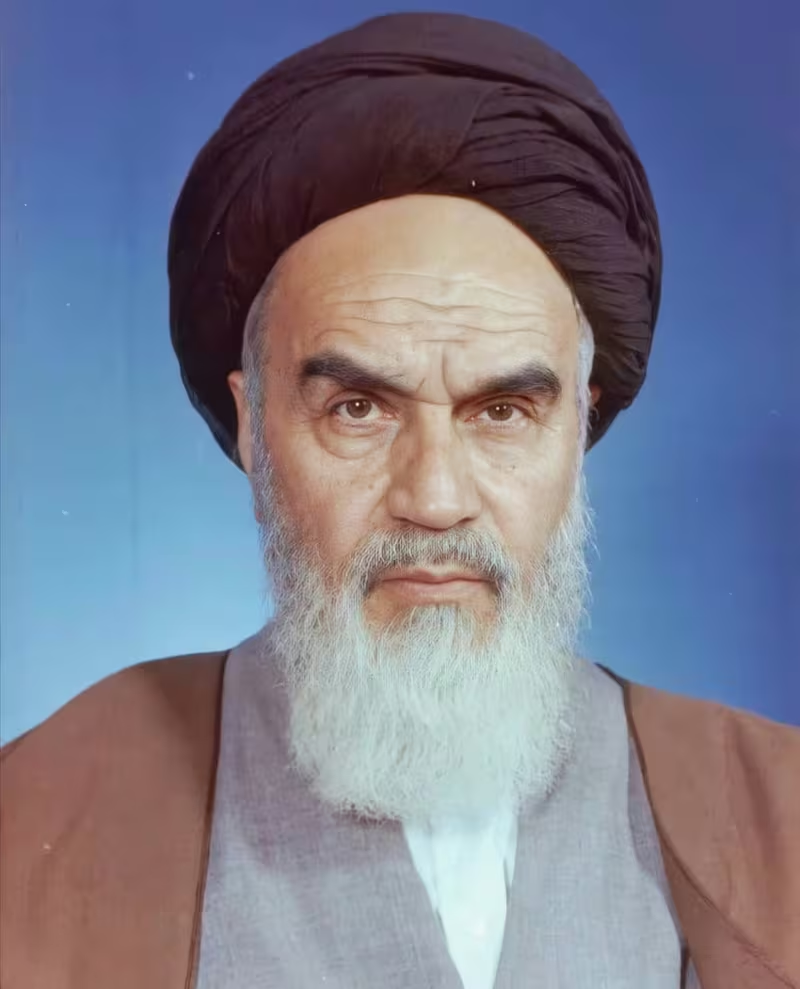
For many Muslims around the world, these passages were deemed deeply blasphemous and offensive. The novel was banned in India even before its UK publication, a decision that Rushdie would later call a critical mistake that opened the floodgates. Protests and book burnings erupted globally. The situation escalated dramatically on 14 February 1989, when Iran's Supreme Leader, Ayatollah Ruhollah Khomeini, issued a fatwa (a religious edict) calling for Rushdie's execution, along with that of his publishers.
The Fatwa and Its Aftermath
The fatwa plunged Rushdie into a life he could never have imagined. He was forced into hiding under the protection of the British government, living for nearly a decade under the constant threat of assassination. His pseudonym during this period, Joseph Anton, was a tribute to his literary heroes Joseph Conrad and Anton Chekhov. The "Rushdie Affair" became a global cultural and political event, a watershed moment that starkly highlighted the clash between religious fundamentalism and the secular principle of free speech. The violence was not limited to threats; Hitoshi Igarashi, the novel's Japanese translator, was murdered in 1991, while its Italian and Norwegian translators were seriously injured in separate attacks.
Despite the immense pressure, Rushdie continued to write. Haroun and the Sea of Stories (1990) was a fantastical allegory for his son, a beautiful and defiant defence of the power of storytelling against the forces of silence. His later works, including The Moor's Last Sigh (1995), The Ground Beneath Her Feet (1999), and Shalimar the Clown (2005), continued to explore his signature themes of hybridity, history, and the collision of worlds. In 2012, he published his memoir, Joseph Anton, a detailed and unflinching account of his years in hiding.
Legacy & Influence: A Symbol of Free Expression
Sir Salman Rushdie's legacy is twofold. First, there is his immense literary contribution. He is a pioneer who irrevocably shaped the course of 20th and 21st-century literature. He demonstrated that the English language could be stretched, remolded, and infused with the rhythms of the Indian subcontinent to tell its stories with authenticity and flair. Midnight's Children remains a towering landmark of postcolonial literature, a novel that liberated Indian writing from its colonial anxieties.
Second, and perhaps more profoundly, Rushdie became an unwilling but resolute symbol of freedom of expression. The fatwa against him was a direct assault on the right of an artist to imagine, question, and provoke. His refusal to be silenced in the face of mortal danger made him a global icon for writers, artists, and activists. The controversy surrounding The Satanic Verses forced a global conversation about the limits of tolerance, the nature of offence, and the responsibilities of both the artist and the audience in a multicultural world.
Today, Sir Salman Rushdie—he was knighted in 2007 for his services to literature—is remembered as one of the most important writers of our time. He is celebrated for his intellectual rigor, his boundless imagination, and his linguistic virtuosity. He remains a prolific author, continually engaging with the complexities of the modern world. The long shadow of the fatwa, however, has never fully receded. In August 2022, this was made brutally clear when he was attacked and severely injured on stage at a literary event in New York. The incident was a horrifying reminder that the battle for which he became a symbol is far from over. Yet, through his survival and his continued commitment to his craft, Rushdie’s life remains a powerful narrative of resilience—the story of a writer who faced down the forces of intolerance and affirmed, with every word, the indomitable power of the human imagination.