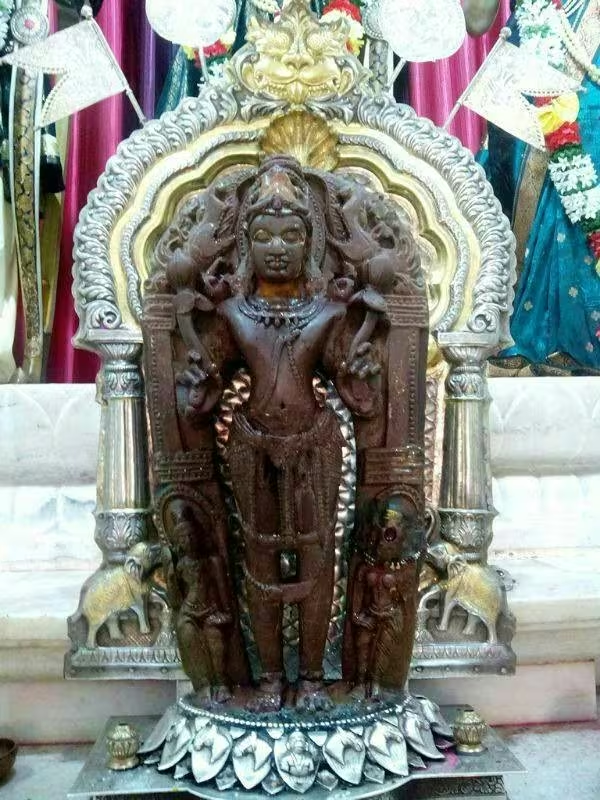
Samarth Ramdas: The Saint Who Forged a Path of Strength and Spirit
In the turbulent landscape of 17th-century India, amidst the clash of empires and the cries for freedom, there walked a figure of immense spiritual and practical power. He was a saint who did not retreat from the world but sought to transform it, a poet whose words were both a balm for the soul and a call to action. This was Samarth Ramdas, a name that translates to 'the powerful servant of Rama,' a title he earned through a life of extraordinary discipline, profound wisdom, and unwavering dedication to Dharma. As the spiritual guide to the great Maratha king, Chhatrapati Shivaji Maharaj, his philosophy became inextricably linked with the forging of Swarajya (self-rule), leaving an indelible mark on the soul of Maharashtra and the history of India.
Early Life & Spiritual Awakening
A Child Destined for a Different Path
In the spring of 1608, on the auspicious day of Ramanavami, the festival celebrating the birth of Lord Rama, a son was born to Suryajipant and Ranubai Thosar in the village of Jamb, in present-day Maharashtra. They named him Narayan. From a young age, Narayan was unlike other children. While others engaged in playful games, he was often found in deep contemplation, his mind wrestling with questions of life, death, and the nature of existence. His introspective nature and sharp intellect were apparent to all, but his path remained a mystery.
This mystery was dramatically resolved when Narayan was a young boy. As per the customs of the time, his parents arranged his marriage. The ceremony was underway, the guests had gathered, and Narayan stood at the altar. As the priests chanted the sacred mantras, they uttered the customary word “Savadhan!” — a term that means 'be alert' or 'be aware'. For the young Narayan, this was no mere ritualistic instruction. He heard it as a divine command, a cosmic call to awaken from the slumber of worldly illusion and pursue a higher truth. In that pivotal moment, he made a decision that would alter the course of his life and the destiny of his land. He turned and fled the wedding mandap, leaving behind a life of domesticity for a solitary quest for enlightenment.
The Forging of a ‘Ramdas’
Narayan journeyed to the holy city of Nashik, a spiritual hub on the banks of the sacred Godavari river. He settled in a cave at a nearby village called Takli, which was to become his crucible for the next twelve years. Here, he embarked on a period of intense tapasya (austerity and spiritual discipline). His routine was rigorous and unwavering. He would wake before dawn, perform his ablutions in the river, and stand in the water, chanting the 13-syllable Rama Taraka Mantra — “Shri Ram Jai Ram Jai Jai Ram.” He would then go into the town to beg for alms, offering half of what he received to the Godavari and consuming the rest.
During these twelve years of relentless devotion, it is said he chanted the mantra an astounding thirteen crore (130 million) times. Through this profound penance and unwavering focus on Lord Rama, the young Narayan was transformed. He attained spiritual illumination and emerged with a new identity: Ramdas, the servant of Rama. His spiritual quest, however, was not merely for personal liberation. It was a preparation for a much larger mission.
Career & Major Contributions
A Nation in Chains: The Great Pilgrimage
Having forged his spirit in the fires of austerity, Ramdas, now in his early twenties, embarked on a twelve-year pilgrimage across the length and breadth of the Indian subcontinent. This was no ordinary tour of holy sites. It was a deep, immersive study of the condition of his motherland. He walked from the Himalayas in the north to Kanyakumari in the south, observing with a keen and compassionate eye.
He witnessed the decay of political institutions, the social disarray, and the despair that gripped the populace under oppressive foreign rule. He saw communities fragmented and traditions eroded. This journey was his education in the realities of Prapancha (worldly affairs). It convinced him that spiritual awakening could not happen in a vacuum. A society living in fear and subjugation could not aspire to higher truths. His philosophy thus evolved from a focus on individual salvation to a mission of societal and national regeneration.
Building a Network of Strength and Spirit
Upon returning to Maharashtra, Samarth Ramdas began his life’s work. He understood that to uplift society, he needed an organized, grassroots movement. His chosen deities for this mission were Lord Rama, the epitome of righteous rule, and Lord Hanuman, the symbol of selfless service, strength, and unwavering devotion.
He began establishing a vast network of mathas (monasteries) and temples dedicated to Hanuman. Over time, more than seven hundred of these centers were strategically established across the land. These were not merely places of worship. They were vibrant hubs of social, cultural, and physical activity. Each matha had an akhada (gymnasium) attached to it, promoting the ideal of Shakti (strength) alongside Bhakti (devotion). They became centers for spiritual discourse, community organizing, and nurturing a sense of unity and self-respect among the people. In a radical move for his time, he welcomed disciples from all castes and social strata, including women, making his Ramdasi Sampradaya a powerful force for social cohesion.
The Magnum Opus: Dasbodh
Samarth Ramdas was a prolific writer, but his most enduring legacy is the monumental philosophical treatise, Dasbodh. Composed in the vernacular Marathi language to ensure its accessibility, the text is a comprehensive guide to life. Structured as a dialogue between a guru and a disciple, its 20 dashaks (chapters) seamlessly weave together spiritual wisdom with intensely practical advice.
Dasbodh is revolutionary because it rejects the idea that spiritual life requires a complete renunciation of the world. Instead, Ramdas championed the integration of Paramartha (the ultimate spiritual reality) with Prapancha (worldly duties). He taught that one could live an active, engaged life in the world while remaining spiritually centered. The text is a masterclass in leadership, management, public speaking, and personal conduct. It speaks of the importance of viveka (discernment), righteous action, and diligent effort. For a society struggling for its identity, Dasbodh was not just a book; it was a blueprint for living a life of purpose, dignity, and spiritual fulfillment.
His other works, particularly Manache Shlok (Verses to the Mind), a collection of 205 simple, four-line verses, became a household staple in Maharashtra, offering daily ethical and moral guidance that continues to be recited by millions.
The Saint and The King: A Fateful Meeting
The most celebrated chapter of Samarth Ramdas’s life is his association with Chhatrapati Shivaji Maharaj. While Shivaji was carving out an independent Maratha kingdom based on the principles of Swarajya and justice, Ramdas was building a foundation of spiritual and cultural resilience among the people. Their meeting, which is believed to have taken place around 1672, was a confluence of two powerful streams—the political and the spiritual.
Shivaji, recognizing the saint's profound wisdom and his role in awakening the consciousness of the people, sought his guidance. Samarth Ramdas became Shivaji's Rajguru (royal preceptor). He provided the Maratha king with the moral and philosophical anchor for his political mission. Ramdas’s teachings on righteous action, selfless duty, and the need for strength to protect Dharma perfectly complemented Shivaji’s vision. He is said to have gifted Shivaji the Bhagwa Dhwaj (saffron flag), a symbol of renunciation and selfless service, advising him to rule not for personal glory but as a servant of the divine and a protector of his people.
Legacy & Influence
The Architect of Maharashtra Dharma
Samarth Ramdas's greatest contribution was the articulation of what came to be known as “Maharashtra Dharma.” This was not a new religion, but a comprehensive socio-spiritual ideology for the times. It was a call for the people of Maharashtra to unite, to cultivate both inner and outer strength, and to defend righteousness against the forces of adharma (injustice). It was a philosophy of action, resilience, and collective responsibility, rooted in deep spiritual faith. This ideology provided the moral legitimacy and popular support for Shivaji's struggle for Swarajya, transforming a political rebellion into a righteous mass movement.
An Enduring Cultural Imprint
Samarth Ramdas spent his final years at Sajjangad (the Fort of the Virtuous), a fortress near Satara gifted to him by Shivaji Maharaj, which became the main center of his Sampradaya. He took samadhi there in 1682, leaving behind a legacy that continues to shape the cultural and spiritual landscape of Maharashtra.
His mathas and Hanuman temples remain active centers of community life. Dasbodh and Manache Shlok are not treated as archaic texts but as living guides, their verses echoing in homes, schools, and spiritual gatherings. His emphasis on balancing the material and the spiritual, on serving society with strength and devotion, resonates even today.
Samarth Ramdas is remembered not just as a reclusive saint, but as a Rashtra Sant—a saint of the nation. He was a visionary who understood that true freedom is built on a foundation of spiritual strength, social unity, and the unwavering courage to act righteously in the world. His life stands as a timeless testament to the power of one individual to awaken the soul of a people and change the course of history.