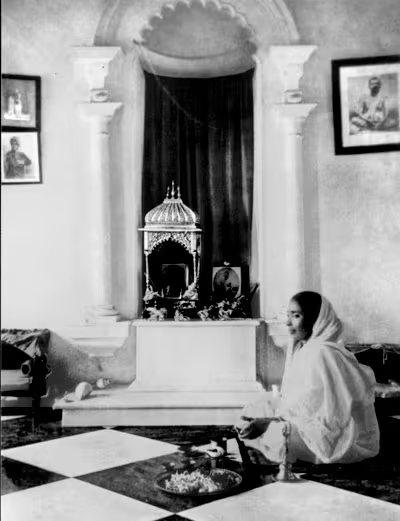
Sarada Devi - Holy Mother of the Ramakrishna Order
In the annals of modern Indian history, few figures command as much reverence with as little ostentation as Sri Sarada Devi. She was not a fiery orator, a political revolutionary, or a prolific author. Instead, her legacy was built in the quiet confines of a tiny music tower, in the gentle cadence of her advice, and in the boundless expanse of her maternal love. Known to millions as the Holy Mother (Sri Maa), she was the spiritual consort of the 19th-century mystic Sri Ramakrishna Paramahamsa and the silent, unshakeable foundation upon which the global Ramakrishna Order was built. Her life, a masterclass in spiritual attainment amidst the mundane, remains a profound testament to the power of selfless service, unconditional compassion, and silent strength.
Early Life & Background: A Flower Blooms in Jayrambati
Saradamani Mukhopadhyay was born on December 22, 1853, in the pastoral quietude of Jayrambati, a small village in the Bankura district of West Bengal. She was the eldest child of Ramchandra Mukhopadhyay and Shyamasundari Devi, a poor but pious Brahmin couple respected for their integrity and generosity. Her childhood was steeped in the simple rhythms of rural life—assisting her mother with household chores, tending to her younger brothers, and participating in the village's religious festivities.
Though she received no formal schooling, a rarity for girls of her time and place, she possessed an innate wisdom and a deep, contemplative nature. From a young age, her compassion was remarkable; she would share her meager meals with anyone in need and was often found deeply absorbed during worship. In a society bound by rigid caste rules, the young Sarada saw no distinctions, an early glimpse of the universal motherhood that would later define her.
Her destiny became intertwined with that of Sri Ramakrishna in 1859. At the time, Ramakrishna, the priest at the Dakshineswar Kali Temple near Calcutta, was soaring through unprecedented heights of spiritual ecstasy, often losing all consciousness of the external world. His concerned relatives, hoping marriage would provide a steadying, worldly anchor, began searching for a bride. When all efforts failed, Ramakrishna himself, in a state of spiritual intuition, revealed that the bride destined for him could be found in the Mukhopadhyay household in Jayrambati.
At the time of their marriage, Sarada was merely five years old and Ramakrishna was twenty-three. This was a betrothal, in keeping with the social customs of 19th-century Bengal, and not a consummated union. For years, she remained at her parents' home, growing into maidenhood, while Ramakrishna plunged ever deeper into his spiritual quest at Dakshineswar.
A Spiritual Partnership: Life at Dakshineswar
In 1872, at the age of eighteen, disturbing rumours about Ramakrishna's mental state reached Jayrambati. It was said that his intense spiritual practices had unhinged his mind. Deeply concerned, Sarada Devi resolved to see for herself. She undertook the arduous sixty-mile journey to Dakshineswar on foot, an act of quiet determination that would mark her character.
Upon her arrival, Ramakrishna received her with immense tenderness. His first question to her was pivotal: "Well, have you come to drag me down to the worldly plane?" Without hesitation, she replied, "No. Why should I do that? I have come only to help you in your chosen path." Her answer sealed their unique spiritual partnership. It would be a union not of the flesh, but of two souls dedicated to the highest spiritual ideal.
For the next fourteen years, until Ramakrishna's passing, Sarada Devi lived in a tiny, cramped room in the Nahabat, or music tower, at the northern edge of the temple garden. Her life was one of extreme austerity and seclusion. She would rise at 3 a.m., perform her ablutions in the sacred Ganga, and spend hours in meditation and prayer before beginning her day's work. Her primary role was one of service—cooking for the Master and the growing stream of devotees who flocked to him. Yet, this service was her spiritual practice. She managed the small household with quiet efficiency, her presence a calming, nurturing force amidst the whirlwind of spiritual activity surrounding Ramakrishna.
Ramakrishna, for his part, saw her not as a wife but as the embodiment of the Divine Mother. He treated her with the utmost respect, instructing her in both spiritual truths and practical wisdom, meticulously preparing her for the great spiritual mission that lay ahead. The culmination of this training occurred on the night of the Phalaharini Kali Puja on June 5, 1872. In a profound ritual known as the Shodashi Puja, Ramakrishna installed the young Sarada on the seat of the goddess and worshipped her as the Divine Mother, Tripura Sundari. In this act, he offered the fruits of his entire life's spiritual practices (sadhana) at her feet, formally awakening her inherent spiritual power and establishing her as his spiritual counterpart.
The Holy Mother: Nurturing a Global Movement
The passing of Sri Ramakrishna in August 1886 plunged Sarada Devi into profound grief. It also marked the beginning of her true mission. After the Master's death, his young, penniless monastic disciples, led by the brilliant Narendranath Dutta (later Swami Vivekananda), were left without a spiritual anchor. It was Sarada Devi who became their Sangha Janani—the Mother of the Order.
From a position of traditional seclusion, she emerged as the unifying force and ultimate spiritual authority for the nascent Ramakrishna movement. Though she never held a formal administrative title, her quiet approval and spiritual guidance were sought for every major decision. When Swami Vivekananda was filled with doubts before his historic journey to America to represent Hinduism at the 1893 Parliament of Religions, he went to her for blessings. It was only after she had a vision of the Master approving the mission that Vivekananda felt fully convinced and set sail on his world-changing voyage.
Her life was now divided between her ancestral home in Jayrambati and Calcutta, where a dedicated house, the 'Udbodhan House' or Mayer Bari (Mother's House), was built for her. Here, she continued her life of prayer, meditation, and unceasing service. Devotees from all walks of life—monks and householders, scholars and the illiterate, Indians and Westerners—flocked to her for solace and guidance. Her teachings were not complex philosophical discourses but simple, direct truths born of her own experience. To a disciple struggling with impurities, she advised, "If you want peace of mind, do not find fault with others. Rather see your own faults. Learn to make the whole world your own."
Her defining quality was her universal motherhood. She made no distinction between sinner and saint, high-caste and low-caste. One of the most powerful examples of this was her relationship with Amjad, a Muslim labourer with a criminal past whom her orthodox relatives shunned. Sarada Devi welcomed him, served him food with her own hands, and treated him with the same affection she showed her own family, declaring, "Amjad is as much my son as Sarat [Swami Saradananda, a pre-eminent disciple] is." In a society rife with caste and religious prejudice, this was a revolutionary act. Similarly, she wholeheartedly accepted Swami Vivekananda's Western disciples, including Sister Nivedita, sharing meals with them and breaking age-old orthodox taboos, thereby legitimizing their place within the Ramakrishna community.
Legacy & Influence: The Enduring Presence
Sri Sarada Devi’s life of relentless service and spiritual practice eventually took a toll on her health. In her final days in Calcutta, she continued to comfort and guide those around her. Her last words of advice, delivered to a grieving devotee, encapsulate her entire life's teaching: "But I tell you one thing—if you want peace of mind, do not find fault with others. Rather see your own faults. Learn to make the whole world your own. No one is a stranger, my child; this whole world is your own."
She passed into her mahasamadhi on July 21, 1920, leaving behind a spiritual vacuum but also an imperishable legacy. Her historical significance is immense. She demonstrated that the highest spiritual realization is not the exclusive domain of world-renouncing ascetics but is equally attainable for those living a life of household duty and service. She redefined the role of women in Indian spirituality, becoming a world teacher and guru in her own right, with thousands of initiated disciples, both monastic and lay.
Her life provided the perfect ideal for the twin pillars of the Ramakrishna Order: renunciation and service. While Sri Ramakrishna represented the pinnacle of spiritual realization and Swami Vivekananda was the dynamic force that spread the message, Sri Sarada Devi was the heart that held it all together—the silent, nurturing force that gave the movement its stability and its soul.
Today, Sri Sarada Devi is revered by millions around the world as the Holy Mother. Temples are dedicated to her, and her simple life continues to inspire countless spiritual seekers. Her most tangible legacy is perhaps the Sri Sarada Math and Ramakrishna Sarada Mission, an independent monastic order for women established in 1954, fulfilling a vision long held by Swami Vivekananda. It stands as a testament to her life, which proved that women could be spiritual leaders and teachers of the highest order. In the end, Sri Sarada Devi’s greatest contribution was her very being—a silent, unassuming village woman who, through her boundless love and spiritual immensity, became the mother of a global spiritual movement.