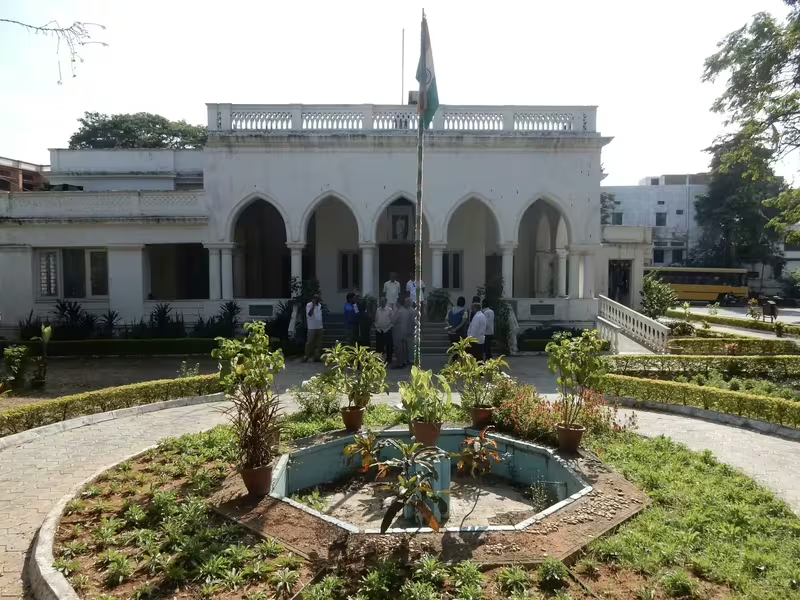
Sarojini Naidu: The Nightingale of India
In the grand tapestry of India's struggle for freedom, few threads are as vibrant and multifaceted as that of Sarojini Naidu. She was a woman who defied the conventions of her time, a prodigious poet whose words sang of the beauty and soul of India, and an indomitable political leader whose voice roused a nation. Known affectionately as the 'Bharat Kokila' or the Nightingale of India, a title bestowed upon her by Mahatma Gandhi, Sarojini Naidu's life was a symphony of art, activism, and unwavering patriotism. Her journey from a child prodigy in a scholarly household to a pivotal figure in the Indian National Congress and the first woman governor of an Indian state is a testament to her extraordinary intellect, courage, and spirit.
Early Life & A Blossoming Prodigy
Sarojini Chattopadhyay was born on February 13, 1879, in the culturally rich city of Hyderabad. She was the eldest of eight siblings born into a Bengali Brahmin family renowned for its intellectual and artistic pursuits. Her home was a crucible of creativity and learning. Her father, Aghorenath Chattopadhyay, was a distinguished scientist with a doctorate from the University of Edinburgh, a philosopher, and the founder of Nizam College in Hyderabad. He was a visionary who championed education for all. Her mother, Varada Sundari Devi, was a gifted Bengali poetess, whose literary sensibilities deeply influenced her daughter.
Growing up in this environment, Sarojini was exposed to a world of ideas, languages, and art. She was a precocious child with a voracious appetite for knowledge. While her father dreamed of her becoming a mathematician or a scientist, Sarojini's heart was tethered to poetry. Her linguistic talents were astounding; she was fluent in English, Bengali, Urdu, Telugu, and Persian. At the tender age of twelve, she achieved national fame by passing the matriculation examination of the University of Madras, a remarkable feat for anyone, let alone a young girl of her time.
A year later, she penned 'Maher Muneer', a full-length play written in Persian, which greatly impressed the Nizam of Hyderabad. Recognizing her exceptional talent, the Nizam awarded her a scholarship to study abroad.
At sixteen, in 1895, Sarojini traveled to England. She first attended King's College, London, and later Girton College, Cambridge. It was in England that her literary voice found its true direction. She met influential literary figures like Sir Edmund Gosse and Arthur Symons. Initially, her poetry emulated the English Romantic tradition of poets like Shelley and Keats. It was Gosse who offered her transformative advice: to cease being a “faultless, echo of English verse” and instead, to set her poems firmly in the heart of India—to write about its mountains, rivers, temples, and the vibrant social tapestry of its people. This counsel became the polestar of her literary career, turning her gaze inward to the land she loved.
During her time in England, she also met Dr. Muthyala Govindarajulu Naidu, a physician. Despite the rigid caste barriers of the era—she a Brahmin and he from a non-Brahmin caste—they fell in love. At the age of 19, in 1898, she returned to India and married him in a progressive ceremony sanctioned by the Brahmo Marriage Act of 1872, defying societal norms and setting a personal example of the social reform she would later champion.
A Poet's Pen, A Patriot's Voice
Sarojini Naidu's literary career flourished upon her return to India. Her poetry, rich with lyrical beauty and vivid imagery, captured the essence of Indian life. Her first volume of poetry, The Golden Threshold, was published in 1905 with an introduction by Arthur Symons. It was followed by The Bird of Time (1912) and The Broken Wing (1917). Her poems celebrated everything from the mundane to the magnificent. In 'In the Bazaars of Hyderabad', she painted a vibrant picture of a marketplace, while 'The Bangle Sellers' explored the cultural significance of simple adornments. Her work delved into themes of nature, love, life, death, and an ever-deepening sense of patriotism.
However, the political climate of India was rapidly changing, and Sarojini Naidu could not remain a mere observer. The Partition of Bengal in 1905 by the British Viceroy Lord Curzon was a watershed moment that galvanized the nationalist movement and deeply stirred her conscience. It was this event that drew her from the quiet world of poetry into the tumultuous arena of politics.
She began to use her powerful oratory skills to advocate for India's freedom. Her journey into the heart of the freedom struggle was shaped by her interactions with its leading lights. She was guided by Gopal Krishna Gokhale and found a kindred spirit in Rabindranath Tagore. But her most definitive political relationship was forged in London in 1914 when she met Mahatma Gandhi for the first time. She was immediately drawn to his philosophy of Satyagraha (non-violent resistance) and became one of his most trusted and devoted followers.
Leading the Charge for Freedom
Sarojini Naidu's political contributions were as significant as her literary ones. She was a tireless advocate for social reform, particularly for women's rights, which she saw as inseparable from the fight for national independence. In 1917, she helped found the Women's Indian Association (WIA) and led a delegation of women to London to meet the Secretary of State for India, Edwin Montagu, to demand female suffrage.
Her stature within the Indian National Congress grew rapidly. Her eloquence, charisma, and unwavering commitment made her a natural leader. In 1925, she reached a historic milestone by being elected President of the Indian National Congress at its Kanpur session. She was the first Indian woman to hold this prestigious post, a powerful symbol of the changing role of women in public life. In her presidential address, she declared, "In the battle for liberty, fear is the one unforgivable treachery, and despair, the one unforgivable sin."
Naidu was at the forefront of every major Gandhian movement. She traveled across the country, delivering fiery speeches that inspired thousands to join the cause. Her most iconic moment of direct action came during the Salt Satyagraha of 1930. After Gandhi's arrest following the Dandi March, he chose Sarojini Naidu to lead the next phase of the protest: a non-violent raid on the Dharasana Salt Works in Gujarat. On May 21, 1930, she stood before hundreds of satyagrahis and said, "You must not use any violence under any circumstances. You will be beaten, but you must not resist: you must not even raise a hand to ward off blows." What followed was a display of immense courage and brutal repression, as the peaceful protestors were mercilessly beaten by the police. The event, reported by American journalist Webb Miller, sent shockwaves across the world and exposed the violent reality of British rule. Sarojini Naidu's calm and resolute leadership in the face of such brutality became legendary.
Her activism led to multiple arrests. During the Quit India Movement of 1942, she was arrested along with Gandhi and other leaders and was imprisoned for 21 months. Her health suffered, but her spirit remained unbroken.
Beyond India's borders, she was a powerful ambassador for the freedom struggle. She traveled to East Africa and South Africa to condemn the treatment of Indian immigrants and later toured the United States, where her powerful oratory countered British propaganda and won support for the Indian cause.
Governor of a New India
When India finally achieved its independence on August 15, 1947, Sarojini Naidu continued her service to the nation. She was appointed as the Governor of the United Provinces (now Uttar Pradesh), becoming the first woman to hold a governorship in India. She brought her characteristic wit, charm, and wisdom to the role. Though she humorously referred to herself as a "bird in a golden cage," she performed her duties with grace and diligence, providing a steadying hand during the turbulent post-partition period.
She remained in this post until her death. On March 2, 1949, Sarojini Naidu passed away from a heart attack in her office in Lucknow. Her death marked the end of an era, leaving a void in the nation's public and cultural life.
Legacy & Enduring Influence
Sarojini Naidu's legacy is as rich and diverse as her life. She was a true renaissance woman who seamlessly blended the worlds of art and politics. Her life serves as a powerful reminder that the fight for freedom is not just a political struggle but a cultural and social awakening.
As a Poet: She remains one of India's most celebrated English-language poets. Her work gave a lyrical voice to the Indian experience and is still studied and cherished for its beauty and patriotic fervor.
As a Freedom Fighter: She was a giant of the independence movement. Her leadership at Dharasana, her presidency of the Congress, and her tireless campaigning made her an indispensable part of the Gandhian struggle.
As a Pioneer for Women: She shattered countless glass ceilings. As the first Indian woman President of the INC and the first woman Governor, she paved the way for women to take on leadership roles in modern India. Her life was an inspiration for gender equality and women's empowerment.
To honor her immense contribution, her birthday, February 13, is celebrated in India as National Women's Day. Sarojini Naidu is remembered not just as a historical figure but as a symbol of courage, intellect, and the unbreakable spirit of India. She was a woman who wrote poetry with the same passion with which she fought for freedom, proving that the pen and the spirit, together, could indeed move a nation.