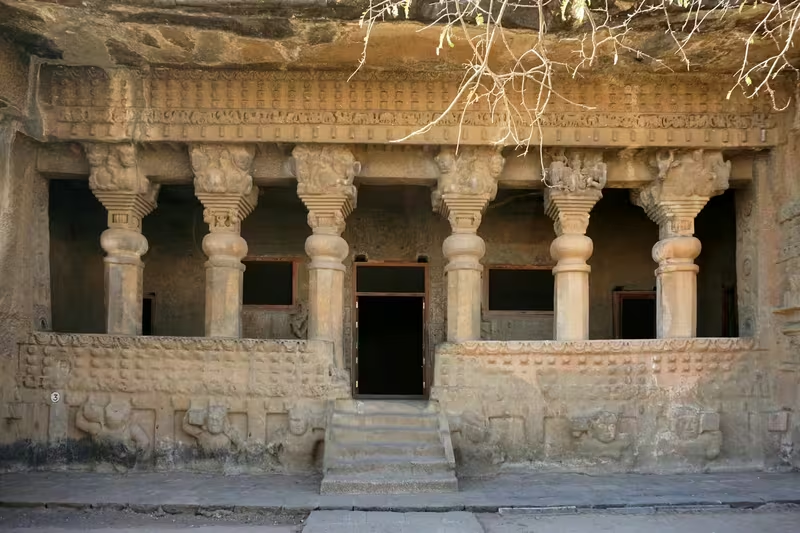
Satakarni I: The Deccan's First Great Emperor
In the sprawling, fragmented landscape of post-Mauryan India, a new power was stirring in the Deccan plateau. The once-mighty Mauryan Empire had crumbled, leaving a vacuum that ambitious regional chieftains and nascent kingdoms rushed to fill. In this crucible of change, the Satavahana dynasty emerged, a lineage destined to dominate the heart of India for centuries. It was during the reign of its third ruler, Satakarni I, that this dynasty transformed from a regional authority into a formidable, pan-Deccan empire. Through strategic alliances, relentless military campaigns, and the revival of ancient Vedic rituals on a breathtaking scale, Satakarni I carved out a vast domain and forged a legacy as the Dakshinapathapati—the undisputed Lord of the Southern Road.
Early Life & Background
Born into the ruling Satavahana family, Satakarni I was the son of Simuka, the dynasty's founder. He inherited a kingdom whose foundations were still being laid. He succeeded his uncle, Kanha (Krishna), to the throne around 120 BCE, stepping into a world of intense political rivalry. To the north, the Shunga Empire held sway over the Gangetic plains, while to the east, the formidable King Kharavela of Kalinga was building his own powerful state. The Deccan itself was a mosaic of powerful local clans and chieftains known as Maharathis.
While specific details of Satakarni’s education and upbringing remain lost to time, his actions as a ruler reveal a man deeply schooled in the arts of war, statecraft, and Vedic tradition. His early life in the Satavahana capital, Pratishthana (modern Paithan in Maharashtra), would have exposed him to the burgeoning trade routes that crisscrossed the Deccan, connecting the ports of the western coast with the markets of the north and east. This strategic location was the economic lifeblood of the kingdom, and controlling it was paramount.
One of the most significant and well-documented events of his early reign was his marriage to Naganika. She was not merely a royal consort but a figure of immense political importance, the daughter of the powerful Maharathi Tranakayiro of the Amgiya clan. This matrimonial alliance was a masterstroke of diplomacy. It neutralized a potential rival and integrated a powerful local lineage into the Satavahana power structure, securing Satakarni's western flank and providing him with the stability needed to launch his ambitious campaigns of expansion.
Career & Major Contributions
Satakarni I’s reign was defined by relentless energy and a grand vision of imperial sovereignty. He was not content to merely rule; he sought to dominate, to unify the Deccan under his banner and proclaim his supremacy in a manner that would echo through the ages.
Military Conquests and Imperial Expansion
With his home base secured, Satakarni I embarked on a series of military campaigns that dramatically expanded the borders of the Satavahana kingdom. His primary targets were the territories controlled by the Shungas to the north and other regional powers.
His armies pushed northwards, conquering the strategically vital region of Western Malwa. This area, with its capital at Ujjain, was a crucial hub on the trade routes connecting the Gangetic valley to the western ports. Wresting it from Shunga influence was a major blow to his northern rivals and a significant economic gain for the Satavahanas. Archaeological evidence, in the form of Satavahana coins found in the region, corroborates these conquests.
He also annexed the territories of Anupa (the Narmada valley) and Vidarbha (in modern-day Maharashtra), further consolidating his control over central India. These conquests were not just territorial gains; they were a clear declaration that the Satavahanas were the new paramount power in the Deccan.
His most famous military encounter, however, was with King Kharavela of Kalinga. The narrative of this conflict comes from Kharavela’s own Hathigumpha inscription at Udayagiri caves. In it, Kharavela claims that in the second year of his reign, he sent a mighty army westward, paying no heed to Satakarni, and that his forces reached the river Kanha-bemna (likely the Krishna river) and struck terror into the city of Musika. Historians interpret this passage in various ways. Some see it as an outright military victory for Kharavela, while others suggest his army simply bypassed the core Satavahana territories. The Satavahana records, particularly the Naneghat inscription, make no mention of any such defeat. Instead, they portray Satakarni as an undefeated and supreme sovereign. This ambiguity highlights the fierce rivalry between the two great kings, each claiming supremacy in their respective domains.
The Proclamation of Sovereignty: Vedic Sacrifices
For Satakarni I, military victory alone was not enough. To truly legitimize his status as an emperor (Samrat), he turned to the most potent rituals of sovereignty known in ancient India: the grand Vedic sacrifices.
The most significant of these was the Ashvamedha Yajna, or the horse sacrifice. This elaborate, year-long ceremony was the ultimate declaration of imperial power. A consecrated horse was set free to wander for a year, followed by the king’s army. Any ruler in whose territory the horse entered had to either accept the king's suzerainty or fight. At the end of the year, if the horse returned unchallenged, it was sacrificed in a grand ceremony, and the king was declared a chakravartin (universal ruler). The Naneghat inscription, commissioned by his widow Queen Naganika, proudly states that Satakarni I performed the Ashvamedha not once, but twice—an extraordinary feat signifying his complete and unchallenged dominion over a vast territory.
He also performed the Rajasuya Yajna, another complex royal consecration ceremony that was believed to bestow divine sanction upon the ruler. Together, these sacrifices elevated him above all other kings, positioning him as a righteous, universal monarch in the classical Indian tradition.
The Naneghat Inscription: A Window into His Reign
The primary source for Satakarni I's reign is a remarkable inscription found in a cave pass at Naneghat in the Western Ghats. Carved on the walls of a rest-stop for traders, it was commissioned by Queen Naganika after her husband's death, while she served as regent for her minor sons, Vedi-Sri and Sakti-Sri. The inscription is a detailed record of the immense donations (dakshina) made to Brahmin priests during the numerous sacrifices performed by the royal couple.
The scale of the wealth recorded is staggering: tens of thousands of cows, thousands of horses, elephants, entire villages, and vast quantities of coins (karshapanas). It meticulously lists the many elaborate Shrauta sacrifices they performed, cementing Satakarni's image as a devout follower and patron of the Vedic faith. The inscription refers to him with grand titles like Apratihatachakra (He whose chariot wheel is unstoppable) and confirms his status as Dakshinapathapati. It also features some of the earliest known relief sculptures of the Satavahana rulers, including Satakarni I and Naganika, forever immortalizing their legacy.
Legacy & Influence
Satakarni I's reign, though lasting several decades, had an impact that resonated for centuries. He was the true architect of the Satavahana Empire, laying the political, economic, and ideological foundations upon which his successors would build.
His greatest legacy was the establishment of the Deccan as a distinct and powerful political entity. By checking the ambitions of the Shungas and the Kalingas, he ensured that the center of gravity in Indian politics was not confined to the Gangetic plains. The title he earned, Dakshinapathapati, became a symbol of prestige and power, coveted by ambitious Deccan rulers for a thousand years.
His reign marked a significant revival of grand Vedic Brahmanism. In an age where Buddhism and Jainism were gaining widespread patronage, Satakarni’s performance of the Ashvamedha and Rajasuya sacrifices was a powerful statement of Hindu sovereignty. This royal patronage helped solidify the place of Vedic traditions in the Deccan.
The empire he forged became a vital cultural and economic bridge between northern and southern India. The trade routes he controlled and protected facilitated a vibrant exchange of goods, ideas, and technologies. The administrative and monetary systems consolidated under his rule provided a model for later kingdoms in the region.
Today, Satakarni I is remembered not through popular legends but through the hard evidence of history—the weathered inscriptions on a mountain pass, the scattered coins bearing his name, and the Puranic lists that name him as a great king. He stands as a testament to an era of bold ambition, a ruler who transformed a regional dynasty into the first great empire of southern India and rightfully earned his place as one of the most significant figures in ancient Indian history.