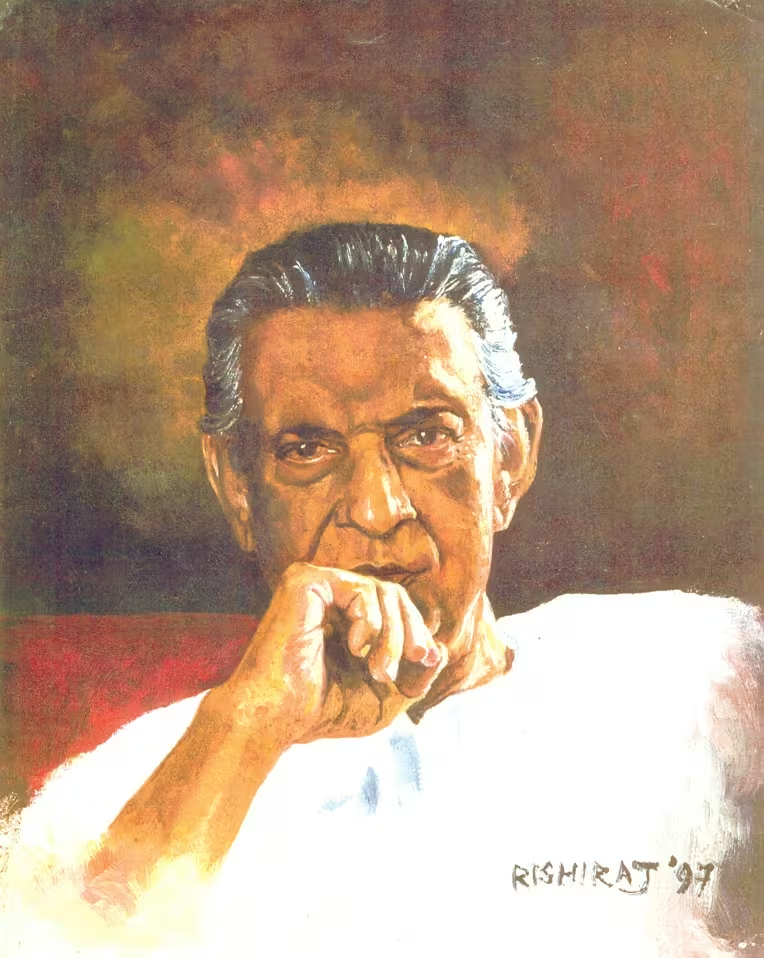
A Universe in a Drop of Dew: The Lyrical World of Satyajit Ray
In the pantheon of world cinema, few names command the reverence accorded to Satyajit Ray. He was more than a director; he was a complete auteur—a writer, composer, editor, illustrator, and graphic designer who orchestrated every element of his cinematic universe with meticulous grace. From the dusty, sun-drenched lanes of a Bengali village to the morally ambiguous corridors of corporate Calcutta, Ray’s camera did not merely observe; it understood. His films, suffused with a profound humanism, transcended cultural and linguistic barriers, placing the complex soul of a newly independent India onto the global stage and transforming the world’s perception of its cinema forever.
Early Life & Background
Satyajit Ray was born on May 2, 1921, into a family that was a crucible of the Bengali Renaissance. His birthplace, Calcutta (now Kolkata), was the intellectual and cultural heart of India, and the Ray family was at its epicentre. His grandfather, Upendrakishore Ray Chowdhury, was a pioneering writer, painter, publisher, and printer. His father, Sukumar Ray, remains a literary legend in Bengal, celebrated for his masterful nonsense verse and illustrations that have captivated generations of children. The family’s printing press, U. Ray and Sons, was a hub of creative energy, and they published the iconic children’s magazine, Sandesh, which Satyajit would later revive.
Tragically, Sukumar Ray passed away when Satyajit was merely three years old. Raised by his mother, Suprabha Ray, he grew up in a world steeped in art and literature but shadowed by financial hardship. He completed his schooling at Ballygunge Government High School and later pursued Economics at Presidency College, one of Calcutta’s most esteemed institutions.
While his education was largely Western-oriented, a pivotal turn came when his mother insisted he enroll at Visva-Bharati University in Santiniketan, the tranquil institution founded by the Nobel laureate Rabindranath Tagore. Initially reluctant to leave the urban stimulation of Calcutta, Ray found Santiniketan to be a transformative experience. Under the tutelage of visionary artists like Nandalal Bose and Benode Behari Mukherjee, he discovered the profound beauty and depth of Indian and Eastern art. This period was crucial in shaping his aesthetic, instilling in him a deep-seated appreciation for his own cultural heritage. It was here that he learned to see the world not just through a Western lens, but with an authentically Indian eye—a perspective that would define his cinematic language.
Career & Major Contributions
The Path to Cinema
Ray began his professional life not as a filmmaker, but as a commercial artist. In 1943, he joined the British-run advertising agency D.J. Keymer as a “junior visualiser.” His talent for graphic design and typography flourished, and he became a sought-after book cover designer. In a moment of profound serendipity, he was commissioned to illustrate a new children's edition of Bibhutibhushan Bandopadhyay’s classic Bengali novel, Pather Panchali (Song of the Little Road). The story of the young boy Apu, his sister Durga, and their life in the village of Nischindipur captivated him. The novel's episodic, lyrical structure and its deep empathy for its characters sparked a powerful vision; Ray knew it had to be a film.
His passion for cinema had been growing for years. In 1947, along with Chidananda Dasgupta and others, he co-founded the Calcutta Film Society, which screened and studied international cinematic masterpieces. This was his film school. In 1949, he had a life-altering encounter with the legendary French director Jean Renoir, who was in Calcutta to shoot his film The River. Ray assisted Renoir in scouting locations and shared his own filmmaking aspirations. Renoir’s encouragement was a vital affirmation.
The final catalyst came in 1950. Sent to London by his agency for six months, Ray immersed himself in cinema, watching an astounding 99 films. It was Vittorio De Sica’s neorealist masterpiece, Ladri di biciclette (Bicycle Thieves), that solidified his resolve. The film’s use of non-professional actors, on-location shooting, and its heart-wrenching portrayal of everyday struggle showed him that it was possible to create powerful, poetic cinema without a large budget or studio artifice. He returned to India, determined to bring Pather Panchali to life.
The Apu Trilogy: A Cinematic Revolution
The making of Pather Panchali (1955) is a legendary tale of perseverance. With a mostly amateur crew, shoestring finances, and a shooting schedule confined to weekends, the project constantly teetered on the brink of collapse. Ray poured all his savings into the film and, at one point, his wife Bijoya Ray had to pawn her jewellery to keep the production afloat. Finally, after a long struggle, the Government of West Bengal provided a loan, allowing the film to be completed.
The result was unlike anything Indian cinema had ever seen. Rejecting the melodrama and theatricality of popular films, Ray crafted a lyrical, observational, and deeply moving portrait of rural life. The film’s premiere was met with a lukewarm response initially, but it slowly built momentum through word of mouth. Its true triumph came on the international stage. At the 1956 Cannes Film Festival, it won the prestigious “Best Human Document” award, stunning the world and announcing the arrival of a major new voice in cinema.
Ray continued Apu’s journey in two subsequent films, creating one of cinema's greatest coming-of-age sagas. Aparajito (The Unvanquished, 1956) followed Apu’s adolescence and education in the city, exploring his intellectual awakening and the painful emotional distance that grows between him and his mother. It won the Golden Lion, the highest prize at the Venice Film Festival. The trilogy concluded with Apur Sansar (The World of Apu, 1959), a masterful exploration of adult love, devastating loss, and eventual fatherhood. The film introduced Soumitra Chatterjee and Sharmila Tagore, two actors who would become mainstays of Ray’s cinematic family.
Together, the Apu Trilogy was a landmark achievement. It demonstrated that Indian stories, told with authenticity and artistry, could resonate with audiences everywhere.
The Master's Canvas: Exploring Diverse Themes
While the Apu Trilogy cemented his international reputation, it was only the beginning of an incredibly diverse and prolific career. Ray directed 36 films, including features, documentaries, and shorts, each marked by his signature style and intellectual curiosity.
He delved into the decaying world of the Bengali aristocracy in films like Jalsaghar (The Music Room, 1958), a poignant study of a feudal lord’s obsession with music in the face of his own ruin, and Devi (The Goddess, 1960), a powerful critique of religious fanaticism.
In the 1970s, as Calcutta was rocked by political turmoil and economic anxiety, Ray turned his lens on the contemporary urban experience with his “Calcutta Trilogy.” Pratidwandi (The Adversary, 1970), Seemabaddha (Company Limited, 1971), and Jana Aranya (The Middleman, 1976) dissected the moral compromises and existential crises facing the city’s youth and middle class.
He ventured beyond Bengal with his first Hindi-language film, Shatranj Ke Khilari (The Chess Players, 1977). Set during the British annexation of the kingdom of Awadh in 1856, the film masterfully uses the metaphor of two noblemen absorbed in a game of chess to explore political apathy and the clash of cultures.
Ray also revealed a lighter, more whimsical side with beloved children's films like the musical fantasy Goopy Gyne Bagha Byne (The Adventures of Goopy and Bagha, 1969), based on a story by his grandfather. His documentaries, such as The Inner Eye (1972) on his Santiniketan mentor Benode Behari Mukherjee, were intimate and insightful portraits.
His total command of the medium was absolute. After 1961’s Teen Kanya, he began composing the musical scores for all his films, creating themes that were as memorable as his visuals. He storyboarded every scene, had a precise vision for Subrata Mitra’s cinematography and Dulal Dutta’s editing, and even designed his own iconic film posters and title cards, a direct link to his roots in graphic design.
Legacy & Influence
Satyajit Ray’s impact on Indian and world culture is immeasurable. He single-handedly elevated Indian cinema from a regional curiosity to a respected art form on the global stage. He created a “parallel cinema” movement in India, inspiring generations of filmmakers like Shyam Benegal, Adoor Gopalakrishnan, and Mrinal Sen to pursue artistic, realist filmmaking as an alternative to the commercial mainstream.
His work serves as an invaluable chronicle of twentieth-century India, capturing the nation's social, political, and cultural transformations with unparalleled sensitivity. He explored the tensions between tradition and modernity, the village and the city, faith and reason, without ever resorting to easy answers. His characters were not heroes or villains but complex, flawed, and recognizable human beings.
Beyond cinema, Ray was a towering figure in Bengali literature. He revived the family magazine Sandesh in 1961 and edited it for the rest of his life. He created two of Bengal’s most beloved fictional characters: Feluda, the sharp-witted private investigator, and Professor Shonku, the eccentric scientist and inventor. Through his stories, he nurtured the minds of young readers, much as his father and grandfather had done before him.
In his final years, his health declined, but his creative spirit remained undimmed. In 1992, just weeks before his death, he was awarded an Honorary Academy Award for his lifetime achievement in cinema. Unable to travel, he accepted the award from his hospital bed in Calcutta, a frail figure who had reshaped the cinematic landscape. That same year, he was awarded the Bharat Ratna, India’s highest civilian honour.
Today, Satyajit Ray is remembered as a titan of the arts, a true Renaissance man. His films are studied in schools, revered by filmmakers from Martin Scorsese to Wes Anderson, and cherished by audiences for their timeless emotional depth. His legacy is not just in the celluloid he left behind, but in the profound empathy and quiet grace with which he viewed the world—a world he taught us all to see with a little more clarity, compassion, and wonder.