Satyendra Nath Bose - Physicist and Mathematician
In the vast, intricate tapestry of 20th-century physics, few names resonate with the same fundamental importance as Satyendra Nath Bose. His contribution was not merely an incremental step but a conceptual leap that redefined our understanding of the very fabric of reality. From a modest lecture hall in Dacca, colonial India, this brilliant physicist and mathematician sent a ripple across the scientific world that would eventually become a tidal wave. His work gave birth to a new way of counting particles, a new branch of statistics, and immortalized his name in one of the two fundamental classes of particles that constitute the universe: the boson.
The Making of a Prodigy in Colonial Calcutta
Satyendra Nath Bose was born on January 1, 1894, in Calcutta (now Kolkata), the nerve centre of the British Raj and a crucible of Indian intellectual and nationalist awakening. He was the eldest of seven children, and his father, Surendranath Bose, was an accountant in the Engineering Department of the East Indian Railway Company. From a young age, it was clear that Satyendra Nath was possessed of a phenomenal intellect.
His early education at the Hindu School in Calcutta revealed a mind that devoured knowledge with insatiable curiosity. Anecdotes from his youth speak of a teacher who, in an attempt to challenge the precocious boy, gave him 100 out of 110 on a mathematics examination, noting that Bose had solved all problems, some by multiple methods, in the allotted time. This was the first glimpse of a mind that did not just seek answers but explored the very structure of problems.
In 1909, Bose joined the prestigious Presidency College, Calcutta, an institution that was a hotbed of academic excellence and nationalist sentiment. Here, he became part of a legendary cohort of students that included the future astrophysicist Meghnad Saha. Theirs was a friendly but intense academic rivalry that pushed both to extraordinary heights. Bose was in the company of remarkable teachers who nurtured his talent, including the eminent scientists Jagadish Chandra Bose and Prafulla Chandra Ray, towering figures who championed the cause of Indian science.
Bose's academic record was nothing short of spectacular. He consistently ranked first in his examinations, completing his BSc in Mixed Mathematics in 1913 and his MSc in the same subject from the University of Calcutta in 1915, once again securing the top position. His results were so far ahead of his peers that they became the stuff of legend within the university's hallowed halls.
The Dacca Derivation: A Moment of Genius
After a brief period as a lecturer at the University of Calcutta alongside Meghnad Saha, Bose moved in 1921 to the newly established University of Dacca (now Dhaka, in Bangladesh) to join its Department of Physics. It was here, away from the more established centres of scientific research, that Bose would make his most profound contribution.
By the early 1920s, quantum theory was a revolutionary but incomplete edifice. One of its cornerstones was Max Planck's law of black-body radiation, which correctly described how objects radiate energy. However, Planck’s own derivation of this law relied on a mix of classical physics and new quantum hypotheses, a combination that left many, including Bose, feeling intellectually unsatisfied.
While teaching this very topic to his postgraduate students in 1924, Bose confronted this logical gap. He found the standard derivation, which used classical statistics to count the states of photons, to be flawed and unconvincing. He decided to re-derive the law from first principles, making a bold and unconventional assumption. Instead of treating photons as distinguishable particles, like coins that can be told apart, he treated them as fundamentally indistinguishable. In his system, it didn't matter which photon was in which energy state, only how many photons were in each state. This was a radical departure from classical thinking.
Working alone, he developed a short, four-page paper titled "Planck's Law and the Hypothesis of Light Quanta." In it, he derived Planck's law perfectly, without any reference to classical electromagnetism. He had stumbled upon a new kind of statistics, a new way of understanding the collective behaviour of quantum particles. He had, in effect, discovered the statistical mechanics of photons.
A Letter to Berlin: Reaching for Einstein
Confident in his work, Bose submitted his paper to the prominent British journal, the Philosophical Magazine. To his dismay, it was rejected. The referees likely failed to grasp the revolutionary nature of his statistical method.
Undeterred, Bose made a decision of audacious brilliance. In June 1924, he sent his manuscript directly to the most famous scientist in the world: Albert Einstein. In a humble but self-assured cover letter, he wrote:
“Respected Sir, I have ventured to send you the accompanying article for your perusal and opinion. I am anxious to know what you think of it. You will see that I have tried to deduce the coefficient 8πν²/c³ in Planck's Law independent of classical electrodynamics, only assuming that the ultimate elementary region in the phase-space has the content h³.”
Einstein immediately recognized the paper's genius. He saw that Bose's method was not just a clever trick to derive Planck's law but a fundamental insight with profound implications. He personally translated Bose's paper into German and arranged for its publication in the prestigious Zeitschrift für Physik, adding a powerful translator’s note:
“Bose’s derivation of Planck’s formula appears to me to be an important step forward. The method used here gives also the quantum theory of an ideal gas, as I shall show elsewhere.”
This endorsement from Einstein catapulted the unknown professor from Dacca onto the world stage. It was a pivotal moment, not just for Bose, but for the history of physics.
Bose-Einstein Statistics and the Dawn of a New Physics
True to his word, Einstein extended Bose's work. He applied Bose's statistical method not just to photons but to atoms with an integer spin. This generalization gave rise to what is now known as Bose-Einstein statistics, a fundamental pillar of quantum mechanics that governs the behaviour of an entire class of particles.
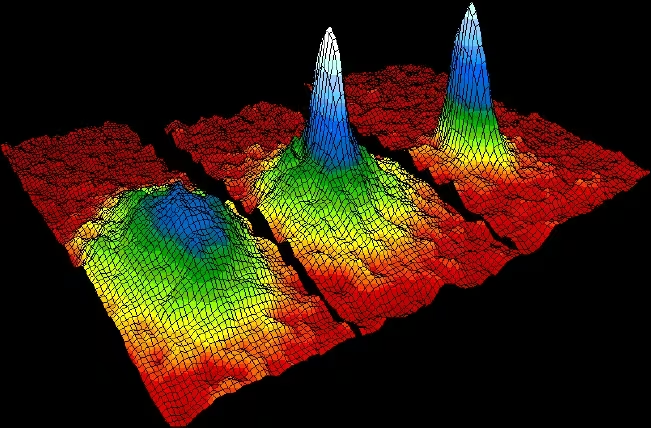
In doing so, Einstein also predicted a bizarre new state of matter. He calculated that if a gas of these particles were cooled to temperatures near absolute zero, they would collapse into a single, collective quantum state. This state, where individual atoms lose their identity and behave as one giant super-atom, was named the Bose-Einstein Condensate (BEC). For over 70 years, it remained a theoretical curiosity until 1995, when physicists Eric Cornell and Carl Wieman finally created a BEC in their laboratory, an achievement for which they, along with Wolfgang Ketterle, were awarded the Nobel Prize in Physics in 2001.
The particles that obey Bose-Einstein statistics were later christened bosons by the English physicist Paul Dirac, in honor of the man who first understood their nature. The universe, at its most fundamental level, is composed of two types of particles: fermions (matter particles like electrons and quarks) and bosons (force-carrying particles like photons, gluons, and the Higgs boson). Bose's name is thus etched into the very classification of reality itself.
Legacy: A Master Who Built the House
Einstein's recognition opened the doors of Europe to Bose. From 1924 to 1926, he travelled and worked with the greatest scientific minds of the era, including Marie Curie in Paris and, of course, Einstein himself in Berlin. He returned to India in 1926 as a celebrated figure, becoming Professor and Head of the Department of Physics at the University of Dacca, a position he held until 1945. He later returned to his alma mater, the University of Calcutta, where he taught until his retirement in 1956.
Despite his monumental early breakthrough, Bose's scientific interests were vast and varied. He published papers on X-ray crystallography, chemistry, and unified field theory, a subject on which he corresponded with Einstein in his later years. He was a true polymath, fluent in several languages including Bengali, English, French, and German, and deeply interested in music (he was an accomplished player of the esraj, a stringed instrument), literature, and philosophy.
One of Bose's most enduring legacies within India was his passionate advocacy for science education in vernacular languages. He firmly believed that scientific concepts could and should be taught in one's mother tongue to foster deeper understanding and wider accessibility. To this end, he founded the Bangiya Bijnan Parishad (Bengal Science Association) in 1948, which published a popular science magazine, Jnan O Bijnan (Knowledge and Science), in Bengali. He was a nation-builder who saw science not as an esoteric pursuit for the elite but as a tool for national progress.
For his immense contributions, he was awarded the Padma Vibhushan, India's second-highest civilian honor, in 1954. In 1958, he was made a Fellow of the Royal Society, and in 1959, he was appointed a National Professor of India, the highest honor the country bestows upon a scholar.
Yet, a question often lingers: why was Satyendra Nath Bose never awarded the Nobel Prize? While his work was the direct foundation for at least seven later Nobel-winning discoveries, including the BEC, he was consistently overlooked. The reasons remain a subject of debate, but many in the scientific community consider it one of the most significant omissions in the history of the prize. Bose himself remained largely unconcerned with accolades, driven instead by an pure, unyielding curiosity.
Satyendra Nath Bose passed away on February 4, 1974, in his beloved Calcutta. He is remembered not just as a scientist but as a symbol of Indian genius on the world stage—a self-taught master who, with a single paper and a courageous letter, fundamentally altered our perception of the cosmos. His name lives on, not only in textbooks and laboratories, but in the dance of light and the fundamental forces that hold our universe together.