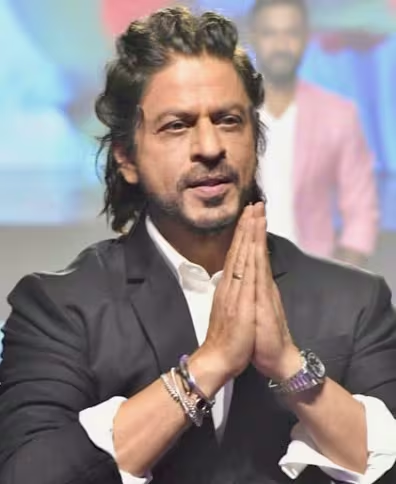
Shah Rukh Khan: The Making of a Modern Indian Icon
In the grand tapestry of Indian cinema, few threads are as vibrant, enduring, and globally recognized as that of Shah Rukh Khan. Born on November 2, 1965, his journey from the middle-class lanes of New Delhi to the zenith of international stardom is a defining narrative of modern India—a story of ambition, resilience, and the sheer power of charisma. More than just an actor, Khan emerged as a cultural phenomenon, an entrepreneur, and a global ambassador for a new, aspirational India. His title, the "Baadshah of Bollywood" (King of Bollywood), is not mere hyperbole; it is a testament to a three-decade-long reign that has shaped the dreams and identity of millions.
Early Life & Formative Years in Delhi
Shah Rukh Khan was born in New Delhi to Mir Taj Mohammed Khan and Lateef Fatima Khan. His father, an ethnic Pashtun from Peshawar, was an Indian independence activist who moved to Delhi before the 1947 partition. His mother was the daughter of a senior government engineer. Growing up in the Rajendra Nagar neighbourhood, Khan's upbringing was a blend of cultures, languages, and faiths, which he has often cited as a cornerstone of his pluralistic worldview.
His education began at St. Columba's School, a prestigious institution in the heart of Delhi. Here, the young Khan was a formidable presence, excelling not just in academics but also in sports, particularly hockey and football. His leadership qualities and all-around excellence earned him the school's highest honour, the 'Sword of Honour'. This period was crucial in shaping his discipline and competitive spirit.
Following school, he enrolled at Hansraj College, University of Delhi, to study Economics, graduating in 1988. It was during his college years that his passion for acting, already kindled in school plays, found a more structured outlet. He became an active member of the Delhi-based Theatre Action Group (TAG), where he honed his craft under the mentorship of renowned theatre director Barry John. This formal training in theatre provided him with the foundational skills and confidence that would later distinguish his screen performances.
Seeking to deepen his understanding of media, he pursued a Master's degree in Mass Communication at Jamia Millia Islamia, but the magnetic pull of acting proved too strong. He eventually left his studies to chase his dream in Mumbai.
A defining aspect of his early life was profound personal loss. He lost his father to cancer in 1981 and his mother to complications from diabetes in 1991. The death of his parents, particularly his mother, at the cusp of his professional career, became a powerful, albeit painful, catalyst. Khan has often spoken about how this loss fueled his relentless work ethic, viewing his success as a tribute to the parents who never got to witness it.
The Rise of a Superstar: From Television to Cinema
Before he became a cinematic icon, Shah Rukh Khan first captured the nation's attention on the small screen. In 1989, he appeared as the earnest and thoughtful soldier, Lt. Abhimanyu Rai, in the television series Fauji. The show was a tremendous success, and Khan's natural charm and intense screen presence made him an instant household name. This was followed by another popular series, Aziz Mirza's Circus (1989–90), where he played a young man managing his late father's circus. These television roles served as his launchpad, showcasing a talent that was clearly destined for a larger canvas.
In 1991, following his mother's passing, Khan moved to Mumbai. His cinematic debut came in 1992 with Deewana. Though he only appeared in the second half of the film, his energetic performance stole the show, earning him the Filmfare Award for Best Male Debut. But what truly set him apart in these initial years was his audacious choice of roles. At a time when aspiring heroes meticulously cultivated a clean, heroic image, Khan took a radical turn.
In 1993, he stunned audiences with two iconic negative roles. In Baazigar, he played a charming anti-hero, a vengeful son who systematically destroys a business tycoon's family. Later that year, in Yash Chopra's Darr, he delivered a chilling performance as an obsessive, stuttering stalker. His iconic line "I love you, K-K-K-Kiran" became a cultural touchstone. These roles were unprecedented for a mainstream hero. By embracing the dark, complex, and villainous, Khan demonstrated a fearless versatility and a willingness to defy convention, a trait that would become a hallmark of his career.
The Reign of Romance: DDLJ and a New Cinematic Era
Having proven his dramatic range with anti-hero roles, Shah Rukh Khan pivoted in 1995 to a character that would define him for a generation. In Aditya Chopra's directorial debut, Dilwale Dulhania Le Jayenge (DDLJ), he played Raj Malhotra, a charming, witty, and modern NRI (Non-Resident Indian) who falls in love with Simran (played by Kajol) during a trip across Europe.
DDLJ was more than just a blockbuster; it was a cultural watershed. The film masterfully blended modern romance with traditional Indian family values. Raj was not a rebel who eloped with his beloved; he was a hero who vowed to win over her stern, patriarchal father. This narrative resonated deeply with a newly liberalized India and its diaspora, grappling with the balance between tradition and modernity. The film ran for over 1,000 weeks at the Maratha Mandir theatre in Mumbai, becoming one of the longest-running films in Indian cinema history and cementing Khan's status as the undisputed "King of Romance."
This persona was further solidified through a series of hugely successful collaborations with directors Yash Chopra and Karan Johar. Films like Dil To Pagal Hai (1997), Kuch Kuch Hota Hai (1998), Kabhi Khushi Kabhie Gham... (2001), Kal Ho Naa Ho (2003), and Veer-Zaara (2004) established him as the face of contemporary Bollywood romance. His on-screen chemistry with actresses like Kajol and Madhuri Dixit became legendary, and his characters—often named Rahul or Raj—became archetypes of the ideal modern Indian man: sensitive, humorous, and deeply devoted.
Beyond Romance: An Actor's Evolution and Entrepreneurship
While his romantic roles brought him immense fame, Khan consciously avoided being typecast. Throughout the 2000s, he sought out roles that challenged him as an actor and pushed the boundaries of mainstream cinema.
In Ashutosh Gowariker's Swades (2004), he delivered one of his most subtle and critically acclaimed performances as Mohan Bhargav, a NASA scientist who rediscovers his roots in a remote Indian village. The film was a departure from his usual flamboyant style, showcasing a restrained and mature actor. In 2007, he delivered another landmark performance in Chak De! India, playing Kabir Khan, the disgraced former captain of the Indian men's hockey team who coaches the underdog women's team to World Cup victory. His portrayal of the tough, inspiring coach was widely praised and the film became an anthem for national pride and women's empowerment.
His role in Karan Johar's My Name Is Khan (2010) as a man with Asperger's syndrome navigating post-9/11 America further demonstrated his global appeal and his willingness to tackle sensitive socio-political issues.
Parallel to his acting career, Khan proved to be a shrewd businessman. In 2003, he and his wife, Gauri Khan, established the film production company Red Chillies Entertainment. The company has produced many of his own films, including blockbusters like Om Shanti Om (2007) and Chennai Express (2013). More significantly, its subsidiary, Red Chillies VFX, has grown into one of India's leading visual effects studios, contributing to numerous high-profile projects. In 2008, he expanded his business portfolio by becoming a co-owner of the Kolkata Knight Riders (KKR), a franchise team in the highly successful Indian Premier League (IPL) cricket tournament.
Legacy & Enduring Influence
Shah Rukh Khan's legacy extends far beyond his impressive filmography and numerous awards. His impact on Indian culture and history is multifaceted and profound.
Globalizing Bollywood: Khan was at the vanguard of Bollywood's global expansion. His films, particularly those catering to the NRI audience, found massive success in the UK, North America, the Middle East, and Southeast Asia. He became one of the first Indian actors to be a truly global brand, often serving as a cultural ambassador for modern India on international platforms. His immense popularity in countries like Germany, France, and Indonesia is a testament to his universal appeal, transcending cultural and linguistic barriers.
Redefining Stardom: As an outsider from Delhi with no familial connections in the film industry, his success story broke the mold in a business often dominated by dynasties. He demonstrated that talent, intelligence, and an indomitable work ethic could pave the path to the top. His quick wit, eloquence, and self-awareness in interviews and public appearances created a new paradigm for celebrity engagement, making him as much a media personality as a film star.
A Symbol of Modern India: In many ways, Shah Rukh Khan's career mirrored the trajectory of post-liberalization India. He represented a new generation that was confident, globally-minded, yet connected to its roots. As a Muslim superstar in a Hindu-majority nation, his widespread acceptance and adoration made him a powerful symbol of India's secular fabric.
Today, Shah Rukh Khan's influence remains undiminished. After a brief hiatus, his spectacular comeback in 2023 with the action blockbusters Pathaan and Jawan shattered box office records, reaffirming his status as a reigning superstar with cross-generational appeal. He is not just remembered; he is actively celebrated as a living legend. His journey from a grieving young man in Delhi to a global icon is more than a biography—it is an integral chapter in the story of contemporary India, a narrative of a self-made 'Baadshah' who built an empire on dreams and determination.