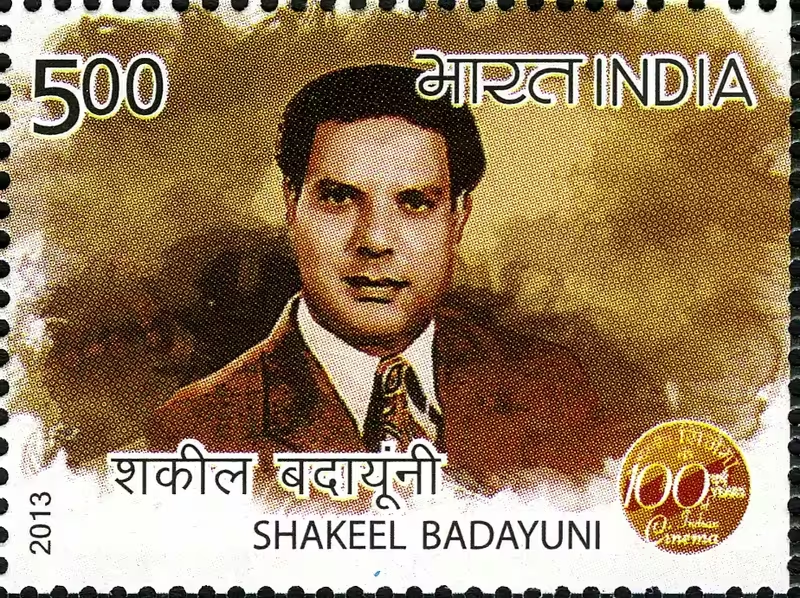
Shakeel Badayuni: The Poet of Beauty and the Soul of the Golden Era
In the grand tapestry of Hindi cinema, where music and poetry are woven into the very fabric of storytelling, few threads shine as brightly as the words of Shakeel Badayuni. He was more than a lyricist; he was a master poet, a shayar whose pen gave voice to the deepest human emotions—love, longing, devotion, and sorrow. His verses, cloaked in the deceptive simplicity of everyday language, carried the weight of classical Urdu poetry, making him the undisputed king of romance during cinema's Golden Age. His legendary partnership with the maestro Naushad Ali created a musical legacy that remains the gold standard, an immortal collection of songs that continue to echo through the heart of the subcontinent.
Early Life & The Making of a Poet
Shakeel Ahmed was born on August 3, 1916, in the historic town of Badaun, Uttar Pradesh. The soil of Badaun was steeped in the traditions of Sufism and Urdu literature, and this environment became the crucible for the young poet's sensibilities. His artistic inclinations were nurtured from his very first breath. His father, Mohammed Jamaal Ahmed Sokhta Qadiri, was a respected cleric and a poet himself, who ensured that Shakeel’s early education was rich in language and literature. At home, he was immersed in the study of Arabic, Persian, Urdu, and Hindi, developing a nuanced understanding of their poetic traditions.
This literary foundation was further solidified at Aligarh Muslim University (AMU), which he joined in 1936. AMU in that era was a vibrant hub of intellectual and cultural activity. It was here, in the charged atmosphere of competitive mushairas (poetic symposiums), that Shakeel truly found his voice. He became a prominent figure in the university's literary circles, his ghazals and nazms winning accolades and capturing the hearts of his peers. The stage of the mushaira taught him the art of performance, the craft of writing for an audience, and the discipline of poetic meter—skills that would prove invaluable in his future career.
After graduating in 1942, Shakeel took up a position as a supply officer in Delhi. However, the structured life of a government job could not contain his creative spirit. His heart longed for the world of poetry, and by 1944, he made the fateful decision to leave his job and move to Bombay, the bustling heart of the Indian film industry, to pursue his destiny as a poet.
Career & Major Contributions
A Fateful Meeting and a Legendary Partnership
Bombay in the 1940s was a city of dreams, but also one of immense struggle for aspiring artists. For Shakeel, the journey began with a meeting that would alter the course of Hindi film music forever. Through a contact, he was introduced to the formidable music director, Naushad Ali. Naushad was already a titan, known for his classical sensibilities and exacting standards. He was on the lookout for a lyricist who could match his musical vision with poetic depth.
According to a widely recounted anecdote, Naushad decided to test the young poet from Badaun. He played a pre-composed melody and asked Shakeel to pen a line that would fit the tune perfectly. Without a moment's hesitation, Shakeel offered the couplet:
“Hum dard ka afsana duniya ko suna denge, har dil mein mohabbat ki ek aag laga denge.” (We will tell the world the story of our pain; in every heart, we will ignite a fire of love.)
Naushad was instantly captivated. The line was not just a perfect fit for the meter; it was imbued with profound emotion, a hallmark of Shakeel’s style. He was signed on the spot for producer A.R. Kardar’s film, Dard (1947). The film’s music became a sensation, and the song “Afsana Likh Rahi Hoon,” sung by Uma Devi (Tun Tun), catapulted Shakeel Badayuni to fame. The partnership between Naushad and Shakeel was born, one that would go on to define an entire era.
The Golden Triumvirate: Naushad, Shakeel, and Rafi
The collaboration between Naushad and Shakeel was symbiotic. Naushad’s compositions, rooted in Indian classical ragas, found their soul in Shakeel’s elegant and accessible poetry. Together, they created a sound that was both sophisticated and immensely popular. When the magical voice of Mohammed Rafi joined them, it formed the Golden Triumvirate of Hindi film music. Rafi became the definitive voice for Shakeel’s words, perfectly conveying the romance, the pathos, and the devotion embedded in his lyrics.
Their shared filmography is a catalogue of cinematic and musical milestones:
Baiju Bawra (1952): A landmark film, its music was a purely classical tour de force. Shakeel’s lyrics not only matched the complexity of Naushad’s raga-based tunes but elevated them. The bhajan “Man Tarpat Hari Darshan Ko Aaj” remains a masterpiece of devotional poetry, while the philosophical plea “O Duniya Ke Rakhwale” is a cry of anguish that resonates to this day. For his work on the song “Tu Ganga Ki Mauj,” Shakeel won the inaugural Filmfare Award for Best Lyricist in 1954.
Mother India (1957): For this epic saga, Shakeel penned lyrics that captured the rustic soul of India. Songs like “Dukh Bhare Din Beete Re Bhaiya” became anthems of hope and resilience for a newly independent nation.
Mughal-e-Azam (1960): Perhaps the pinnacle of their collaboration, the music of this magnum opus required lyrics of matching grandeur and historical weight. Shakeel delivered with breathtaking perfection. From the defiant declaration of love in “Pyar Kiya To Darna Kya” to the heartbreaking lament of “Mohabbat Ki Jhooti Kahani Pe Roye,” his words gave voice to the film’s epic tragedy and timeless romance.
Gunga Jumna (1961): Showcasing his incredible versatility, Shakeel wrote the lyrics for this film in the Awadhi dialect. The playful, rustic charm of “Nain Lad Jaihen” proved that his poetic command extended far beyond the sophisticated Urdu of courtly romance.
Mere Mehboob (1963): The title track, “Mere Mehboob Tujhe Meri Mohabbat Ki Kasam,” is a quintessential filmi ghazal, a perfect fusion of poetic tradition and cinematic melody that became an anthem for lovers across generations.
Beyond Naushad: A Versatile Genius
While his name is inextricably linked with Naushad, Shakeel Badayuni’s genius was not confined to a single partnership. He collaborated with other great music directors, consistently producing work of the highest quality.
His association with composer Ravi yielded the timeless classic “Chaudhvin Ka Chand Ho” from the film Chaudhvin Ka Chand (1960). The song, a sublime ode to beauty, won him his second Filmfare Award. They collaborated again on Gharana (1961), for which the song “Husnwale Tera Jawab Nahin” earned him his third consecutive Filmfare Award.
With Hemant Kumar, he created a completely different mood in the suspense thriller Bees Saal Baad (1962). The haunting, ethereal melody of “Kahin Deep Jale Kahin Dil” demonstrated his ability to evoke mystery and melancholy, winning him a record-breaking fourth Filmfare Award. Their work in Guru Dutt’s masterpiece Sahib Bibi Aur Ghulam (1962), especially the poignant “Na Jao Saiyan Chhuda Ke Baiyan,” further cemented his reputation as a lyricist of unparalleled range.
Legacy & Influence
Shakeel Badayuni passed away on April 20, 1970, at the young age of 53, due to complications from diabetes. His death marked the end of an era, but his words had already achieved immortality.
Historical Significance: Shakeel Badayuni was a foundational pillar of the Golden Age of Hindi cinema. He elevated the craft of lyric writing, proving that film songs could be a medium for high-quality poetry. He set a benchmark for lyrical excellence, blending the literary grace of the ghazal with the narrative demands of cinema. His success in writing devotional bhajans, folk songs, and romantic ballads in a single film demonstrated a versatility that few have matched.
Awards and Recognition: His four Filmfare Awards for Best Lyricist, including three in a row (1961–1963), were a testament to his consistent brilliance and his dominance in the field during his peak.
Lasting Impact on Culture: Shakeel’s songs are not relics of the past; they are a living part of India's cultural consciousness. They are sung at weddings, celebrated on radio shows, and rediscovered by new generations. His simple yet profound couplets have become part of the common lexicon, used to express love and heartbreak. He is remembered as the Shayar-e-Husn (Poet of Beauty), a title that perfectly encapsulates his focus on the romantic and the sublime.
His legacy lies in the perfect balance he struck. He never sacrificed poetic integrity for popular appeal, nor did he make his poetry so esoteric that it became inaccessible. He wrote for the common person, but with the elegance of a classical master. In the grand symphony of Indian cinema, the voice of Shakeel Badayuni remains one of the purest, most resonant, and most enduring notes.