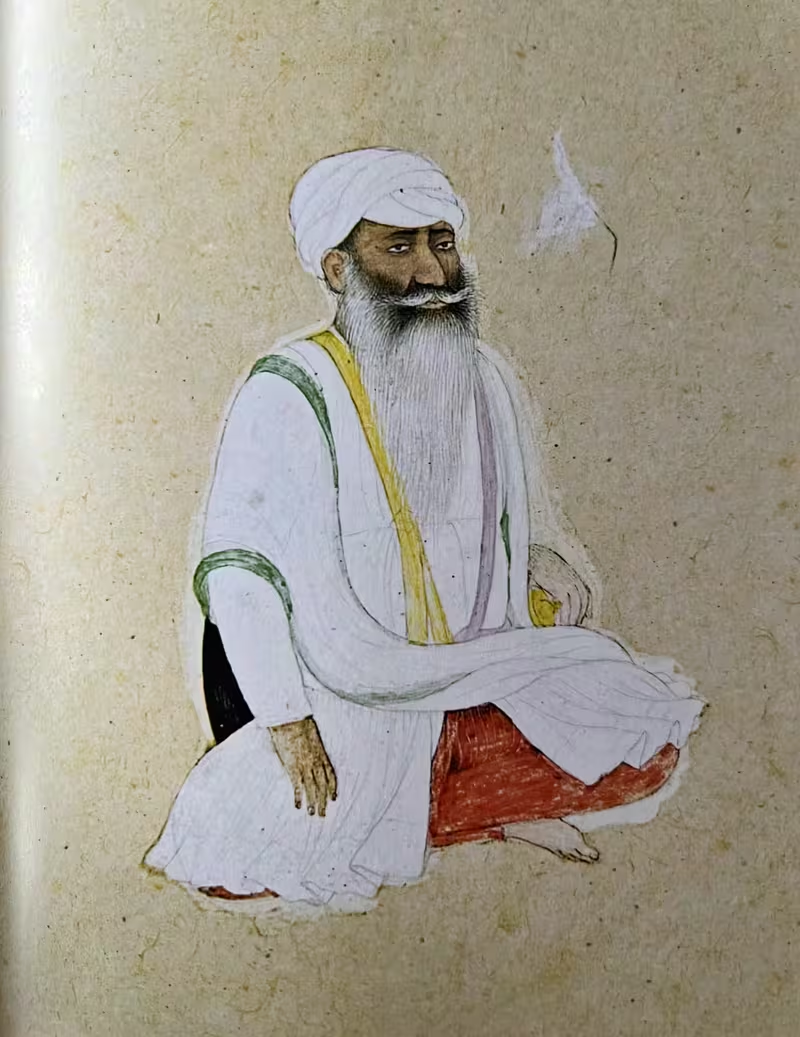
The White-Clad Lion of Sobraon: The Saga of Sham Singh Attariwala
In the grand tapestry of the Sikh Empire, woven with threads of conquest, glory, and courtly splendour, few figures stand as tall or as tragic as Sham Singh Attariwala. He was a man forged in the crucible of Maharaja Ranjit Singh’s expanding kingdom, a pillar of the old guard who embodied the martial spirit and unwavering loyalty of the Khalsa. Yet, his final and most defining act was not one of victory, but of sacrifice—a spectacular, defiant last stand against a backdrop of betrayal, marking the twilight of a mighty empire. His story is not just a biography of a general; it is the eulogy of an era.
Early Life & Forging of a Warrior
Sham Singh was born in 1790 in the village of Attari in the Majha region of Punjab, the heartland of the Sikh faith. He belonged to the Sidhu Jat clan, a family with a proud martial lineage. His father, Sardar Nihal Singh, was a respected nobleman in the service of the Sukerchakia Misl, the confederacy from which Maharaja Ranjit Singh would rise to forge his empire. From a young age, Sham Singh was immersed in the Sikh traditions of seva (service) and shastar vidya (the art of weaponry).
His formative years coincided with the meteoric rise of Ranjit Singh. The air in Punjab was thick with the ambition of building a sovereign Sikh state, a kingdom that would stretch from the Khyber Pass to the plains of the Sutlej. Sham Singh joined the Maharaja’s service around 1803, entering a court and an army that were dynamic, meritocratic, and constantly on the move. Under the tutelage of his father and the demanding standards of the Maharaja, he quickly distinguished himself. He was not merely a warrior but a keen student of military strategy and statecraft, learning the delicate balance of power that held the Lahore Durbar together.
Career in the Khalsa Army: A Pillar of the Empire
Sham Singh’s career was a mirror of the Sikh Empire's expansion. He was present at nearly every significant military campaign that defined its borders and cemented its authority. His valour was not just a matter of record but of legend, earning him the trust of the Maharaja and vast jagirs (land grants) that made the Attariwala family one of the most powerful in the kingdom.
The Conquest of Multan (1818): One of his first major tests came during the brutal siege of Multan. The fortress, under the command of the Afghan governor Nawab Muzaffar Khan, was considered impregnable. The Khalsa army laid siege for months, and in the final, bloody assault, Sham Singh was at the forefront, scaling the walls and fighting with conspicuous bravery. Though he was severely wounded in the battle, his contribution was instrumental in a victory that brought the entire region of southern Punjab under Sikh control.
The Kashmir Campaign (1819): A year later, he was a key commander in the expedition to conquer Kashmir. Leading a division of troops through the treacherous mountain passes, he played a crucial role in defeating the Afghan governor Jabbar Khan. The annexation of the Kashmir Valley was a monumental achievement for Ranjit Singh, adding a priceless jewel to his crown, and Sham Singh's reputation as a reliable and brilliant field commander was sealed.
Securing the North-West Frontier: The most turbulent border of the empire was the North-West Frontier, a land of fierce Pashtun tribes and the gateway for Afghan invasions. Sham Singh spent years campaigning in this hostile territory. He fought in the pivotal Battle of Nowshera in 1823, a decisive Sikh victory that broke the power of the Afghan tribes and established Sikh dominance over the Peshawar valley. His continued service in the region helped to pacify it, a task that required not only military might but also immense administrative and diplomatic skill.
His influence was not confined to the battlefield. At the Lahore Durbar, he was a respected voice of reason and integrity. This status was spectacularly affirmed in March 1837, when his daughter, Nanki Kaur, was married to Prince Nau Nihal Singh, the grandson and heir-apparent of Maharaja Ranjit Singh. The wedding was an event of unparalleled magnificence, intended to display the power and wealth of the Sikh Empire to the world. British and other foreign dignitaries who attended wrote of the staggering displays of jewels, the endless days of feasting, and the sheer scale of the celebrations, which reportedly cost the state an immense fortune. For the Attariwala family, it was the zenith of their prestige, cementing their bond with the royal house.
The Anarchy and the Call to Duty
The death of Maharaja Ranjit Singh in 1839 plunged the empire into a dark period of intrigue and bloodshed known as the Sikh anarchy. The unifying force of the 'Lion of Punjab' was gone, and the court fractured into warring factions. A succession of rulers were assassinated, and the powerful Dogra brothers and the Sandhanwalia Sardars vied for control. The Khalsa army, once a disciplined force of conquest, became a king-making entity, its loyalty bought and sold by ambitious courtiers.
Disgusted by the treachery and moral decay that had gripped the Lahore Durbar, Sham Singh Attariwala largely withdrew from public life, retiring to his estate at Attari. He was a man of the old school, his loyalty pledged to the throne of Ranjit Singh and the ideals of the Khalsa, not to the corrupt cabal that now ran the state. He watched with a heavy heart as the kingdom he had helped build began to crumble from within.
By 1845, the situation had become untenable. The British East India Company, ever watchful from across the Sutlej River, saw an opportunity in the chaos. The leadership in Lahore, particularly the treacherous Wazir Lal Singh and the Commander-in-Chief Tej Singh, saw war with the British as a way to distract the unruly Khalsa army and, perhaps, to destroy it, thereby securing their own power. They goaded the army into crossing the Sutlej, initiating the First Anglo-Sikh War.
After a series of battles marked by Sikh valour but compromised by incompetent and treacherous leadership, the Khalsa army was pushed back to the banks of the Sutlej at Sobraon. With defeat looming, a desperate summons was sent to the old general at Attari. Though he was now in his mid-fifties, and knew the war was being deliberately lost by its commanders, his sense of honour and duty was absolute. He made a solemn vow before the Guru Granth Sahib: he would return from Sobraon victorious or not at all.
The Last Stand at Sobraon
On the morning of 10 February 1846, Sham Singh Attariwala rode onto the battlefield of Sobraon. He was dressed not in armour, but in immaculate white—the colour of martyrdom in Sikh tradition. He was a striking figure, with his flowing white beard and unwavering gaze, a living embodiment of the empire's fading glory.
The Sikh position at Sobraon was a strong, well-entrenched semi-circle, its back to the Sutlej River, connected to the far bank by a single, fragile pontoon bridge. The British, under Commander-in-Chief Sir Hugh Gough, launched a ferocious assault, meeting resistance of a kind they had rarely encountered in India. The Khalsa soldiers fought with desperate courage, repelling charge after charge.
But betrayal sealed their fate. As the battle raged, Tej Singh, the Sikh Commander-in-Chief, fled the field. In an act of ultimate treachery, he ordered the pontoon bridge behind the Sikh army to be destroyed, cutting off their only route of retreat. Trapped between the British guns and the swollen river, the Sikh soldiers were doomed.
It was in this moment of utter despair that Sham Singh Attariwala made his final, immortal stand. Seeing the bridge broken and the commanders flee, he knew all was lost. But surrender was not an option. Roaring the Sikh war cry, “Bole So Nihal, Sat Sri Akal!”, he rallied the men around him. Astride his steed, a beacon in white, he charged towards the enemy, sword in hand, inspiring his soldiers to fight to the last man rather than suffer the dishonour of flight or capture.
He plunged into the thick of the fighting, cutting down enemy soldiers before he was finally overwhelmed. British officers who witnessed the scene were awestruck by his courage. Joseph Davey Cunningham, a contemporary historian, wrote that Sham Singh “rallied the flying, and renewed the combat wherever his personal presence could be of avail... he showed himself the worthy leader of the champions of his country.”
He fell, riddled with bullets. His body was recovered from amidst a pile of the slain, a testament to the ferocity of his last stand. With him died the spirit of the independent Khalsa army and the dream of Ranjit Singh.
Legacy: The Symbol of Honour
The death of Sham Singh Attariwala was more than the death of a general; it was the death of an ideal. In a war defined by the treachery of its leaders, his sacrifice stood out as a singular act of pure, unblemished honour. He became an instant legend, a martyr for the Sikh Panth whose name was immortalised in folk ballads (vaars) sung across Punjab.
His legacy is one of stark contrast. He represents the best of the Sikh Empire—its martial prowess, its unwavering loyalty, its code of honour. The men who betrayed him, Lal Singh and Tej Singh, are remembered in Punjabi history as the vilest of traitors. Sham Singh’s story serves as the ultimate cautionary tale of how internal corruption can destroy what no external enemy can conquer.
Today, Sham Singh Attariwala is revered as one of the great heroes of Sikh history. His samadh (memorial) in Attari is a place of pilgrimage. He is remembered not for the battles he won, but for the one he chose to lose in the most honourable way imaginable—fighting for the dignity of his people, a white-clad lion roaring defiance in the face of certain death.