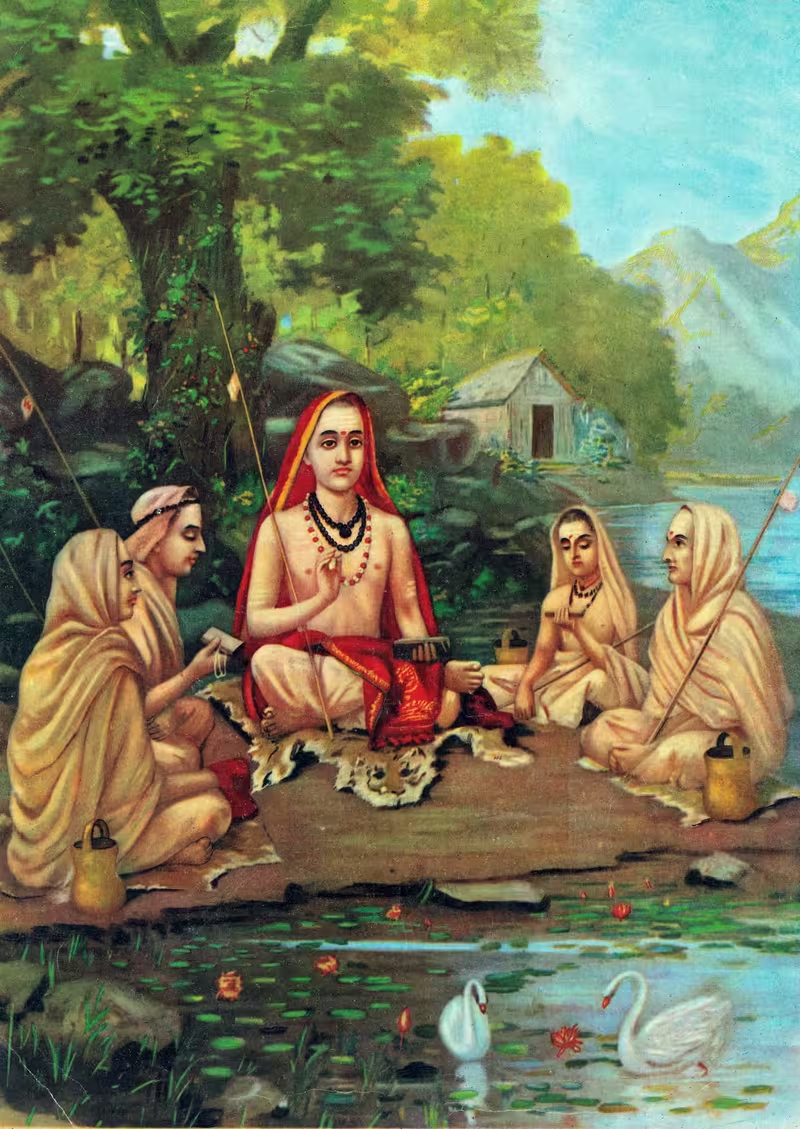
The Enduring Legacy of the Shankaracharya
In the vast tapestry of Indian history and philosophy, few figures cast as long a shadow as Shankaracharya. The name itself resonates with profound intellectual authority and spiritual leadership. However, to speak of Shankaracharya is to speak of two distinct yet inextricably linked concepts: a singular, revolutionary philosopher known as Adi Shankara, and the enduring institution he created—a lineage of pontiffs who continue to hold the title of Shankaracharya to this day. This is the story of a boy-sage who unified a subcontinent's spiritual landscape and the powerful legacy he bequeathed to India.
Early Life & Background: The Rise of a Prodigy
While the exact dates of his life are a subject of scholarly debate, mainstream historical consensus places Adi Shankara in the 8th century CE, likely between 788 and 820 CE. He was born into a Nambudiri Brahmin family in the serene village of Kalady, nestled on the banks of the Periyar River in modern-day Kerala. Traditional accounts name his parents as Sivaguru and Aryamba.
From his earliest years, Shankara displayed a prodigious intellect. He is said to have mastered all four Vedas and the Vedangas (the six auxiliary disciplines) by the age of eight, an unheard-of feat that marked him as a once-in-a-generation mind. Yet, his heart was not set on the life of a householder. He was deeply drawn to the path of sannyasa, or complete renunciation, a decision that met with resistance from his widowed mother.
A famous hagiographical account illustrates his unwavering resolve. While bathing in the river, a crocodile seized his leg. He cried out to his mother that he would only be released if she granted him permission to become a renunciate. Fearing for his life, she tearfully agreed, and the crocodile miraculously let him go. This event, whether literal or allegorical, symbolizes Shankara's release from worldly obligations to pursue his spiritual destiny.
Leaving home, the young Shankara traveled north in search of a guru who could initiate him into the formal path of monasticism. His journey led him to the banks of the Narmada River, where he found his master, Govinda Bhagavatpada. Under Govinda's tutelage, Shankara delved into the profound philosophy of Advaita Vedanta, a non-dualistic school of thought rooted in the Upanishads. He quickly absorbed his guru's teachings and was soon tasked with a monumental mission: to write a definitive commentary on the Brahma Sutras and propagate the truth of Advaita across the length and breadth of India.
Career & Major Contributions: The Architect of a Philosophical Renaissance
Shankara's career was a whirlwind of intellectual activity, travel, and organization that fundamentally reshaped the religious and philosophical landscape of India. His contributions can be understood through three primary domains: his philosophy, his writings, and his institutional framework.
The Philosophy of Advaita Vedanta
At the heart of Shankara's contribution is his masterful exposition of Advaita Vedanta. It is a radically non-dualistic system that posits a single, ultimate reality: Brahman. Shankara's genius lay in his ability to logically and systematically argue for this truth based on the foundational scriptures of Hinduism—the Upanishads, the Brahma Sutras, and the Bhagavad Gita (collectively known as the Prasthanatrayi).
His core tenets can be summarized in a famous half-verse: Brahma Satyam, Jagan Mithya, Jivo Brahmaiva Naparah (Brahman is the only reality, the world is an illusory appearance, and the individual self is nothing but Brahman).
- Brahman: The ultimate, unchanging, attributeless, and absolute reality. It is the substratum of all existence.
- Atman: The individual self or soul, which, due to ignorance (avidya), appears to be separate and distinct.
- Maya: The cosmic illusion or creative power of Brahman that makes the singular reality appear as the diverse, pluralistic world of names and forms that we experience through our senses.
Shankara used powerful analogies to explain these subtle concepts. The world, he argued, is like a snake mistakenly perceived in a rope in the dim light. The rope is Brahman, the snake is the world, and the misperception is Maya. Once the light of knowledge (jnana) dawns, the snake vanishes, and only the rope remains. Similarly, through self-realization, one understands that the individual Atman was never separate from the universal Brahman.
The Luminous Commentaries and Works
To establish Advaita as the preeminent school of Hindu philosophy, Shankara produced a body of work renowned for its intellectual rigor, logical precision, and spiritual insight. His most significant works are his bhashyas (commentaries) on the Prasthanatrayi.
- Brahmasutra Bhashya: Considered his magnum opus, this commentary on Badarayana's terse Brahma Sutras is a masterpiece of philosophical argumentation. In it, he systematically refutes the doctrines of other major schools of thought, including Samkhya, Vaisheshika, Buddhism, and Jainism, while firmly establishing the non-dualistic interpretation of the sutras.
- Commentaries on the Upanishads: He wrote brilliant commentaries on the ten principal Upanishads, including the Brihadaranyaka, Chandogya, and Mandukya, unlocking their profound non-dualistic message.
- Bhagavad Gita Bhashya: His commentary on the Gita interprets the text through an Advaitic lens, emphasizing the path of knowledge (Jnana Yoga) as the direct means to liberation.
Beyond these, several introductory texts (Prakarana Granthas) like Vivekachudamani (Crest-Jewel of Discrimination) and devotional hymns (stotras) like Bhaja Govindam are traditionally attributed to him, though modern scholarship sometimes questions the authorship of some. These works made the lofty philosophy of Advaita accessible to a wider audience.
The Four Mathas: Pillars of a Unified Tradition
Shankara was not just a philosopher; he was a visionary organizer. To ensure the preservation and propagation of his teachings for millennia, he embarked on a Digvijaya (tour of victory), traveling across the Indian subcontinent, engaging in scholarly debates (shastrartha), and establishing centers of learning. His most enduring organizational achievement was the establishment of four principal monasteries, or Amnaya Peethams, in the four cardinal directions of India.
- Sringeri Sharada Peetham: Located in the south (Karnataka), associated with the Yajurveda.
- Dwaraka Sharada Peetham: Located in the west (Gujarat), associated with the Samaveda.
- Jyotir Math Peetham: Located in the north (Uttarakhand), associated with the Atharvaveda.
- Govardhan Peetham: Located in the east (Puri, Odisha), associated with the Rigveda.
These mathas were not merely monasteries; they were designed as spiritual and intellectual citadels, each responsible for safeguarding a Veda and a key Upanishadic teaching (mahavakya). He appointed his four most senior disciples as the first heads of these institutions, bestowing upon them the title of Shankaracharya. This created a structured, self-perpetuating system for the transmission of Advaitic knowledge and spiritual authority.
Furthermore, he is credited with organizing wandering ascetics into the Dashanami Sampradaya, ten distinct orders (e.g., Giri, Puri, Bharati, Tirtha) that provided structure and discipline to Hindu monasticism.
Legacy & Influence: The Eternal Philosopher
Adi Shankara is believed to have left his mortal body at the young age of 32, but his impact has been immeasurable and eternal.
Historical Significance
Shankara's work came at a time of great religious and philosophical ferment in India. He is widely credited with halting the decline of Vedic thought and providing Hinduism with a unifying philosophical backbone. By synthesizing the disparate strands of belief—worship of Vishnu, Shiva, Shakti, Ganesha, and Surya—within the overarching framework of Advaita, he championed a form of Smartism that saw all deities as different manifestations of the one formless Brahman. This intellectual synthesis provided a powerful counter-narrative to the influence of Buddhist and Jain philosophies, revitalizing the Hindu tradition from within.
His establishment of the mathas created a pan-Indian network that fostered cultural and spiritual integration. These centers became hubs of Sanskrit learning, manuscript preservation, and philosophical discourse, binding the subcontinent together with a shared intellectual heritage.
The Enduring Title of Shankaracharya
The most visible aspect of his legacy is the continuing institution of the Shankaracharyas. The heads of the four cardinal mathas (and other derivative mathas) continue to bear this title. They are the foremost authorities on Advaita Vedanta and are regarded as the spiritual leaders of a significant portion of the Hindu community. They are not just administrators but are expected to be profound scholars and spiritual guides, continuing the tradition of teaching and commentary initiated by Adi Shankara.
In contemporary India, the Shankaracharyas are highly respected figures. They play a crucial role in preserving orthodox Hindu traditions, overseeing religious rituals, and offering spiritual guidance to millions. They are often consulted on matters of religious doctrine and social custom, and their pronouncements carry immense weight among their followers. They represent a living link to the 8th-century sage, an unbroken chain of tradition—guru-shishya parampara—stretching back over 1,200 years.
Adi Shankara was more than a philosopher; he was a spiritual unifier, a brilliant commentator, and an institutional architect. Through his profound insight and tireless efforts, he established Advaita Vedanta as a pinnacle of Indian philosophical achievement. The title he created, Shankaracharya, continues to be a beacon of this tradition, symbolizing the enduring power of knowledge, renunciation, and the timeless quest for the ultimate reality.