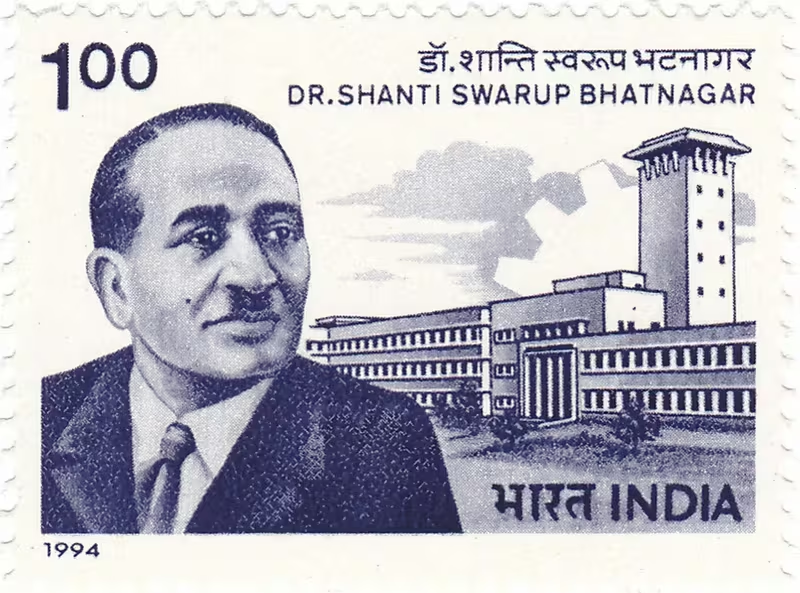
Shanti Swarup Bhatnagar - Pioneer of Indian Scientific Research
In the grand tapestry of modern India, woven with the threads of independence, industrialisation, and intellectual awakening, few figures stand as tall as Sir Shanti Swarup Bhatnagar (1894-1955). More than a brilliant chemist, he was a visionary, an institution-builder, and the chief architect of the scientific infrastructure that would power a newly sovereign nation. While Jawaharlal Nehru famously called the new dams and factories the "temples of modern India," it was Bhatnagar who laid the foundation and built the sanctum sanctorum for scientific research—a sprawling network of national laboratories that remains his most enduring monument. His life is a testament to the power of a single individual's will to bridge the gap between pure science and national progress, earning him the revered title, the "Father of Research Laboratories in India."
Early Life & The Making of a Scientist
Shanti Swarup Bhatnagar was born on February 21, 1894, in Bhera, a part of the Shahpur district in Punjab, British India (now in Pakistan). His early life was marked by tragedy; his father, Parmeshwari Sahai Bhatnagar, a respected headmaster, passed away when Shanti Swarup was a mere eight months old. This profound loss led to him being raised in the household of his maternal grandfather, Munshi Pyare Lal, in Sikandrabad, Uttar Pradesh.
This change of fortune proved to be a crucible for his scientific curiosity. His grandfather was an engineer, and his home was a wonderland of instruments, gadgets, and intellectual inquiry. Young Shanti Swarup was not merely an observer but an active participant. He spent his childhood dismantling and reassembling mechanical toys, building rudimentary telegraphs, and tinkering with electric batteries. This hands-on, empirical education, fostered by his grandfather's patient guidance, instilled in him a deep-seated love for science and engineering that would define his life's trajectory.
His formal education began at the D.A.V. High School in Sikandrabad, but his academic prowess truly blossomed in Lahore. He joined the Dayal Singh College and later the prestigious Forman Christian College, where he earned his Bachelor of Science in Physics in 1916 and a Master of Science in Chemistry in 1919. It was here that he came under the tutelage of inspiring mentors like Professor J.M. Benade and the eminent Professor Ruchi Ram Sahni, who nurtured his scientific talent. Even as a student, his multifaceted abilities were evident. A keen poet and dramatist, he translated the scientific play Karamat (Wonder), winning a prize of Rs. 500 from the Saraswati Stage Society—a sum that would later help fund his voyage for higher studies.
In 1919, armed with a scholarship from the Dayal Singh College Trust, Bhatnagar set sail for England. He enrolled at University College London (UCL) to study under the world-renowned physical chemist, Professor Frederick G. Donnan. Immersed in one of the world's leading centres for scientific research, he thrived. In 1921, he was awarded the Doctor of Science (D.Sc.) from the University of London for his pioneering thesis on the surface tension of oils, a field where he would later make significant industrial contributions.
A Career Forged in Service to Science and Nation
Returning to India in August 1921, Dr. Bhatnagar was appointed Professor of Chemistry at the newly founded Banaras Hindu University (BHU). In just three years, he transformed the department, establishing a vibrant school of research in physical chemistry and inspiring a generation of young students. His reputation as both a brilliant researcher and an able administrator began to grow.
In 1924, he was invited to the University of the Punjab in Lahore as a Professor of Physical Chemistry and, later, the Director of the University Chemical Laboratories. The sixteen years he spent in Lahore represented the zenith of his career as a research scientist. His work spanned diverse fields, but he made his most indelible marks in magneto-chemistry and applied colloid chemistry.
One of his most significant inventions from this period was the Bhatnagar-Mathur Magnetic Interference Balance. Co-developed with his student K.N. Mathur, this instrument was remarkably sensitive, capable of measuring magnetic properties with high precision. It was not merely an academic curiosity; its practical utility was immediately recognized. The London-based company Steel Brothers & Co. used the device for geological surveys and mineral prospecting, a testament to Bhatnagar's core belief in applying scientific principles to solve real-world problems.
It was this focus on industrial application that earned him national fame. The Attock Oil Company (later Burmah Oil Company) was facing a critical drilling problem. The mud they used as a lubricant would inexplicably solidify upon contact with the underground saline formations, causing the expensive drilling equipment to seize up. The problem had stumped their best engineers. In desperation, they turned to Professor Bhatnagar's laboratory.
With his profound understanding of colloids and emulsions, Bhatnagar diagnosed the issue and developed an ingenious solution: an oleocolloid, a substance that, when added to the drilling mud, lowered its viscosity and prevented it from solidifying in the saline environment. The solution worked flawlessly. The grateful company offered him a handsome reward of Rs. 1,50,000—a fortune at the time. In an act of extraordinary selflessness and foresight, Bhatnagar refused the money for himself. Instead, he had the sum directed to the university, which used it to establish a dedicated Department of Petroleum Research. This single act cemented his reputation as a scientist whose primary loyalty was not to personal gain but to the advancement of scientific research in India.
His contributions did not go unnoticed by the British administration. He was made an Officer of the Order of the British Empire (OBE) in 1936 and was conferred a knighthood in 1941, thereafter to be known as Sir Shanti Swarup Bhatnagar.
Architect of India's Scientific Infrastructure
The outbreak of the Second World War in 1939 exposed the critical weaknesses in India's industrial base, which was heavily dependent on imports. Recognizing the urgent need for domestic scientific and industrial research, the colonial government established the Board of Scientific and Industrial Research (BSIR) in 1940, with Sir Shanti Swarup as its Director.
But Bhatnagar’s vision was far grander. He envisioned an autonomous, powerful national organization that could drive India's industrial future. With the crucial support of Sir Arcot Ramaswami Mudaliar, the Commerce Member of the Viceroy's Executive Council, his vision became a reality. On September 26, 1942, the Council of Scientific and Industrial Research (CSIR) was born as an autonomous body, with Bhatnagar as its first Director (later Director-General).
With India's independence in 1947, Bhatnagar's mission acquired a new, electrifying urgency. He found a powerful and enthusiastic patron in Prime Minister Jawaharlal Nehru, who saw science and technology as the twin engines of national development. The partnership between the visionary scientist and the statesman-politician would change the face of Indian science forever.
What followed was a period of breathtakingly rapid institution-building. Bhatnagar, with his boundless energy and persuasive charm, embarked on a mission to create a chain of national laboratories, each dedicated to a specific field of research. He travelled the length and breadth of the country, identifying locations, securing land, raising funds, and recruiting top scientific talent. He was a master of navigating the labyrinthine bureaucracy of the newly formed government, famously employing a tactic of asking ministries for a token grant of one rupee to approve a project in principle, only to return later for the full funds once the project was on the books.
In the first few years of independence, a dozen world-class laboratories were planned and established under his direct supervision. This first wave included:
- National Chemical Laboratory (NCL) in Pune
- National Physical Laboratory (NPL) in New Delhi
- Central Food Technological Research Institute (CFTRI) in Mysore
- Central Fuel Research Institute (CFRI) in Dhanbad
- Central Glass and Ceramic Research Institute (CGCRI) in Kolkata
- National Metallurgical Laboratory (NML) in Jamshedpur
These institutions were the physical embodiment of Nehru's 'scientific temper' and Bhatnagar's tireless execution. He was not just a director; he was the chief architect, engineer, and project manager, personally overseeing every detail from the blueprint to the inauguration.
Legacy & Enduring Influence
Sir Shanti Swarup Bhatnagar passed away from a heart attack on January 1, 1955, at the age of 60. He had literally worked himself to the end in the service of his nation. But his legacy was already cast in stone and steel across the Indian landscape.
His most tangible legacy is the CSIR network, which has grown into one of the world's largest publicly funded research and development organizations. The laboratories he founded continue to be at the forefront of scientific innovation in India, contributing to everything from space exploration and defence technology to agriculture and medicine.
To honour his immense contribution, the CSIR instituted the Shanti Swarup Bhatnagar Prize for Science and Technology in 1958. Awarded annually to scientists under the age of 45 for outstanding contributions, it is widely considered the most coveted and prestigious science prize in India. His name remains a benchmark for excellence, inspiring generations of young researchers.
Beyond the CSIR, Bhatnagar's influence permeated the entire structure of Indian science and education policy. He served as the Secretary of the Ministry of Education and, in 1953, was appointed the first-ever Chairman of the University Grants Commission (UGC), the apex body for coordinating and maintaining standards of higher education in India. In 1954, a year before his death, the Government of India bestowed upon him the Padma Vibhushan, the nation's second-highest civilian honour.
Sir Shanti Swarup Bhatnagar was a rare combination of a first-rate scientist and a first-rate administrator. He was a poet who understood patents, a professor who could persuade politicians, and a patriot who saw laboratories as instruments of national liberation. He laid the very foundation upon which India’s modern scientific enterprise was built, and his work continues to shape the country's journey towards becoming a global scientific power.