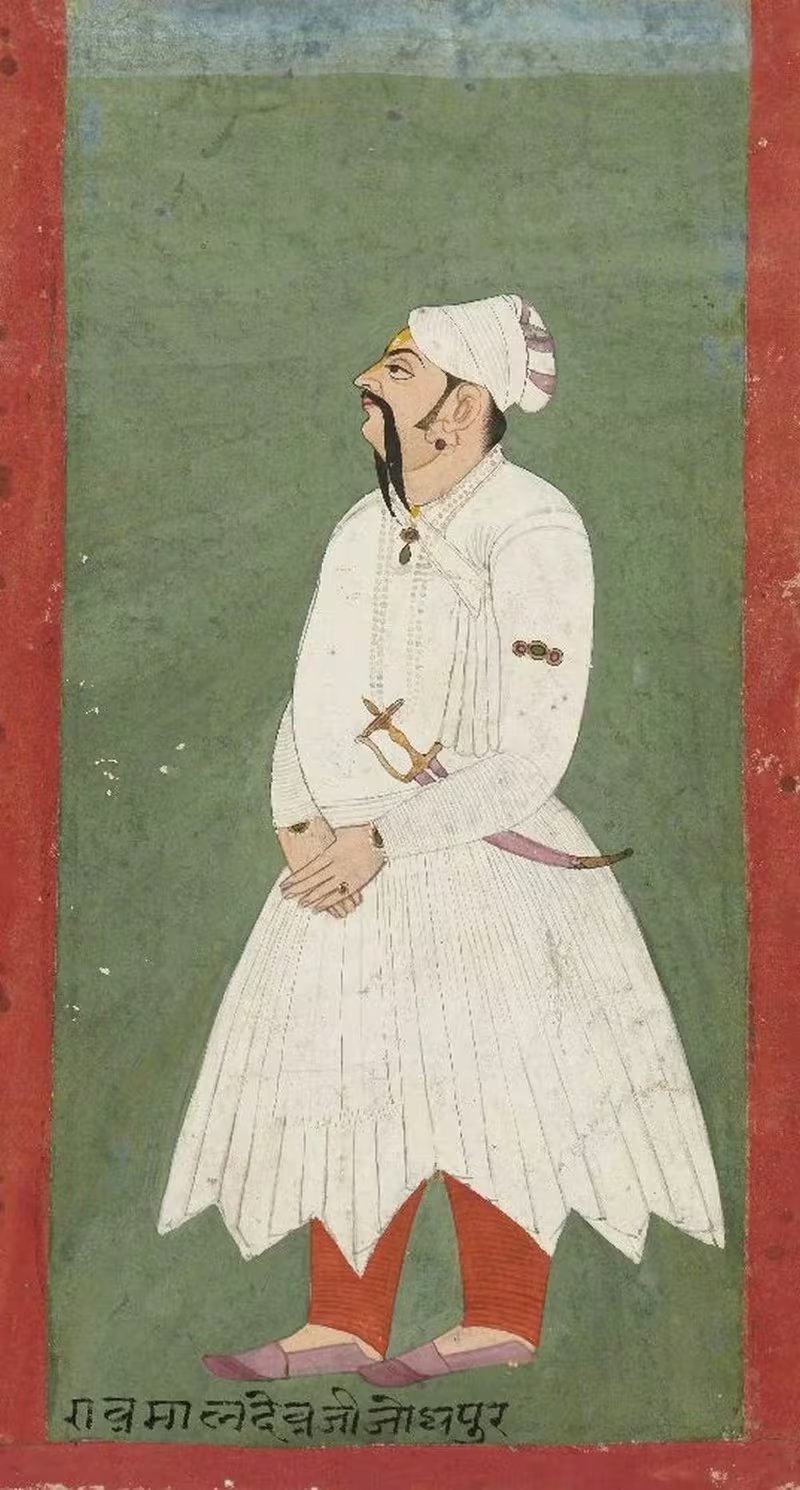
Sher Shah Suri: The Afghan Lion Who Forged an Empire
In the grand tapestry of Indian history, the sixteen-year interlude between the first and second reigns of the Mughal emperor Humayun is often dominated by one towering figure: Farid al-Din Sher Shah Suri. He was more than a mere usurper; he was an administrative visionary, a military genius, and the architect of a system of governance so profound that it would be emulated by the very dynasty he unseated. In a brief but brilliant reign of just five years, Sher Shah, the “Lion King,” rose from the son of a minor jagirdar to become the Sultan of Hindustan, leaving an indelible mark on the subcontinent's political, economic, and infrastructural landscape.
Early Life & The Forging of a Leader
Born Farid Khan in 1472, his beginnings gave little hint of the imperial destiny that awaited him. His grandfather, Ibrahim Khan Sur, was a horse trader from the Pashtun Sur tribe of Afghanistan who had migrated to India seeking opportunity. His father, Hasan Khan, served the Lodi Sultans and held a small jagir (land grant) at Sasaram in Bihar. Farid’s childhood was marred by domestic strife; he was one of eight sons, and his father’s preference for the children of a younger wife created a tense and unhappy home.
Frustrated and seeking his own path, the ambitious young Farid left Sasaram for Jaunpur, then a major center of Islamic learning often called the “Shiraz of the East.” Here, he immersed himself in the study of Arabic and Persian, memorizing the classic poetic works of Saadi and delving into the histories of great rulers. This period was not just an academic exercise; it was the crucible in which his principles of justice and governance were forged. He learned that the stability of a kingdom rested not just on the strength of its army, but on the prosperity and security of its peasantry.
Impressed by his son’s scholarly reputation, Hasan Khan recalled him and entrusted him with the administration of his two parganas (districts). It was here, in the dusty fields of Sasaram, that Farid first put his theories into practice. He bypassed the corrupt and powerful local chieftains (zamindars), dealing directly with the cultivators. He had the land meticulously measured and fixed the state’s revenue share based on its productivity, ensuring a predictable tax for the peasant and a steady income for the treasury. He was ruthless with rebellious zamindars but famously just with the common people. His success was immediate and remarkable, a small-scale rehearsal for the imperial reforms he would one day enact across all of North India.
The Ascent to Power: From General to Emperor
Following his father's death, renewed family disputes forced Farid to seek new patronage. He entered the service of Bahar Khan Lohani, the governor of Bihar, who soon declared independence from the crumbling Lodi Sultanate. It was in Bahar Khan's court that Farid earned the name that would echo through history. According to legend, he saved his patron's life by killing a tiger single-handedly during a hunt, earning him the title Sher Khan (Tiger Lord).
The political landscape of the 1520s was a whirlwind of shifting alliances. Babur’s victory at Panipat in 1526 had shattered the Lodi Sultanate and established the Mughal Empire. For a time, Sher Khan astutely entered Mughal service, an experience that proved invaluable. He was a keen observer, studying the Mughal military machine from the inside—its reliance on artillery, its command structure, and its internal political weaknesses. He famously noted that the Mughals were not invincible and, if fortune favored him, he could drive them from India.
Returning to Bihar, he became the de facto ruler as the regent for Bahar Khan’s minor son. His power grew steadily, built on a loyal Afghan following and a reputation for competence. A decisive moment came at the Battle of Surajgarh in 1534, where his small force outmaneuvered and crushed the much larger army of the Sultan of Bengal. The victory gave him control of Bihar and immense wealth, transforming him from a regional player into a major contender for power. His strategic acquisition of the formidable Chunar Fort, through a politically savvy marriage to the widow of its commander, gave him an anchor in the heart of the Ganges valley.
The new Mughal emperor, Humayun, finally recognized the grave threat Sher Khan posed. In 1537, Humayun besieged Chunar, but Sher Khan’s brilliant defensive strategy delayed the emperor for months, allowing Sher Khan to consolidate his hold on the wealthy province of Bengal. What followed was a masterclass in military strategy. While Humayun occupied the Bengali capital of Gaur, Sher Khan systematically cut off his supply lines, trapping the Mughal army far from its base in Delhi.
The climax came at the Battle of Chausa in 1539. Feigning a retreat, Sher Khan launched a surprise dawn attack on the unprepared Mughal camp. The result was a total rout. The Mughal army was annihilated, and Humayun himself barely escaped by plunging into the Ganges, saved from drowning by a humble water-carrier. After this stunning victory, Sher Khan proclaimed himself Sher Shah Sultan-e-Adil (The Just King).
The final confrontation occurred a year later at the Battle of Kannauj in 1540. Once again, Sher Shah’s superior tactics and the high morale of his Afghan troops triumphed over a larger but disorganized Mughal force. Humayun was defeated decisively and forced into an exile that would last for fifteen years. At the age of 68, Sher Shah Suri entered Delhi as the undisputed ruler of Hindustan.
The Sur Empire: A Legacy of Governance
Sher Shah’s five-year reign was a whirlwind of relentless activity, focused on building a state that would last. His reforms were so comprehensive and far-reaching that they became the foundation upon which the great Mughal emperor Akbar would later build his own empire.
Administrative and Revenue Reforms: His central achievement was a rational and just system of administration. He divided his empire into provinces (sarkars) and districts (parganas), with officials appointed to maintain law, collect revenue, and dispense justice. His genius, however, lay in his land revenue system. He instituted a systematic survey and measurement of all agricultural land. The land was classified into three categories—good, middling, and bad—and the state’s share, typically one-third of the average produce, was fixed. Each peasant was given a formal deed (patta) stating the tax owed, and in return, they signed an agreement (qabuliyat). This system protected the farmers from arbitrary exactions and provided the state with a stable, predictable source of income.
Economic and Infrastructural Development: Sher Shah understood that a strong state required a vibrant economy. He standardized the currency, introducing a high-purity silver coin called the rupiya and a copper coin called the dam. This silver rupee, weighing 178 grains, was of such quality that it became the standard for centuries, its name and form enduring through the Mughal and British periods to the present day.
To foster trade, he abolished all internal customs duties, streamlining commerce across his vast empire. His most visible legacy was in infrastructure. He restored and extended the ancient Mauryan highway, the Uttarapatha, renaming it Sadak-i-Azam (The Great Road)—the precursor to the famous Grand Trunk Road. This arterial route, stretching over 2,500 kilometers from Sonargaon in Bengal to the Indus, was the lifeline of the empire. He had sarais (inns) built at every two kos (approximately every eight kilometers). These were not mere rest stops; they were fortified complexes with separate lodgings for Hindus and Muslims, wells, mosques, and state-supplied grain for travelers and fodder for their animals. The sarais also functioned as stations for the imperial post (dak chowki), allowing news and intelligence to travel with astonishing speed.
Justice and Military: Sher Shah’s reputation for impartial justice was legendary. He was the highest court of appeal and was known to be mercilessly fair, punishing even his own relatives if they transgressed the law. He rebuilt the army as a disciplined, professional force paid directly from the central treasury. To eliminate corruption, he revived the system of branding army horses (dagh) and maintaining detailed descriptive rolls of soldiers (chehra), ensuring that commanders could not cheat the state by mustering proxies on payday.
Architecture: His reign marked a brilliant transition in Indo-Islamic architecture. The Qila-i-Kuhna mosque in Delhi's Purana Qila (which he largely built) is a masterpiece of harmony and refined decoration. For defense, he constructed the massive Rohtas Fort in modern-day Pakistan, a UNESCO World Heritage site. But his crowning architectural achievement is his own mausoleum in Sasaram. A majestic, five-storied octagonal tomb set in the middle of a large artificial lake, it is a monument of sublime power and grace, a fitting final resting place for a ruler of his stature.
Final Campaign and Death
In 1545, Sher Shah laid siege to the powerful Rajput fortress of Kalinjar in Bundelkhand. The siege was long and arduous. On May 22, 1545, as he directed the bombardment, a stray rocket rebounded from the fort wall and landed in the ammunition dump where he was standing. The resulting explosion left him fatally burned. Even in his final moments, his indomitable will prevailed. He commanded his troops to press the attack, living just long enough to hear the news that the fort had fallen before he succumbed to his injuries.
Legacy and Influence
Sher Shah Suri’s empire did not long survive him. His successors lacked his vision and ability, and within a decade, a resurgent Humayun reclaimed the throne of Delhi for the Mughals. Yet, Sher Shah’s true legacy was not his dynasty, but his system.
When Akbar the Great began to consolidate the Mughal Empire, he did not have to invent a system of governance from scratch. He adopted and refined Sher Shah’s land revenue system, his currency, his provincial administration, and his policies on trade and infrastructure. In this sense, Sher Shah was the true administrative forerunner of the great Mughals. He demonstrated how India could be governed effectively, justly, and prosperously.
He is remembered today not as a fleeting conqueror, but as one of medieval India’s most capable and enlightened rulers—a man who, in just five years, laid an administrative blueprint that would shape the destiny of the Indian subcontinent for centuries to come.