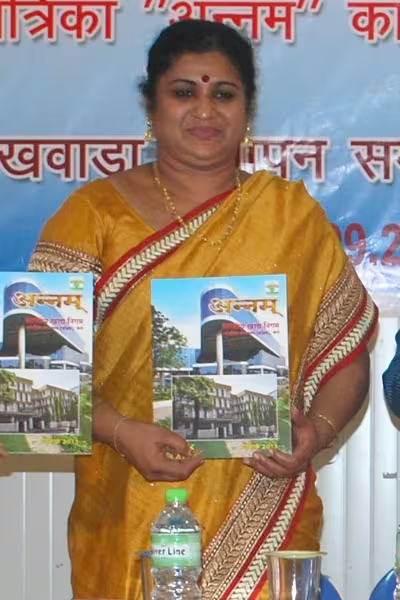
Shiny Wilson: The Enduring Queen of India's Middle Distance
In the grand tapestry of Indian athletics, certain names are woven in threads of pure gold, their legacies defined not just by medals and records, but by the barriers they shattered and the paths they forged. Shiny Kurisingal Wilson is one such luminary. For over a decade and a half, her elegant, powerful stride dominated the 400m and 800m tracks across Asia. A four-time Olympian, the first Indian woman to reach an Olympic semi-final, and a national record holder for a staggering quarter of a century, Shiny Wilson's career is a masterclass in talent, tenacity, and extraordinary longevity.
Her story is not merely one of athletic prowess; it is the story of a young girl from the verdant hills of Kerala who ran her way into the annals of Indian history, becoming a symbol of female empowerment and a beacon of hope for generations of aspiring athletes.
Early Life & The Making of a Champion
Shiny was born on May 8, 1965, in Thodupuzha, a town nestled in the Idukki district of Kerala. This was a region and an era brimming with athletic potential, a nursery that would produce some of India's greatest track and field stars. From a young age, Shiny displayed a natural aptitude for running, a raw talent that needed the right guidance to be sculpted into greatness.
Her journey began in earnest when she joined the sports division in Kottayam. It was here that she came under the tutelage of the visionary coach P.J. Devasia, who recognized the spark of a champion in her. The structured training and competitive environment provided the perfect crucible for her talent. Later, she moved to the prestigious G.V. Raja Sports School in Trivandrum, an institution renowned for honing the skills of Kerala's finest athletes.
This period was formative. The rigorous training regimens, the camaraderie with fellow athletes, and the single-minded focus on excellence shaped her both physically and mentally. She was part of a golden generation of Keralite athletes, including P.T. Usha and M.D. Valsamma, who pushed each other to new heights, creating a wave that would soon sweep across the national and international arenas.
A Meteoric Rise on the National Stage
Shiny's transition from a promising junior to a national champion was swift and decisive. By the early 1980s, she had established herself as the undisputed queen of the 800 metres in India. Her running style was a study in grace and power; a fluid, rhythmic motion that seemed to devour the track with effortless efficiency. While P.T. Usha was blazing a trail in the sprints and hurdles, Shiny made the middle-distance events her own personal fiefdom.
In 1981, at just 16, she was crowned the national champion in the 800m, a title she would fiercely defend for years to come. Her dominance was absolute. She didn't just win; she redefined the limits of performance. This was powerfully demonstrated in 1985 when she set a new national record in the 800m, a mark that would remain unbroken for over 25 years until it was finally surpassed by her protégée, Tintu Luka, in 2010. This single statistic is perhaps the greatest testament to her exceptional talent and the sheer quality of her peak performance.
The Olympic Dream: A Four-Time Olympian
The Olympic Games represent the pinnacle of athletic ambition, and for Shiny Wilson, it was a stage she would grace an incredible four times, a feat of endurance and consistency rarely seen in Indian athletics.
1984 Los Angeles: At just 19, Shiny made her Olympic debut. She was not there merely to participate. In the 800m, she powered her way into the semi-finals, becoming the first Indian woman in history to advance past the initial heats in an individual event. It was a monumental achievement that announced her arrival on the world stage. Furthermore, she was a vital part of the Indian 4x400m relay team, alongside P.T. Usha, M.D. Valsamma, and Vandana Rao. The quartet blazed their way into the final, finishing seventh but proving that Indian women could compete with the world's best.
1988 Seoul: Her second Olympic appearance solidified her status as a veteran competitor, representing India with distinction.
1992 Barcelona: This was a moment of supreme honour. In recognition of her stature, her leadership, and her immense contribution to Indian sport, Shiny Wilson was chosen as the flag bearer for the Indian contingent at the opening ceremony. Leading her nation into the Olympic stadium was a poignant acknowledgment of her role as a senior stateswoman of Indian athletics.
1996 Atlanta: Her final Olympic appearance was perhaps her most inspiring. Competing in her fourth Games after a break for motherhood demonstrated a level of dedication and passion that transcended the quest for medals. It cemented her legacy as an athlete of unparalleled longevity.
The Asian Arena: A Reign of Medals
While the Olympics showcased her global standing, it was on the tracks of Asia that Shiny Wilson's dominance was most tangible, her cabinet overflowing with medals from the continent's most prestigious competitions.
She competed in seven Asian Track and Field Championships, amassing an incredible haul of 14 medals: 7 Gold, 5 Silver, and 2 Bronze. From Jakarta in 1985 to Kuala Lumpur in 1991, she was a constant presence on the podium, often winning medals in the 400m, 800m, and the 4x400m relay at the same event.
The Asian Games were the backdrop for some of her most memorable and dramatic performances.
At the 1986 Seoul Asian Games, she was at the peak of her powers. She won a silver medal in the 400m and anchored the 4x400m relay team to a glorious gold. However, the 800m final became one of the most talked-about events of the Games. Leading the race and looking certain for gold, she inadvertently cut into the inner lane in the final stretch. Despite crossing the finish line first, she was heartbreakingly disqualified. It was a moment of profound disappointment, but her ability to recover and lead the relay team to victory just a day later spoke volumes of her mental fortitude.
She continued her medal-winning streak, securing a silver in the 400m at the 1990 Beijing Asian Games. Her most inspiring performance, however, came at the 1994 Hiroshima Asian Games. After taking a break from the sport to give birth to her daughter, many believed her career was over. Yet, she staged a remarkable comeback, winning a bronze medal in the 800m, a powerful statement of a champion's indomitable will.
Legacy & Influence
Shiny Wilson's impact on Indian history extends far beyond her collection of medals and records. She was a pioneer who, along with her contemporaries, irrevocably changed the landscape for women in Indian sports.
A Trailblazer for Women: In an era when female athletes faced numerous societal and institutional hurdles, Shiny's success provided powerful inspiration. She demonstrated that Indian women could not only compete but excel at the highest international levels. Her grace, professionalism, and fierce competitive spirit made her a role model for an entire generation.
The Queen of Middle Distance: For decades, the 800m event in India was synonymous with Shiny Wilson. Her long-standing national record was a benchmark of excellence, a mountain that aspiring athletes aimed to climb. She brought a new level of tactical intelligence and endurance to the event, raising the bar for all who followed.
A Symbol of Resilience: Her career was a testament to perseverance. From the heartbreak of the 1986 disqualification to her powerful comeback after motherhood, she consistently defied expectations. Her marriage to Wilson Cherian, himself an international swimmer and Arjuna Awardee, created one of India's most celebrated sporting families, embodying a life dedicated to athletic excellence.
In recognition of her immense contributions, the nation bestowed upon her its highest honours. She received the Arjuna Award in 1985 and was awarded the Padma Shri, one of India's highest civilian awards, in 1998.
Today, Shiny Wilson remains an influential figure in Indian athletics. She has served as a selector for the Indian athletic team and continues to be a respected voice in the sporting community. Her legacy is not just etched in record books but is alive in the dreams of young athletes on tracks across India. She is remembered not just as a champion, but as a graceful, resilient, and pioneering spirit who ran with her heart and carried the hopes of a nation on her shoulders.