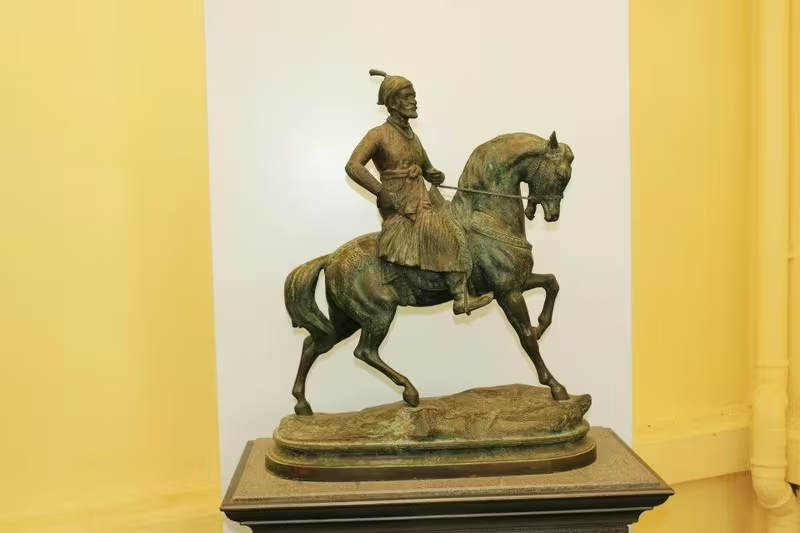
Chhatrapati Shivaji Maharaj: The Architect of a Maratha Empire
In the grand tapestry of Indian history, few figures loom as large or command as much reverence as Shivaji Shahaji Bhonsale. More than a king, he was the architect of a sovereign state, a military visionary who outmaneuvered empires, and the embodiment of an ideal—Swarajya, or self-rule. Born in the rugged hills of the Western Ghats, Chhatrapati Shivaji Maharaj (1630-1680) forged a formidable Maratha Empire from a small fiefdom, challenging the seemingly invincible Mughal authority and forever altering the political landscape of the subcontinent. His life was a saga of audacious courage, brilliant strategy, and an unwavering commitment to justice and independence.
Early Life & Background
The Dawn at Shivneri
Shivaji was born on 19 February 1630 in the hill-fort of Shivneri, near the city of Junnar in present-day Maharashtra. The era was one of political turmoil. The Deccan plateau was a contested chessboard, with the waning Adilshahi Sultanate of Bijapur and the Nizamshahi of Ahmadnagar vying for control, all under the shadow of the expanding Mughal Empire to the north. His father, Shahaji Bhonsale, was a brilliant Maratha general, a kingmaker who served various Deccan Sultanates, holding significant jagirs (land grants) in his own right.
His mother, Jijabai, was the true crucible in which his character was forged. A pious, proud, and fiercely independent woman, she had witnessed the subjugation of her people and yearned for a sovereign Hindu kingdom. While Shahaji was often away on military campaigns, it was Jijabai who became Shivaji’s first and most important mentor. She filled his young mind with tales of heroism, dharma, and sacrifice from the great epics, the Ramayana and Mahabharata, instilling in him a profound sense of duty and a burning desire to establish a just and independent rule.
A Formative Education
Shivaji’s early years were spent in the Pune jagir, administered by his father's trusted aide, Dadoji Konddeo. Under Konddeo’s tutelage, he received formal training in the arts of warfare, administration, and statecraft. He mastered horse riding, swordsmanship, and archery. However, his true education came from the land itself. He roamed the Sahyadri mountains, intimately learning its secret paths, hidden valleys, and impregnable cliffs. It was here that he befriended the local Mavalas—hardy, loyal hill-people who would later form the backbone of his army.
This unique combination of formal training and practical experience shaped his worldview. He witnessed firsthand the plight of the common people, oppressed by the capricious demands of distant sultans. At the tender age of 16, in 1646, a pivotal event took place at the Raireshwar temple. With a handful of his loyal Mavala companions, Shivaji reportedly took a solemn oath, pricking his thumb and anointing the Shiva lingam with his blood, vowing to establish Swarajya. This was not merely a rebellion; it was the declaration of a new ideal.
Career & Major Contributions: Forging an Empire
Shivaji’s career was a masterclass in strategic state-building, marked by audacious military victories and astute diplomacy.
The First Conquests and a Bold Declaration
His quest began not with a grand battle, but with calculated, stealthy moves. In 1646, he persuaded or compelled the Adilshahi commander of the Torna Fort to hand over its keys. Using the treasure he discovered there, he fortified the nearby hill of Murumbdev, renaming it Rajgad—which would become his first capital. This was followed by the swift acquisition of other key forts like Kondana (later Sinhagad) and Purandar. These were not random acts of plunder; each fort was a strategic node that secured his home territory around Pune and established a base for future operations.
The Confrontation with Afzal Khan (1659)
The rising power of Shivaji did not go unnoticed. The Adilshahi court of Bijapur, viewing him as a dangerous upstart, dispatched its most formidable general, Afzal Khan, with a large army and a simple command: bring back Shivaji, dead or alive. Khan, known for his cruelty and strength, marched through Maharashtra, desecrating temples to provoke Shivaji into an open battle where his larger army would have the advantage.
Shivaji, however, refused to take the bait. He retreated to the dense forest and high cliffs of Pratapgad fort and invited Khan for a personal meeting. Wary of Khan's reputation for treachery, Shivaji came prepared. He wore chain mail under his clothes and concealed a bichawa (dagger) in his sleeve and the now-legendary wagh nakh (iron tiger claws) in his hand. As anticipated, during the embrace, Afzal Khan attempted to stab him. The armor saved Shivaji, who retaliated with a swift, brutal counter-attack, disemboweling the general with the tiger claws. In the pre-planned signal that followed, Shivaji's hidden troops descended upon the unsuspecting and now leaderless Bijapuri army, routing them completely. The victory was a turning point. It transformed Shivaji from a regional chieftain into a major power and brought him immense wealth, weaponry, and prestige.
Outwitting the Mughals
Shivaji’s success inevitably drew the attention of the Mughal Emperor Aurangzeb. In 1660, Aurangzeb sent his maternal uncle, Shaista Khan, with a massive army of over 150,000 to annihilate the Maratha leader. Shaista Khan captured Pune and took up residence in Lal Mahal, Shivaji's childhood home.
For three years, the Mughal occupation seemed absolute. Then, in a stroke of unparalleled audacity, Shivaji executed a daring night raid in April 1663. With a small band of 400 men, he infiltrated the heavily guarded Mughal camp in Pune. He located Shaista Khan's chambers and attacked him directly. In the ensuing melee, the Khan escaped but lost three fingers, while his son was killed. The psychological impact was immense. That Shivaji could strike the heart of the Mughal command was a source of profound humiliation for the Empire and a massive boost to Maratha morale.
To replenish his treasury, Shivaji carried out a tactical raid on the wealthy Mughal port city of Surat in 1664, acquiring a vast fortune without harming the civilian population—a principle he largely adhered to.
The Treaty of Purandar and the Great Escape (1666)
Enraged, Aurangzeb dispatched his most capable general, the Rajput ruler Mirza Raja Jai Singh I. Jai Singh’s systematic and relentless campaign, coupled with a naval blockade, cornered Shivaji. Recognizing the futility of fighting a war on multiple fronts, Shivaji agreed to a strategic truce. Under the Treaty of Purandar (1665), he surrendered 23 of his forts and agreed to visit the Mughal court in Agra.
In Agra, he was treated not as a visiting noble but as a minor commander and was placed under house arrest. Facing the prospect of execution or a lifetime in prison, Shivaji planned one of history’s most ingenious escapes. Feigning illness, he began sending out large baskets of sweets and fruits to be distributed among the poor. After several weeks, the guards grew complacent in their checking. Seizing the opportunity, Shivaji and his young son Sambhaji concealed themselves in two of these baskets and were carried out of their prison. They then traveled hundreds of miles, disguised as ascetics, through hostile territory to finally reach the safety of Rajgad. This escape from the clutches of Aurangzeb cemented his legendary status across India.
The Coronation and the Birth of a Sovereign State
After returning, Shivaji spent a few years consolidating his power. In 1670, he launched a blitzkrieg offensive, reclaiming most of the forts he had surrendered within months. This period of resurgence culminated in the most significant event of his life. On June 6, 1674, at Raigad Fort, Shivaji was formally coronated in a grand ceremony conducted according to Vedic rites by the renowned scholar Gaga Bhatt. He assumed the titles of Chhatrapati (Sovereign Monarch) and Haindava Dharmoddharak (Protector of the Hindu Faith).
This coronation was a revolutionary political statement. It formally established a sovereign Hindu kingdom, a legitimate seat of power, in defiance of Mughal supremacy. It symbolized the culmination of his life's work to create a state founded on the principles of Swarajya.
A Visionary Administrator and Military Innovator
Shivaji's genius was not limited to the battlefield. He was a far-sighted administrator who created a robust and efficient system of governance.
- Ashta Pradhan Mandal: He established a council of eight ministers, the Ashta Pradhan, each with a specific portfolio (finance, foreign affairs, justice, etc.). This cabinet-based system was built on meritocracy and ensured a clear separation of powers.
- Revenue System: He reformed the revenue system to be fair to the peasantry, abolishing the exploitative jagirdari system and implementing direct collection through state officials. Taxes were fixed, protecting farmers from the whims of local landlords.
- Military Organization: He built a disciplined, professional army with a clear command structure. He emphasized merit over heredity for promotions. His true innovation was in mastering guerrilla warfare (ganimi kava), using speed, surprise, and the terrain of the Sahyadris to defeat much larger, conventionally-trained armies.
- Father of the Indian Navy: Recognizing the threat from European traders and the Siddis of Janjira, Shivaji was the first Indian ruler of his era to build a formidable navy. His fleet protected Maratha trade and coastline, challenging the naval supremacy of the Portuguese and the English on the western coast.
Legacy & Influence
Chhatrapati Shivaji Maharaj passed away on April 3, 1680, at Raigad, after a brief illness. But his legacy was just beginning.
Historical Significance: He was the catalyst that checked the expansion of the Mughal Empire and ultimately contributed to its decline. The sovereign state he founded grew into the Maratha Empire, which, at its peak in the 18th century, dominated the Indian subcontinent from Attock in the north to the Thanjavur in the south.
A Symbol of Resistance and Self-Rule: Shivaji's life has been a timeless source of inspiration for countless Indians. He is remembered not as a mere conqueror, but as a protector of his people, a just ruler who fought for the dignity and freedom of his homeland. His concept of Swarajya became a foundational idea for the Indian independence movement centuries later.
A Secular and Just Ruler: Despite his strong Hindu faith, Shivaji’s rule was marked by religious tolerance. Muslims occupied high positions in his army and administration, and he respected all places of worship. His primary fight was against oppressive political powers, not against any religion.
Today, Shivaji Maharaj is revered as a national hero. His magnificent hill-forts stand as silent sentinels to his genius, his name echoes in the folklore of Maharashtra, and his story continues to inspire a sense of pride, courage, and an unyielding spirit of independence. He was a king who dared to dream of freedom in an age of empires and, through sheer force of will and strategic brilliance, made that dream a reality.