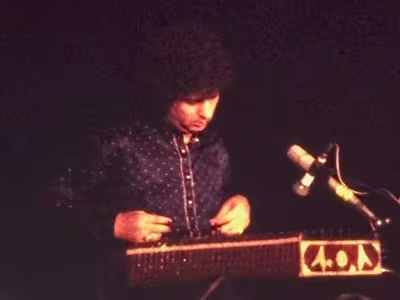
Shivkumar Sharma - The Maestro Who Gave the Santoor a Classical Voice
In the grand tapestry of Hindustani classical music, certain artists are not just performers; they are visionaries who redefine the very instruments they touch. Pandit Shivkumar Sharma was one such revolutionary. He was the architect who took a humble, hundred-stringed folk instrument from the valleys of Kashmir, the santoor, and through sheer genius and perseverance, elevated it into a celebrated solo voice on the world’s most prestigious concert stages. His life, spanning from 1938 to 2022, is a story of artistic conviction, audacious innovation, and the creation of a sound that became synonymous with both spiritual serenity and breathtaking virtuosity.
Early Life & The Unlikely Instrument
Shivkumar Sharma was born on January 13, 1938, in Jammu, into a family deeply immersed in music. His father, Pandit Uma Dutt Sharma, was a distinguished vocalist of the Benaras Gharana and a versatile musician who served as the 'Raj Pandit' in the court of Maharaja Hari Singh of Jammu and Kashmir. From the tender age of five, young Shivkumar was initiated into the world of music, beginning his rigorous training in vocal music and the tabla. His prodigious talent was evident early on, and he soon began performing on All India Radio, Jammu.
His life's mission, however, was presented to him when he was just thirteen. His father, a keen musicologist, had been conducting extensive research on the santoor. Known in ancient texts as the Shata-Tantri Veena (the hundred-stringed lute), the instrument was primarily used in Kashmir to accompany Sufiana Mausiqi, a regional form of Sufi music. Uma Dutt Sharma saw immense, untapped potential in its shimmering, ethereal sound. He envisioned a future where this folk instrument could hold its own in the demanding world of classical music. He bestowed this monumental task upon his son, instructing him to dedicate his life to mastering the santoor and establishing its classical credentials.
This was no simple inheritance; it was a profound challenge. The Hindustani classical tradition is built upon the concepts of meend (the smooth gliding between notes), gamak (ornamentation), and microtonal nuances that give ragas their soul. The santoor, a hammered dulcimer, produced distinct, staccato notes. It was seen by purists as inherently incapable of producing the melodic continuity essential for a raga's exposition. The initial reception was, therefore, one of skepticism and often outright dismissal.
Career & Major Contributions: Forging a New Path
Undeterred, Shivkumar Sharma embarked on a journey of intense dedication and radical innovation. He understood that to make the santoor 'speak' the language of classical music, both the instrument and the playing technique needed to be fundamentally reimagined.
He made crucial modifications to the santoor's structure, altering the string arrangement and refining its tuning system to better suit the chromatic scale of classical ragas. More importantly, he developed a revolutionary playing technique. He controlled the sustain of the notes with phenomenal precision, using his deep knowledge of rhythm (layakari) from his tabla training to create complex patterns. He pioneered a new method of gliding the mallets (kalams) across the strings, creating a tremolo effect that brilliantly simulated the sustain of a bowed or plucked instrument, giving the illusion of meend.
His first major public performance in Bombay in 1955 at the prestigious Haridas Sangeet Sammelan was a trial by fire. While some were intrigued by the novel sound, many orthodox critics were unsparing, questioning the instrument's classical suitability. But Sharma's conviction was unshakeable. In 1960, he cut his first solo album, a landmark recording that formally announced the arrival of the santoor as a legitimate solo classical instrument.
The Call of the Valley and Global Recognition
The turning point in his international career came in 1967 with the release of the album Call of the Valley. This seminal work, a collaboration with flautist Pandit Hariprasad Chaurasia and guitarist Brij Bhushan Kabra, was a concept album that musically depicted a day in the life of a Kashmiri shepherd. It was a masterpiece of thematic and melodic brilliance, blending classical structures with a folk-like simplicity. The album was an unprecedented international success, introducing the sound of the santoor to a global audience and becoming one of the best-selling Indian classical music records of all time.
This album also marked the beginning of two of the most significant musical partnerships of his life. His collaboration with the tabla maestro Ustad Zakir Hussain became the stuff of legend. Their on-stage chemistry was electric, a dynamic dialogue between melody and rhythm that left audiences spellbound across the globe for decades.
Shiv-Hari: The Sound of Bollywood's Golden Era
His artistic partnership with Pandit Hariprasad Chaurasia extended beyond the classical stage into the vibrant world of Hindi cinema. As the composing duo Shiv-Hari, they created some of the most iconic and beloved film scores of the 1980s and 90s. Beginning with Yash Chopra’s Silsila (1981), they crafted unforgettable soundtracks for films like Faasle (1985), Chandni (1989), Lamhe (1991), and Darr (1993). The Shiv-Hari sound was unique; it seamlessly wove the purity of classical ragas and the charm of folk melodies into popular film songs, creating a sophisticated yet accessible musical landscape that defined an era of Bollywood romance.
Despite his immense success in film, Pandit Shivkumar Sharma remained deeply rooted in the classical tradition. He continued to perform, record, and tour extensively, solidifying his status as one of the titans of Hindustani music. His concerts were not mere recitals; they were immersive experiences, where the cascading notes of his santoor could evoke the gentle flow of a mountain stream or the awesome power of a storm.
Legacy & Influence: The Voice of the Valley
Pandit Shivkumar Sharma’s passing on May 10, 2022, marked the end of an era. His legacy, however, is immortal and multi-faceted.
His single greatest contribution is the transformation of the santoor. He is to the santoor what Ustad Bismillah Khan is to the shehnai or Pandit Pannalal Ghosh is to the flute. He single-handedly took an obscure folk instrument, weathered the storm of criticism from purists, and through his genius, established it as a mainstream classical instrument. He did not just play the santoor; he gave it a new soul and a new grammar, creating a distinct school or gharana of santoor playing.
As a Guru, he nurtured the next generation of artists, passing on his invaluable knowledge and technique. His son, Rahul Sharma, is now a celebrated santoor player in his own right, carrying his father's magnificent legacy forward.
Pandit Shivkumar Sharma was a cultural ambassador who introduced the unique, meditative sound of Kashmir to the world. His music became the definitive 'voice of the valley' for listeners globally, evoking images of snow-capped peaks and serene, sunlit landscapes. He was a bridge between worlds—between folk and classical, tradition and innovation, India and the West.
For his immense contributions, he was honoured with India’s highest civilian awards, including the Sangeet Natak Akademi Award in 1986, the Padma Shri in 1991, and the Padma Vibhushan in 2001. Yet, his true honour lies in the sound he created—a sound that continues to resonate in concert halls and homes, a shimmering, melodic torrent that tells a timeless story of a visionary who dared to make a hundred strings sing with the profound depth of the human soul.