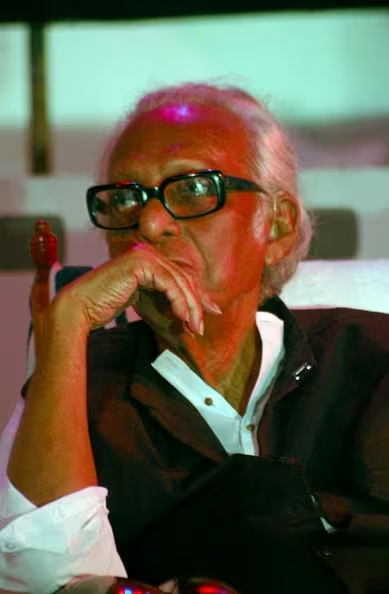
Shyam Benegal: The Conscience of Indian Cinema
In the grand theatre of Indian history, few have chronicled the nation's post-independence soul with the quiet intensity and profound empathy of Shyam Sunder Benegal. He was not merely a filmmaker; he was a sociologist with a camera, a historian with a script, and the undisputed pioneer of India's 'Parallel Cinema' movement. From the feudal landscapes of rural India to the complex corridors of power, Benegal’s lens captured a nation in flux, dissecting its contradictions, celebrating its resilience, and giving voice to its marginalized. His passing on December 23, 2023, marked the end of an era, but his work remains an indelible archive of modern India's conscience.
Early Life & Background
Shyam Sunder Benegal was born on December 14, 1934, in Secunderabad, then a part of the princely state of Hyderabad. His father, Sridhar B. Benegal, was a photographer, and the world of images became Shyam’s first language. This early exposure was formative; at the tender age of twelve, his father gifted him a hand-cranked 16mm camera, a tool with which he made his very first film. The seeds of a cinematic giant were sown in these early experiments.
Another significant, albeit indirect, influence was his cousin, the legendary filmmaker Vasanth Kumar Padukone, known to the world as Guru Dutt. While their cinematic styles were vastly different, the familial connection to the world of filmmaking provided a powerful, if distant, inspiration.
Benegal’s intellectual foundation was as robust as his artistic inclination. He pursued and completed a Master's degree in Economics from Osmania University in Hyderabad. This academic grounding would later manifest in his films, which were marked by a deep understanding of socio-economic structures, power dynamics, and historical processes. During his university years, he was actively involved in the film society movement, immersing himself in the works of global masters like Satyajit Ray, Akira Kurosawa, and Vittorio De Sica, which shaped his belief in cinema as a tool for serious social commentary.
The Forge of a Filmmaker: Advertising and Documentaries
In 1959, Benegal moved to Bombay (now Mumbai), the bustling heart of the Indian film industry. However, he did not immediately dive into feature filmmaking. Instead, he began his career as a copywriter at the advertising agency Lintas, where he steadily rose to become its creative head. This period, far from being a detour, was a crucial training ground. Advertising taught him the art of concise storytelling, visual discipline, and communicating a powerful message within a tight frame. Over the years, he would direct more than 700 advertising films.
Alongside his advertising career, Benegal began directing documentaries, a form that perfectly suited his passion for realism. He directed over 90 documentaries, exploring a wide range of subjects. Works like A Child of the Streets (1967) showcased his innate humanism and his ability to find profound stories in everyday life. This extensive work in non-fiction honed his observational skills and cemented his commitment to authenticity, a quality that would become the hallmark of his feature films.
A brief but impactful stint as an instructor at the Film and Television Institute of India (FTII) in Pune in the late 1960s put him in touch with a new generation of talent. Actors like Naseeruddin Shah, Om Puri, and Shabana Azmi, and technicians trained in a new, more realistic school of performance and craft, would soon become the core of his cinematic family.
The Rise of Parallel Cinema: The Rural Trilogy
By the early 1970s, mainstream Hindi cinema was dominated by star-driven, formulaic musicals. In this landscape, the state-backed Film Finance Corporation (FFC) began supporting a new wave of filmmakers committed to artistic integrity over commercial appeal. This was the birth of the 'Parallel Cinema' or 'New Wave' movement, and Shyam Benegal was about to become its leading light.
Ankur (The Seedling, 1974) His debut feature film was a seismic event. Based on a true story he had heard in Hyderabad, Ankur was a stark and powerful examination of caste, class, and sexual exploitation in rural Andhra Pradesh. It told the story of a landlord’s son who seduces a low-caste servant woman, only to abandon her when she becomes pregnant. The film was raw, unflinching, and devoid of any commercial trappings. It launched the careers of Shabana Azmi and Anant Nag, who delivered incredibly naturalistic performances. Ankur not only won three National Film Awards but also announced the arrival of a powerful new cinematic voice.
Nishant (Night's End, 1975) Benegal followed up this success with Nishant, an even more searing indictment of feudal oppression. The film depicted the abduction and repeated rape of a schoolteacher's wife by the powerful brothers of a local zamindar, and the subsequent, violent uprising of the villagers. Featuring a stellar ensemble cast that included Girish Karnad, Shabana Azmi, Naseeruddin Shah, Smita Patil, and Amrish Puri, Nishant was a brutal and compelling narrative. It won the National Film Award for Best Feature Film in Hindi and was India's official entry to the Academy Awards.
Manthan (The Churning, 1976) Perhaps the most unique film of this trilogy was Manthan. The film was a fictionalized account of the birth of India's White Revolution, inspired by the milk cooperative movement led by Verghese Kurien in Gujarat. What made Manthan extraordinary was its funding model: it was entirely financed by 500,000 dairy farmers, each of whom contributed ₹2 to its budget, making them producers of the film. It was a true "people's film." Starring Girish Karnad, Smita Patil, and Naseeruddin Shah, the film was a critical and commercial success, proving that meaningful cinema rooted in social change could find its audience. It too won the National Film Award and was an Oscar entry.
This rural trilogy firmly established Benegal as the leader of the Parallel Cinema movement, creating a new aesthetic of realism and social purpose.
Exploring the Indian Tapestry: Later Works and Television
Having explored the rural feudal landscape, Benegal turned his gaze to other facets of Indian society.
Bhumika (The Role, 1977): A complex and layered biopic of the 1940s Marathi actress Hansa Wadkar, featuring a tour-de-force performance by Smita Patil. The film was a landmark in Indian feminist cinema, exploring a woman's quest for identity and freedom in a patriarchal world.
Junoon (Obsession, 1978): Based on Ruskin Bond's novella A Flight of Pigeons, this was a larger-scale historical film set against the backdrop of the 1857 Indian Rebellion. It demonstrated Benegal's versatility and his ability to handle epic narratives with the same nuance he brought to his intimate dramas.
Kalyug (The Machine Age, 1981): A brilliant and ambitious modern-day adaptation of the Mahabharata, transposing the epic's themes of dynastic conflict, morality, and greed onto the world of two rival industrialist families. It was a testament to his intellectual depth and narrative skill.
Benegal's most monumental contribution, however, may have come on the small screen. In 1988, he directed Bharat Ek Khoj (The Discovery of India) for the state broadcaster Doordarshan. This epic 53-episode series, based on Jawaharlal Nehru's seminal book, was an unprecedented attempt to chronicle 5,000 years of Indian history, from the Indus Valley Civilization to Independence. In an era before the explosion of private television, Bharat Ek Khoj was a national cultural event, educating an entire generation about their heritage.
Decades later, he returned to this historical-educational format with Samvidhaan (2014), a 10-part miniseries for Rajya Sabha TV that meticulously dramatized the Constituent Assembly debates that framed the Constitution of India. It was yet another act of profound national service, using his craft to illuminate the foundations of Indian democracy.
Legacy & Influence
Shyam Benegal's legacy is monumental and multi-faceted.
The Architect of Parallel Cinema: He gave the movement its identity, its purpose, and its first major successes. He proved that films of substance, shot on real locations with realistic characters, could not only win critical acclaim but also resonate with audiences.
A Nurturer of Genius: Benegal was a master at spotting and nurturing talent. He created a veritable repertory company of some of India’s finest actors. The names he launched or mentored—Shabana Azmi, Naseeruddin Shah, Om Puri, Smita Patil, Amrish Puri, Anant Nag, Kulbhushan Kharbanda, Rajit Kapur—reads like a who's who of Indian acting royalty. He fostered a school of naturalistic performance that forever changed acting in Hindi cinema.
A Chronicler of a Nation: His films are invaluable historical documents. They capture the anxieties, struggles, and aspirations of a young nation grappling with ancient inequalities and modern challenges. He was a filmmaker of profound social conscience, who believed cinema had a duty to hold a mirror up to society.
His immense contributions were recognized with India's highest honors. He received the Padma Shri in 1976, the Padma Bhushan in 1991, and in 2005, the Dadasaheb Phalke Award, the highest recognition in Indian cinema. He won the National Film Award for Best Feature Film in Hindi a record seven times.
Shyam Benegal was more than a director; he was an institution. He was a quiet revolutionary who, without shouting, fundamentally altered the landscape of Indian cinema. His films were not escapes from reality, but deep, thoughtful immersions into it. He taught us that the most compelling stories were not in the realm of fantasy, but in the soil of our villages, the politics of our cities, and the complex, churning heart of India itself.