Simuka - Founder of the Satavahana Dynasty
In the tumultuous aftermath of the Mauryan Empire's decline, when the Indian subcontinent was a fractured mosaic of competing powers, a new leader emerged from the Deccan plateau. His name was Simuka, a figure shrouded in the mists of ancient history, yet whose actions would resonate for nearly half a millennium. As the founder of the Satavahana Dynasty, Simuka was not merely a king; he was an architect of an empire that would act as a stabilizing bridge between North and South India, fostering a unique cultural and economic efflorescence that defined the era.
While the man himself remains enigmatic, a composite of Puranic genealogies, rare coin finds, and later inscriptions, his legacy is monumental. He transformed a regional chiefdom into the bedrock of a dynasty that would outlast many of its contemporaries, fiercely defending the Deccan's sovereignty and cultivating a rich artistic and religious heritage. This is the story of Simuka, the progenitor of the great Satavahana power.
Early Life & Background
The precise origins of Simuka are a subject of intense scholarly debate, a puzzle pieced together from fragmented and often contradictory sources. The Puranas, ancient texts that chronicle royal genealogies, refer to the dynasty he founded as Andhra-jatiya, or 'of the Andhra tribe'. This has long linked the Satavahanas to the Andhra people, native to the fertile deltas of the Krishna and Godavari rivers in modern-day Andhra Pradesh. However, the earliest Satavahana inscriptions, including the pivotal Naneghat inscription from the reign of a later ruler, are found not in Andhra but in the northern Deccan, in present-day Maharashtra. Their earliest coins are also concentrated in this western region. This geographical discrepancy suggests that Simuka and his immediate successors established their power base in Maharashtra, with their influence expanding into the Andhra region later in the dynasty's history.
Details of Simuka's parentage, birth, and formative years are lost to history. Ancient chroniclers were more concerned with dynastic succession and grand political events than with the personal lives of rulers. What is clear, however, is the world that shaped him. Simuka came of age during a period of profound political transition. The mighty Mauryan Empire, which had once unified most of the subcontinent under a single authority, had crumbled by the early 2nd century BCE. In its wake, regional powers asserted their independence. In the north, the Shunga and later the Kanva dynasties controlled the old Mauryan heartland of Magadha. In the Deccan, local chieftains and feudatories, once subservient to the Mauryas, vied for supremacy.
It was in this crucible of ambition and opportunity that Simuka began his ascent. He was likely a local ruler or chieftain, possessing the military acumen and political foresight to consolidate the smaller, scattered territories around him into a coherent and defensible kingdom. His initial domain was probably centered around Pratishthana (modern Paithan) in Maharashtra, a strategic location on the banks of the Godavari River that would serve as the Satavahana capital for generations.
Career & Major Contributions
Simuka's reign marks the pivotal moment when a local power in the Deccan transformed into an imperial force. His most celebrated, though historically contested, achievement is the overthrow of the Kanva dynasty of Magadha.
The Puranic Account
The Matsya Purana provides a dramatic, if chronologically complex, account of his rise. It states that Simuka, the Andhra servant, “will assail the Kanvayanas and Susarman [the last Kanva king], and destroy the remains of the Sunga's power and will obtain this earth.” This narrative positions Simuka as a powerful conqueror who marched north from the Deccan to extinguish the last remnants of Magadhan supremacy. For centuries, this was accepted as the definitive account of the Satavahanas' origin, placing Simuka's reign around 28 BCE, the time of the Kanva dynasty's fall.
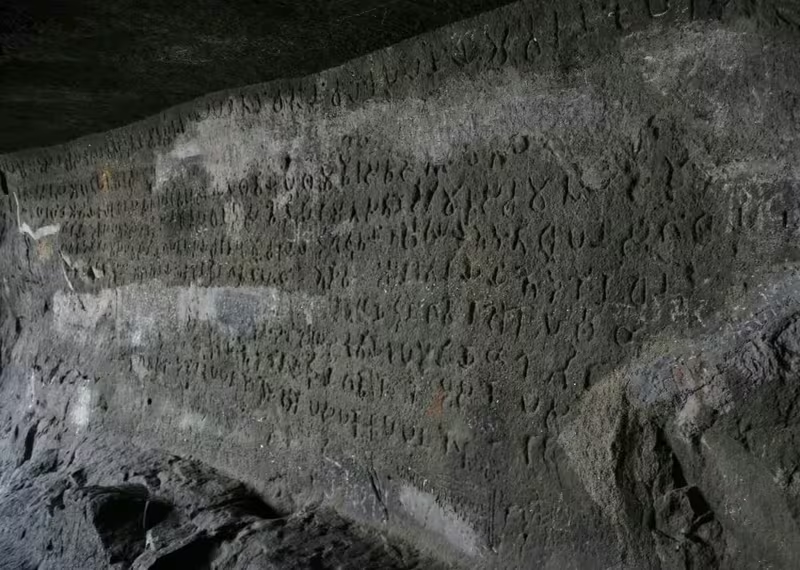
However, modern historical analysis, particularly through inscriptions and coin evidence, has challenged this timeline. The Naneghat inscription, commissioned by Queen Naganika, the wife of Simuka's successor Satakarni I, lists Simuka as the dynasty's founder. Palaeographic analysis of the script used in this inscription dates it to the 1st century BCE, suggesting Simuka must have lived and ruled significantly earlier than the fall of the Kanvas. This has led to several theories: perhaps the Puranas condensed historical events, attributing the fall of the Kanvas to the dynasty's founder as a symbolic gesture, or perhaps Simuka's reign was much longer and earlier, with a later Satavahana king being responsible for the final blow to the Kanvas. The exact chronology remains elusive, with proposed dates for the start of his reign varying from the late 3rd century BCE to the early 1st century BCE.
Consolidation of the Deccan
Regardless of the precise dates, Simuka's primary contribution was the establishment of a sovereign kingdom in the Deccan. He unified the territories of the northern Deccan plateau, creating a state strong enough to stand on its own. This was a monumental task in an era of fragmentation. His success laid the groundwork for his successors to expand the empire across central and southern India.
Numismatic Evidence
More tangible than the Puranic chronicles are the coins issued during his reign. These small pieces of metal are powerful testaments to his sovereignty and the geographical extent of his early influence. Coins bearing the Brahmi script legend Siri Chimuka Sata (a variant of Simuka Satavahana) have been discovered in Vidarbha and other parts of Maharashtra and Andhra. These coins, typically made of copper or lead, feature distinct symbols such as the Ujjain symbol (a cross with four circles at its ends), elephants, and swastikas. The circulation of this currency across a wide area signifies the establishment of a centralized economic and political authority under his rule.
Patronage and Religion
Later Jain texts offer a fascinating, albeit sectarian, glimpse into Simuka's character and religious affiliations. According to these traditions, Simuka was initially a patron of Jainism. He is said to have built numerous Jain temples (chaityas) and stupas. However, these same accounts claim that in his later years, he became a tyrant, turning against the faith he once supported. This narrative, while potentially biased, suggests a complex religious landscape and a ruler who may have shifted his allegiances. The broader Satavahana dynasty is overwhelmingly known for its patronage of Brahmanism, with later rulers performing elaborate Vedic sacrifices, and also for its significant support of Buddhist monasteries. Simuka's reign may represent an early, more fluid period of religious patronage before the dynasty’s strong Brahmanical identity was solidified.
Legacy & Influence
Simuka's legacy is not defined by grand monuments or extensive personal records, but by the enduring empire he brought into being. His life's work was the foundation upon which one of India's longest and most influential dynasties was built.
Founder of a 450-Year Dynasty
First and foremost, Simuka is remembered as the founder of the Satavahana dynasty, which ruled for approximately 450 years (c. 1st century BCE to 3rd century CE). This remarkable longevity is a testament to the strength of the political and administrative structures he established. The Satavahanas provided stability and continuity in the Deccan for centuries, a feat few other dynasties in Indian history can claim.
A Deccan Bulwark
The empire Simuka founded served as a crucial bulwark against the incursions of foreign powers, particularly the Sakas (Western Kshatrapas) from the northwest. For centuries, the Satavahanas and the Sakas were locked in a fierce struggle for control of western India's lucrative trade routes. By establishing a strong, indigenous power in the Deccan, Simuka ensured that the region's cultural and political development would proceed on its own terms, resisting complete domination by outside forces.
Catalyst for Cultural and Economic Growth
The political unity forged by Simuka created an environment where culture and commerce could flourish. The Satavahana empire became a vibrant center of trade, controlling key land routes connecting the Gangetic plains with the southern peninsula, as well as the bustling sea ports on both the western and eastern coasts that traded with the Roman Empire. This immense wealth funded extraordinary artistic achievements. The dynasty patronized the development of Prakrit literature and oversaw the initial phases of rock-cut architecture at sites like Ajanta, Nasik, and Karle, and the construction of magnificent stupas, most famously at Amaravati. While these achievements belong to his successors, they were only possible because of the stable and prosperous kingdom that Simuka founded.
A Symbol of Regional Power
Today, Simuka is remembered as a pioneering figure in the history of the Deccan. He represents the shift from pan-Indian imperial rule under the Mauryas to the rise of powerful, sophisticated regional kingdoms. His name, preserved in Puranic lists, on ancient coins, and in inscriptions, marks the beginning of a new chapter in Indian history—one where the Deccan was not a peripheral territory but a dynamic heartland of power, culture, and innovation. Though the details of his life remain obscure, the empire he founded stands as his undeniable and magnificent legacy.