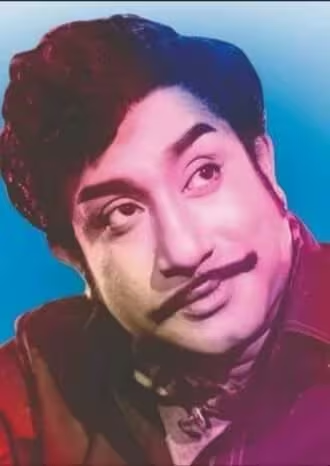
Sivaji Ganesan: The Nadigar Thilagam of Tamil Cinema
In the grand tapestry of Indian cinema, few figures command as much reverence and awe as Villupuram Chinnaiya Manrayar Ganesamoorthy, known to the world by a name that became synonymous with acting itself: Sivaji Ganesan. Hailed as the Nadigar Thilagam (The Doyen of Actors), his career was a monumental saga of artistic brilliance that spanned five decades and nearly 300 films. He was not merely an actor; he was a force of nature, an institution who set an unassailable benchmark for performance, and a cultural icon whose influence permeates the very soul of Tamil cinema.
Early Life & Theatrical Beginnings
Born on October 1, 1928, in Villupuram, in the then South Arcot district of the Madras Presidency, Ganesamoorthy's entry into the world was marked by the tumult of India's freedom struggle. His father, Chinnaiya Manrayar, was a dedicated participant in the independence movement, a commitment that often led to his imprisonment and absence during his son's formative years. Raised primarily by his mother, Rajamani Ammal, young Ganesamoorthy found his calling not in formal schooling, but in the vibrant, itinerant world of theatre.
At the tender age of seven, a chance encounter with a therukoothu (street theatre) performance mesmerized him. The raw energy, the dramatic storytelling, and the larger-than-life characters ignited a passion that would define his destiny. Compelled by this newfound purpose, he made a life-altering decision. He left home without a word and joined the Madurai Original Boys' Company, a renowned theatrical troupe that served as a rigorous training ground for aspiring artists.
Life in the troupe was demanding. It was an academy of discipline, voice modulation, and classical performance techniques. As was customary for young boys, Ganesan initially played female roles, mastering the nuances of expression and body language, before graduating to more substantial male characters. These years were crucial, shaping him into a disciplined and versatile performer, instilling in him a deep understanding of rhythm, dialogue, and stage presence.
It was on the stage that V.C. Ganesamoorthy was reborn. In the late 1940s, he was cast in the lead role of the 17th-century Maratha emperor in the play Sivaji Kanda Hindu Rajyam, penned by the Dravidian ideologue and future Chief Minister of Tamil Nadu, C. N. Annadurai. His portrayal was so commanding, so filled with regal fire and authority, that E.V. Ramasamy, the rationalist leader popularly known as 'Periyar', who was in the audience, was profoundly moved. He rose and declared that Ganesamoorthy should henceforth be known by the name of the king he had so brilliantly embodied. From that day forward, he was Sivaji Ganesan.
The Dawn of a Cinematic Era: Parasakthi
The transition from the proscenium arch to the silver screen was inevitable. In 1952, Sivaji Ganesan exploded into the consciousness of Tamil audiences with his debut film, Parasakthi. This was no ordinary debut; it was a cultural and political earthquake. Written by M. Karunanidhi, another towering figure of the Dravidian movement, the film was a revolutionary social commentary that challenged religious dogma, caste hierarchies, and social injustice.
At its heart was Ganesan's electrifying performance as Gunasekaran. His dialogue delivery, a vestige of his theatrical training, was a torrential flow of perfectly enunciated, alliterative Tamil, delivered with an emotional intensity that had never been witnessed before on screen. The climactic courtroom scene, where he rails against the ills of society, remains one of the most iconic moments in Indian cinema. Parasakthi did more than launch a star; it announced the arrival of a new, powerful voice in Tamil cinema and established Sivaji Ganesan as an actor of extraordinary calibre.
The Reign of the Nadigar Thilagam: A Career of Unmatched Versatility
What followed was a career of breathtaking scope and variety. Sivaji Ganesan possessed an unparalleled ability to disappear into a character, embodying kings and commoners, gods and villains, with equal conviction. His mastery over the nine classical emotions, the Navarasas, was absolute. He could convey a universe of meaning with a subtle glance, a tremor in his voice, or a flicker of his expressive eyes.
His filmography is a masterclass in versatility:
Mythological & Historical Epics: This was a domain he ruled with imperial authority. He didn't just play historical figures; he became their definitive cinematic representation.
- Veerapandiya Kattabomman (1959): His portrayal of the 18th-century chieftain who defied the British East India Company was a tour de force. The film's powerful dialogues, particularly the famous refusal to pay taxes—"Vari, vatti, kisthi..."—became anthems of defiance. This role won him the Best Actor award at the Afro-Asian Film Festival in Cairo in 1960, making him the first Indian actor to receive an international award for a specific film.
- Karnan (1964): As the tragic and noble warrior from the Mahabharata, Ganesan delivered a performance steeped in pathos and grandeur. His depiction of Karna's anguish, loyalty, and ultimate sacrifice remains a benchmark for mythological roles.
- Thiruvilaiyadal (1965): In this beloved classic, he played Lord Shiva with a majestic blend of divine authority and playful humanity, effortlessly switching between roles as the omnipotent god and his various earthly disguises.
Social and Family Dramas: He was equally masterful at capturing the complexities of ordinary lives, making his characters deeply relatable.
- Pasamalar (1961): A poignant saga of sibling love, his performance as the doting elder brother Rajasekhar is considered one of the most emotionally resonant in Tamil cinema. The film's heartbreaking climax showcases his profound ability to evoke empathy.
- Vietnam Veedu (1970): As 'Prestige' Padmanabhan, a man grappling with the void of retirement, he gave a nuanced and sensitive portrayal of aging, pride, and the search for relevance.
Complex & Unconventional Roles: Ganesan was never afraid to defy convention and explore the darker shades of human nature.
- Andha Naal (1954): A film noir that was revolutionary for its time, it featured no songs or fight sequences. Ganesan played an anti-hero, a radio engineer who turns traitor, a remarkably bold choice for an actor so early in his career.
- Thillana Mohanambal (1968): A cultural masterpiece, this film celebrated the classical arts of Bharatanatyam and Nadaswaram. Ganesan played 'Sikkil' Shanmugasundaram, a virtuoso musician, with such authenticity that he appeared to be a master of the instrument himself. His on-screen chemistry with Padmini, who played the dancer Mohanambal, is legendary.
Legacy & Influence
Sivaji Ganesan's impact extends far beyond his own filmography. He was a cinematic institution, a walking, talking school of acting. His meticulous preparation, unparalleled dialogue delivery, and emotional depth set a standard that generations of actors have aspired to.
His work became a primary inspiration for countless performers who followed, including superstars like Kamal Haasan and Rajinikanth, who have openly acknowledged their debt to his artistry. To this day, his films are studied by aspiring actors for their lessons in expression, timing, and character development.
His immense contribution to the arts was recognized with numerous accolades:
- The Padma Shri in 1966.
- The Padma Bhushan in 1984.
- The title of Chevalier de l'Ordre des Arts et des Lettres by the French Government in 1995, one of the highest honours bestowed upon an artist.
- The Dadasaheb Phalke Award in 1996, India's highest lifetime achievement award in cinema.
Beyond the screen, Ganesan had a brief foray into politics. Initially associated with the DMK, he later aligned with the Indian National Congress and served as a Member of Parliament in the Rajya Sabha. However, his true and enduring legacy remained in the world of cinema.
Sivaji Ganesan passed away on July 21, 2001, but his presence remains indelible. He is remembered not just for the awards he won or the number of films he made, but for the indelible characters he brought to life. He was the king, the commoner, the god, and the patriot. In the history of Indian culture, Villupuram Chinnaiya Ganesan, the boy who ran away to join the theatre, stands immortal as the one and only Nadigar Thilagam.