Skandagupta Kramaditya: The Saviour of a Golden Age
In the grand tapestry of Indian history, the Gupta period shines with a particular brilliance. It was an era of unprecedented cultural, scientific, and artistic efflorescence—the classical age of India. But golden ages are fragile, and by the mid-5th century CE, this luminous epoch faced its gravest threat. From the windswept steppes of Central Asia, a storm was gathering, a force so destructive it had humbled empires from Persia to Europe. These were the Hunas, and they were at India's doorstep.
Standing between this maelstrom and the heartland of Gupta civilization was one man: Skandagupta Kramaditya. The last of the great Gupta emperors, his reign was forged in conflict, a desperate and heroic struggle against both internal dissent and external invasion. He is remembered not merely as a ruler, but as a saviour, the monarch whose courage and military genius bought India precious time, shielding its classical legacy from a tide of destruction.
Early Life and A Contested Throne
Skandagupta was born into the imperial purple of the Gupta dynasty, the son of the great Emperor Kumaragupta I. His father’s reign (c. 415-455 CE) represented the zenith of Gupta power, an era of relative peace and prosperity spanning a vast territory from the Bay of Bengal to the Arabian Sea. Yet, the final years of Kumaragupta’s rule were troubled, and the circumstances of Skandagupta's ascent to the throne are shrouded in a compelling mystery, hinted at in the very inscriptions he left behind.
While he was the son of an emperor, evidence suggests Skandagupta was not the son of Kumaragupta’s chief queen (mahadevi). His half-brother, Purugupta, born to the chief queen, likely held a more direct and legitimate claim to the throne. This detail, seemingly a minor point of lineage, set the stage for a potential succession crisis. Ancient Indian polity, while favouring primogeniture, often saw power fall to the most capable and ambitious prince.
Skandagupta’s own Bhitari pillar inscription, a remarkable document of his reign, does not gloss over this struggle. Instead, it frames his victory in poetic and divine terms. It speaks of how, after his father’s death, the family's fortune (Lakshmi) had become unsteady. The inscription declares that Skandagupta, through his own prowess, subdued his enemies and “made the goddess of fortune steady,” concluding that she chose him herself, “having discarded all the other sons of the king.” This is not the language of an undisputed heir; it is the carefully crafted narrative of a man who fought for and won his crown through merit and might, legitimizing a contested claim.
Even before his father’s death, Skandagupta had proven his mettle. The Bhitari inscription recounts a harrowing conflict against a people known as the Pushyamitras. This tribe, located in central India, had amassed considerable power and threatened the very stability of the empire. The conflict was so severe that Skandagupta is said to have spent an entire night sleeping on the bare earth, a stark image of a warrior-prince enduring hardship in the field. He emerged victorious, having “restored the fallen fortunes of his family.” This early triumph established his reputation as a formidable military commander, a quality that would soon be tested on a far grander scale.
Career: The Bulwark Against the Huna Tide
Skandagupta ascended the throne around 455 CE, inheriting an empire that was wealthy and powerful, but also facing existential threats. His reign was dominated by warfare, a constant vigil against forces that sought to dismantle the world his ancestors had built.
The Huna Menace
His greatest challenge, and his most celebrated achievement, was the confrontation with the Hunas. Known in European sources as the Hephthalites or White Huns, this confederation of nomadic tribes was a formidable military power that carved a path of destruction across Asia. They had shattered the Kidarite kingdom in Bactria and severely weakened the mighty Sassanian Empire in Persia. Their arrival at the northwestern frontiers of India was not a mere border skirmish; it was an invasion by one of the most feared military forces of the ancient world.
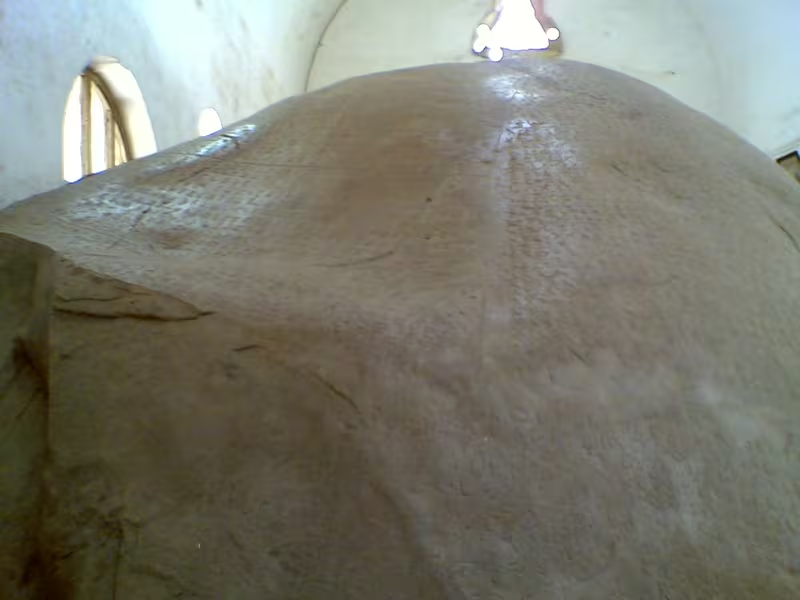
The Junagadh rock inscription in Gujarat provides a vivid, if brief, account of this cataclysmic clash. It records Skandagupta’s “terrible” and decisive victory over the Mlecchas (a term for foreigners, here referring to the Hunas). The inscription proclaims that his victory resounded “in every region,” a testament to its significance. The Bhitari pillar inscription offers a more poetic and dramatic rendering of the battle, describing how Skandagupta’s arrows flew amidst a “terrible whirlpool of battle” and how the “earth was made to tremble” by the clash of armies.
By defeating the Hunas so crushingly, Skandagupta achieved something extraordinary. At a time when the Western Roman Empire was crumbling under the pressure of similar migrations and invasions, Skandagupta not only held the line but decisively repelled the invaders. This victory pushed the Huna threat back for several decades, saving the rich heartland of northern India—its cities, universities, and monasteries—from plunder and devastation. It is this singular achievement that earned him the posthumous title of “Saviour of India.”
An Able Administrator
Skandagupta was not solely a warrior. His inscriptions reveal a conscientious and effective administrator deeply concerned with the welfare of his subjects. The most detailed evidence of his administrative acumen comes from the Junagadh inscription, which documents a remarkable feat of public works.
In the first year of his reign (c. 455-456 CE), excessive rains caused the bursting of the dam on the Sudarshana Lake near Girnar in Saurashtra. This was no ordinary reservoir. It was an ancient and vital structure, first commissioned by the Mauryan Emperor Chandragupta in the 4th century BCE and later repaired by the Shaka ruler Rudradaman I in the 2nd century CE. Its destruction was a natural disaster that threatened the agricultural prosperity of the entire region.
Skandagupta acted swiftly. His appointed governor of Saurashtra, Parnadatta, was tasked with the reconstruction. Parnadatta’s son, Chakrapalita, who administered the city of Girinagara, was placed in direct charge of the project. The inscription details the immense difficulty and expense of the task, noting that the dam was rebuilt in just two months with “an immeasurable expenditure of wealth.” Chakrapalita then consecrated a temple to the god Vishnu on the dam, a pious act that celebrated the successful completion of this monumental public work.
This episode is significant for several reasons. It demonstrates the efficiency of the Gupta provincial administration, the empire's capacity to marshal resources for large-scale infrastructure projects even after costly wars, and Skandagupta’s personal commitment to his duty as a protector of his people (praja-palan).
Economic Realities and Monetary Reforms
The constant warfare, however, took a heavy toll on the imperial treasury. This economic strain is visible in the physical record of his reign: his coinage. While Skandagupta continued to issue the magnificent gold coins (dinaras) for which the Guptas were famous, numismatic analysis shows a progressive decline in the purity of the gold over the course of his reign. His later coins have significantly less gold content than those of his predecessors, a clear sign of a state under financial duress.
He also introduced new types of silver coinage and debased the existing ones, likely as a pragmatic measure to manage the economy and pay his vast armies. This monetary policy, while born of necessity, reflects an emperor grappling with the immense cost of defending an empire, a stark contrast to the opulent image of his ancestors.
Legacy: The Glorious Sunset
Skandagupta Kramaditya died around 467 CE after a reign of only about twelve years. In that short time, he had faced down a succession crisis, suppressed internal rebellion, and defeated one of the most feared armies on earth. He upheld the dharma of a king, protecting his land and his people with all his strength.
He is rightly remembered as the last of the great Gupta emperors. While the dynasty would persist for nearly another century, it never again commanded the power, prestige, or territorial expanse it held under Skandagupta and his predecessors. After his death, the Hunas eventually returned and, though they never conquered the core of the Gangetic plains, they succeeded in breaking Gupta control over western India. Internal conflicts and the rise of feudatory powers further accelerated the empire’s fragmentation.
Skandagupta’s legacy, therefore, is both heroic and tragic. He was the dyke that held back the flood, a brilliant flash of defiance before the inevitable twilight. His reign represents the glorious sunset of the Gupta Empire. By holding the Hunas at bay, he ensured that the immense cultural, intellectual, and scientific heritage of India's classical age was not extinguished. The astronomical discoveries of Aryabhata, the literary genius of Kalidasa, the sublime sculptures of Sarnath, and the complex philosophical debates of the great universities were given a crucial reprieve. They had time to be absorbed, consolidated, and transmitted to future generations.
Today, Skandagupta is remembered through the powerful Sanskrit of his inscriptions and the silent testimony of his coins. They tell the story of a king who inherited a golden legacy and spent his life in the crucible of war to defend it. He was a warrior, a builder, and a protector—a true Kramaditya, the one whose valour is like the sun.