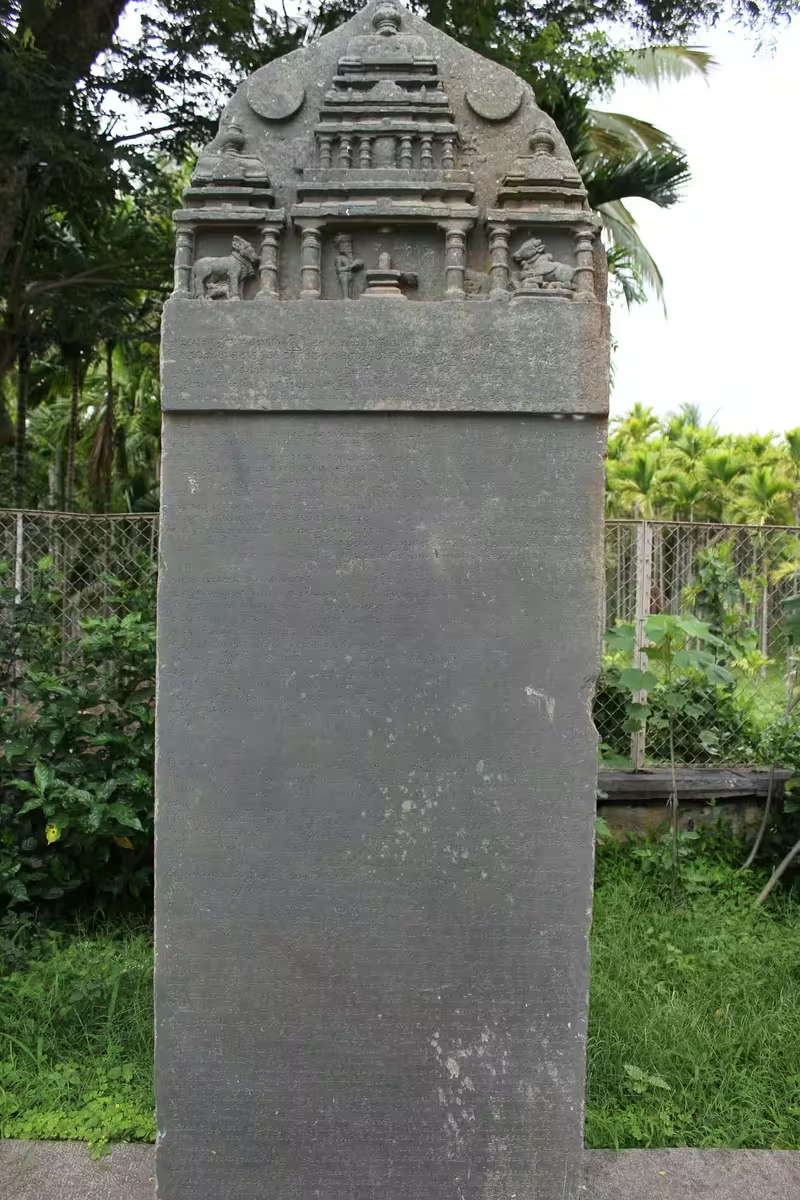
Someshvara III: The Scholar-King of the Western Chalukyas
In the grand tapestry of Indian history, the threads of power and knowledge are often woven together, but rarely are they embodied so completely in a single individual as they were in Someshvara III. Ascending the throne of the formidable Western Chalukya empire in 1126 CE, he was a monarch born into a legacy of conquest and imperial grandeur. Yet, while his contemporaries measured their reigns in territory won and enemies vanquished, Someshvara III carved out a different kind of immortality. He was the Sarvajna-bhupa—the “all-knowing king”—a ruler whose greatest legacy was not a fortress or a conquered city, but a monumental encyclopedia of knowledge, the Manasollasa.
Early Life & Background: The Scholar Prince
Someshvara III was the son and successor of one of the most illustrious rulers of the Deccan, Vikramaditya VI. His father’s reign, spanning an impressive fifty years, was a golden age for the Western Chalukyas. From their magnificent capital at Kalyani (present-day Basavakalyan in Karnataka), Vikramaditya VI had expanded the empire to its greatest extent, subduing the Hoysalas, keeping the Cholas at bay, and establishing Chalukya supremacy over a vast swathe of southern and central India.
Born into this environment of unparalleled power, stability, and cultural efflorescence, the young prince Someshvara was groomed not just for the throne, but for the life of a cultured aristocrat. He inherited a kingdom at peace, a treasury that was full, and a court that was a vibrant hub of art, literature, and philosophy. This unique inheritance of stability provided him with the time, resources, and intellectual freedom to pursue pursuits far beyond the battlefield.
While specific details of his formal education remain undocumented, the sheer breadth and depth of his later work paint a vivid picture of a prodigious intellect. He was clearly a polymath, a man whose curiosity was boundless. His education must have been exceptionally comprehensive, encompassing Rajaniti (statecraft), Dhanurvidya (archery and warfare), and Arthashastra (economics), as was standard for a prince. But it evidently went much further, delving into music, painting, architecture, culinary arts, veterinary science, alchemy, astronomy, poetry, and a host of other disciplines. He was a product of an age that valued a holistic understanding of the world, and he became its ultimate champion.
When Vikramaditya VI’s long and celebrated reign ended, Someshvara III ascended the throne in 1126 CE. His accession was peaceful, a smooth transition of power that allowed him to continue the cultural patronage his father had fostered, but with the added passion of a practitioner rather than just a patron.
Career & Major Contributions: The Reign of a Polymath
Someshvara III’s reign, which lasted until 1138 CE, presents a fascinating contrast to that of his father. While Vikramaditya VI was a warrior-king defined by his military campaigns, Someshvara III was a scholar-king whose primary focus was the consolidation and documentation of culture and knowledge. He adopted imperial titles like Tribhuvanamalla (“Lord of the Three Worlds”), but the title that truly defined him and his reign was Sarvajna-bhupa.
Military Endeavors and Imperial Challenges
Despite his scholarly inclinations, Someshvara III could not escape the political realities of 12th-century India. The Deccan was a volatile chessboard of ambitious kingdoms, and the vast empire he inherited required constant defense.
His reign was marked by persistent challenges from resurgent feudatories and rival powers. To the south, the Hoysalas, who had been subdued by his father, saw an opportunity to reassert their independence under the dynamic King Vishnuvardhana. Someshvara III had to lead expeditions to quell their ambitions, and while he met with some success, he struggled to maintain the firm grip his father once held over the region. The Hoysalas gradually began to chip away at the southern frontiers of the Chalukya empire.
He also faced pressures from the east, losing some territory in the Vengi region to the Eastern Ganga dynasty. Conflicts also arose with the Paramaras of Malwa and the Kalachuris of Tripuri. Unlike his father, Someshvara III was not an expansionist. His military career was largely defensive, a continuous effort to preserve the boundaries of the empire he had inherited. His reign marked the beginning of a slow decline in the military fortunes of the Western Chalukyas, a process that would accelerate under his successors.
The Crown Jewel: Manasollasa
If his military record was mixed, his contribution to Indian culture was monumental and unparalleled. Someshvara III’s most significant achievement was the composition of the Manasollasa (meaning “Delight of the Mind” or “Refresher of the Intellect”), also known as the Abhilashitartha Chintamani (“The Wish-Fulfilling Gem of All Desires”).
Written in Sanskrit verse around 1129 CE, this encyclopedic treatise is a unique and invaluable window into the secular life of medieval India. It is structured as a guide for a king, detailing every aspect of royal life, from governance and administration to personal enjoyment and recreation. The work is divided into five books (Vimshatis), each containing twenty chapters, covering a hundred distinct topics.
Rājyaprāptikāraṇa (On Acquiring a Kingdom): This section deals with the ethics and politics of kingship. It lays out the necessary qualifications for a king, his ministers, and the principles of just rule and conduct.
Rājyasya Sthairyakāraṇa (On the Stability of the Kingdom): This book is a manual on administration, covering topics like law, justice, taxation, treasury management, and the fortification of cities. It provides a practical framework for maintaining a stable and prosperous state.
Upabhogasyakāraṇa (On the Means of Enjoyment): This is perhaps the most famous and culturally rich section of the Manasollasa. It is a detailed compendium of the arts and luxuries of courtly life. It contains chapters on:
- Architecture & Painting: Describing the construction of houses and the techniques of painting (chitrakala), including the preparation of pigments and brushes.
- Cuisine (Pākadarpaṇa): This section is one of the earliest and most detailed accounts of Indian gastronomy. Someshvara III describes vegetarian and non-vegetarian recipes, the souring of milk, and the preparation of sweets and flavored drinks. It is a treasure trove for food historians.
- Music & Dance (Gīta-vinoda & Nṛtya-vinoda): He provides a sophisticated analysis of Indian classical music, discussing various ragas, vocal techniques, and musical instruments. The chapters on dance are equally detailed, exploring different forms and expressions.
Vinoda (On Entertainment): This book explores the various forms of royal entertainment. It includes detailed descriptions of sports like wrestling and horse racing, board games like chess, and pastimes such as magic and puppetry.
Krīḍā (On Sports and Recreation): This final section expands on royal amusements, covering everything from hunting and polo to the care and training of elephants and horses. It also includes sections on jewelry, perfumes, and royal gardens.
The Manasollasa is far more than a simple list; it is a meticulously detailed, practical guide. Someshvara III wrote not as a distant observer but as an expert practitioner. His work is a primary source of the highest order, providing technical knowledge on arts and sciences that is found nowhere else. It reflects the ideal of a king as a rasika—a connoisseur—and a master of all worldly knowledge.
Someshvara III also authored another work, Vikramankabhyudayam, a historical poem that served as a biography of his celebrated father, Vikramaditya VI. Though overshadowed by the Manasollasa, it demonstrates his literary skill and his deep reverence for his family’s legacy.
Legacy & Influence: The Enduring Reign of the Mind
Someshvara III’s reign ended in 1138 CE. Politically, it was the beginning of the end for the great Western Chalukya empire, which would crumble within a few decades under pressure from the Hoysalas, Kakatiyas, and the internal revolt of the Kalachuris. In the cold calculus of military history, his rule might be seen as a period of decline.
But history remembers its figures in many ways. While the empire Someshvara III ruled has long since vanished, his intellectual and cultural legacy has proven far more durable. He is remembered not as Tribhuvanamalla, the lord of three worlds, but as Sarvajna-bhupa, the king who knew everything.
His legacy is a powerful testament to the idea that a ruler's greatness can be measured by the culture they cultivate, not just the lands they conquer. He represents the Indian ideal of the Rajarshi—the sage-king—who combines political power with profound wisdom. His reign marked a deliberate pivot from military expansion to cultural consolidation, a moment when the Chalukya court paused to take stock of its vast knowledge and codify it for posterity.
The Manasollasa remains his enduring gift to India and the world. For centuries, it has been a vital resource for historians, musicologists, art historians, and sociologists seeking to understand the material culture, social norms, and daily realities of 12th-century India. It is a work that continues to inform and inspire, offering glimpses into the refined tastes, scientific temper, and vibrant artistic life of a bygone era.
In the end, Someshvara III achieved a different kind of conquest. He conquered not land, but knowledge. He built not a fortress of stone, but an indestructible citadel of learning. While the political boundaries he fought to protect were eventually erased by time, the world he so meticulously documented in the pages of the Manasollasa lives on, a timeless delight for the mind.