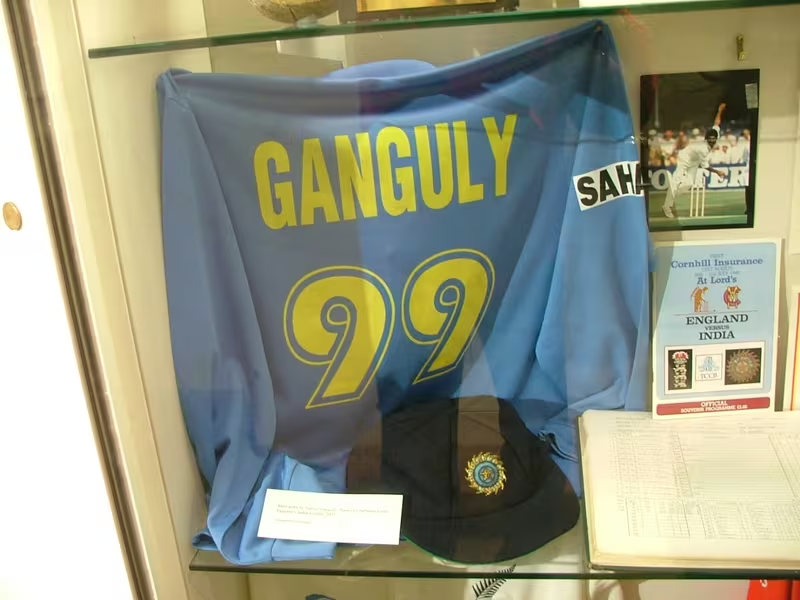
Sourav Ganguly: The Prince Who Taught India to Win
In the grand theatre of Indian cricket, few figures loom as large or as transformative as Sourav Chandidas Ganguly. Known affectionately as 'Dada' (elder brother), he was more than just a captain; he was an architect. Taking the helm of a team demoralised by scandal and mediocrity, Ganguly instilled a new, aggressive, and fearless identity, forging a unit that would not just compete, but conquer. His story is one of dramatic comebacks, iconic confrontations, and the forging of a legacy that laid the foundation for India's 21st-century cricketing dominance.
Early Life & Background: The 'Maharaj' of Behala
Sourav Ganguly was born on 8 July 1972, in Calcutta (now Kolkata), into an affluent and influential family. His father, Chandidas Ganguly, ran a thriving printing business, and the family home in the Behala neighbourhood was a sprawling mansion. Nicknamed 'Maharaj' (prince) for his privileged upbringing, young Sourav was initially drawn to football, the lifeblood of Calcutta's sporting culture. Cricket was the domain of his elder brother, Snehasish, a talented left-handed batsman for the Bengal state team.
It was Snehasish who guided his younger brother towards cricket. Legend has it that Sourav, a natural right-hander, began batting left-handed simply to be able to use his brother's equipment. A concrete cricket pitch was installed at their home, and the younger Ganguly's prodigious talent soon became impossible to ignore. Educated at the prestigious St. Xavier's Collegiate School, he quickly rose through the junior ranks, his elegant off-side play and natural timing marking him as a special talent.
Career & Major Contributions: From a False Start to a Glorious Reign
The Debut and the Wilderness
Ganguly's international career began with a whimper. He made his One Day International (ODI) debut against the West Indies in Brisbane during the 1992 tour of Australia. A score of just 3 runs and whispers of a poor attitude saw him unceremoniously dropped from the national side. For four long years, he was cast into the cricketing wilderness, a forgotten prodigy.
Undeterred, Ganguly returned to domestic cricket, where he plundered runs for Bengal in the Ranji Trophy and Duleep Trophy. His sheer weight of performance became undeniable, forcing the national selectors to grant him a second chance for the 1996 tour of England.
The Lord's Proclamation
On 20 June 1996, Sourav Ganguly walked out to bat on the hallowed turf of Lord's Cricket Ground for his Test debut. What followed was a masterclass in timing and grace. He stroked his way to a magnificent 131, becoming only the third cricketer in history to score a century on Test debut at Lord's. The 'Prince of Kolkata' had announced his arrival. As if to prove it was no fluke, he scored another century (136) in the very next Test at Trent Bridge. A new star was born, and his exquisite cover drives and square cuts soon earned him the moniker, 'God of the Off Side'.
For the next few years, Ganguly became a mainstay of the Indian batting lineup, forming a formidable middle order alongside Sachin Tendulkar, Rahul Dravid, and VVS Laxman. He was a prolific ODI batsman, forming a legendary opening partnership with Tendulkar, and a reliable, elegant presence in the Test side.
The Captaincy: Forging a New India
In 2000, Indian cricket was at its nadir. The match-fixing scandal had shattered the faith of a nation, and the team's morale was in tatters. Sachin Tendulkar, burdened by the pressure, had resigned from the captaincy. It was into this chaos that Sourav Ganguly was thrust as the new captain.
What he inherited was not a team but a collection of broken spirits. What he built was a fighting force. Ganguly's greatest contribution was not his batting or his bowling, but his leadership. He was fiercely protective of his players and unafraid of confrontation. He looked for talent in the unlikeliest of places and backed them to the hilt, creating a generation of match-winners.
He unearthed a swashbuckling opener in Virender Sehwag, a fiery off-spinner in Harbhajan Singh, a potent left-arm seamer in Zaheer Khan, and two fearless middle-order batsmen in Yuvraj Singh and Mohammad Kaif. He famously made the formidable Australian captain Steve Waugh wait for the toss, a small but symbolic act that declared that India would no longer be pushed around.
Key Triumphs of the Ganguly Era:
The 2001 Border-Gavaskar Trophy: This series is etched in cricketing folklore as the ultimate comeback. After a thrashing in the first Test against the seemingly invincible Australians, India were forced to follow-on in the second Test at Eden Gardens, Kolkata. In a career-defining performance, VVS Laxman (281) and Rahul Dravid (180) put on a historic 376-run partnership. A young Harbhajan Singh, who had taken a hat-trick in the first innings, then spun a web around the Australians to script an impossible victory. India went on to win the series 2-1, ending Australia's world-record streak of 16 consecutive Test wins. It was the moment the world saw the new, defiant India that Ganguly had created.
The 2002 NatWest Series Final: Chasing a mammoth 326 to win against England at Lord's, India collapsed to 146 for 5. Victory seemed a distant dream. But two of Ganguly's young protégés, Yuvraj Singh and Mohammad Kaif, staged a breathtaking counter-attack to seal a famous win. As the winning runs were hit, an ecstatic Ganguly, watching from the Lord's balcony, took off his shirt and whirled it around his head in a raw, unforgettable display of emotion. This was a direct response to a similar act by England's Andrew Flintoff in Mumbai months earlier, and it became the enduring symbol of Ganguly's aggressive, tit-for-tat captaincy.
2003 ICC World Cup: Ganguly led India to the final of the World Cup in South Africa for the first time in 20 years. Though they were outplayed by a dominant Australian side in the final, their spirited journey galvanized the nation and re-established India as a global cricketing powerhouse.
Shedding the 'Tigers at Home' Tag: Under Ganguly, India began to win consistently overseas. Landmark Test victories at Headingley (England, 2002), Adelaide (Australia, 2003), and a historic first-ever series win in Pakistan (2004) proved that this Indian team could win in any conditions.
The Chappell Feud and Final Comeback
The appointment of Greg Chappell as coach in 2005 marked a tumultuous period. A public and acrimonious fallout between the captain and coach led to Ganguly being sacked from the captaincy and, eventually, dropped from the team. It was a bitter end to a revolutionary captaincy tenure.
But, true to his character, Ganguly fought back. He once again turned to domestic cricket, scoring heavily to earn a recall to the national side in late 2006. He enjoyed a stellar run as a batsman on his return, scoring his maiden Test double-century (239) against Pakistan in 2007. He finally retired from international cricket in October 2008, fittingly in a home series victory against Australia.
Legacy & Influence: The Architect of Modern Indian Cricket
Sourav Ganguly's legacy is not measured in runs or wickets, but in a fundamental shift in the psyche of Indian cricket. He inherited a team of talented individuals and bequeathed a fearless, fighting unit. He taught India how to look the opposition in the eye, how to play aggressively, and most importantly, how to win away from home.
The players he nurtured—Sehwag, Yuvraj, Harbhajan, Zaheer, and a young wicketkeeper named MS Dhoni whom he promoted up the order—formed the core of the team that would go on to win the 2007 T20 World Cup and the 2011 ODI World Cup. He built the foundation upon which future captains built their empires.
After his playing career, Ganguly transitioned into administration, serving as the President of the Cricket Association of Bengal (CAB) before becoming the 39th President of the Board of Control for Cricket in India (BCCI) in 2019. He remains one of the most powerful and respected voices in world cricket.
Today, Sourav Ganguly is remembered as 'Dada', the beloved elder brother of Indian cricket. He is the fiery captain on the Lord's balcony, the elegant batsman caressing the ball through the covers, and the leader who gave a billion people reason to believe again. He was the prince who became a kingmaker, the man who didn't just play for India, but fundamentally changed what it meant to be an Indian cricketer.