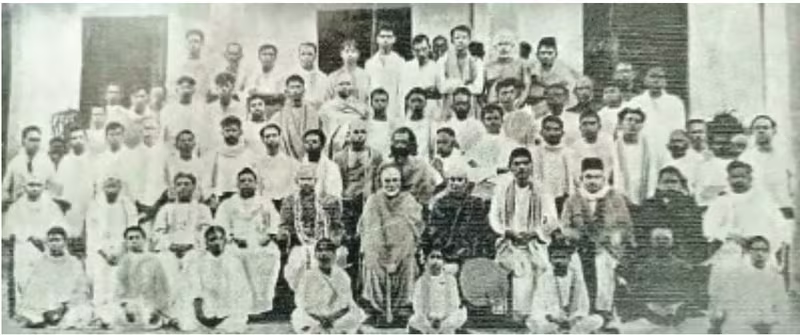
A Silent Revolution: The Life and Legacy of Sree Narayana Guru
In the annals of modern Indian history, few figures cast as long and transformative a shadow as Sree Narayana Guru. He was not a king who conquered lands, nor a politician who forged nations, but a saffron-clad ascetic whose revolution was one of consciousness. In a society suffocated by the rigid hierarchies of caste, Narayana Guru became a beacon of social equality and spiritual humanism. His life was a testament to the power of wisdom and compassion to dismantle centuries of oppression, fundamentally reshaping the social and spiritual landscape of Kerala and offering a timeless message of universal brotherhood.
Early Life & The Making of a Visionary
Narayanan, who would later be revered as Narayana Guru, was born on August 20, 1856, in the serene village of Chempazhanthy, near Trivandrum in the erstwhile Kingdom of Travancore. He was born into the Ezhava community, a caste then deemed 'avarna' (outside the four-fold varna system) and subjected to severe social discrimination. They were denied access to temples, public roads, and mainstream educational institutions. This oppressive environment was the crucible in which his revolutionary spirit was forged.
His parents, Madan Asan and Kuttiyamma, provided a nurturing environment that stood in stark contrast to the world outside. His father, a farmer, was also a respected teacher and a scholar of Sanskrit and Ayurveda, a rare accomplishment for someone from his community at the time. From a young age, 'Nanu', as he was affectionately called, displayed a profound contemplative nature, a sharp intellect, and a deep empathy for the suffering of others. He received his early education in Malayalam and Sanskrit from his father and uncle.
His formal education began under a renowned scholar, Kummampilli Raman Pillai Asan, at a traditional 'gurukula'. Here, he mastered Sanskrit grammar, literature, logic, and delved deep into the foundational texts of Hindu philosophy—the Vedas, Upanishads, and Vedanta. However, his education was not merely academic. It was a spiritual quest. The more he studied the profound Advaitic principle of a single, all-pervading reality (Brahman), the more he was disturbed by the fractured, hierarchical society around him, which treated human beings as unequal based on the accident of birth.
Upon completing his studies, Narayanan did not settle into a conventional life. Instead, he chose the path of a parivrajaka—a wandering ascetic. For nearly a decade, he journeyed across Southern India, living a life of extreme austerity. He meditated for long periods in the solitude of the Maruthwamala hills in Kanyakumari, a place that became his spiritual laboratory. During these years of wandering and deep contemplation, he engaged with people from all walks oflife, observing their customs, sharing their sorrows, and deepening his understanding of both human nature and the divine. This period of intense sadhana (spiritual practice) crystallized his life's mission: to spiritually and socially emancipate the downtrodden masses.
Career & Major Contributions: Forging a New Path
The public life of Sree Narayana Guru began not with a political speech or a protest, but with a single, revolutionary spiritual act that sent shockwaves through the orthodox society of Travancore.
The Aruvippuram Prathishta (1888): A Defiant Consecration
On the holy night of Shivaratri in 1888, on the banks of the Neyyar river at Aruvippuram, Narayana Guru performed an act that was until then the exclusive privilege of the Brahmin priestly class. He retrieved a stone from the river, sanctified it, and installed it as a Shivalinga, consecrating a temple for Lord Shiva. This was a direct challenge to Brahminical hegemony.
When confronted by Nambudiri Brahmins who questioned his authority to perform the consecration, his reply was calm, profound, and devastatingly logical: "We have consecrated our Siva, not a Brahmin Siva."
This simple statement was a declaration of spiritual independence. It asserted that the divine was not the monopoly of any caste and that every individual had the right to access and worship God. The Aruvippuram consecration became the opening salvo of a silent, non-violent revolution against caste-based religious exclusion. On the temple wall, he inscribed the following lines, outlining the ethos of his movement:
"Without differences of caste, Nor enmities of creed, This is a model abode, Where all live in brotherhood."
A Movement of Temples and Social Reform
Aruvippuram was just the beginning. Narayana Guru went on to consecrate dozens of temples across Kerala and beyond. However, these were not mere replicas of traditional temples. He used them as instruments of social reform and spiritual education. Over time, his consecrations evolved from traditional deities to more abstract and enlightening symbols.
- At the Kalavankode temple, he installed a mirror instead of an idol, inscribed with the Upanishadic maxim "Tat Tvam Asi" (That Thou Art). Devotees who came to worship saw their own reflection, a powerful lesson in self-realization and the divinity inherent in every human being.
- In another temple at Murikkumpuzha, he consecrated a simple, radiant lamp (deepam), symbolizing the light of knowledge that dispels the darkness of ignorance.
He also worked tirelessly to reform the social customs that kept his community in debt and backwardness. He urged people to abandon extravagant and often ruinous rituals associated with marriages, funerals, and festivals, advocating for simplicity, hygiene, and fiscal prudence.
Founding of the SNDP Yogam (1903)
To give his movement an organizational structure, Narayana Guru, along with his disciple, the great poet Kumaran Asan, and the social activist Dr. Padmanabhan Palpu, founded the Sree Narayana Dharma Paripalana (SNDP) Yogam in 1903. The SNDP Yogam became the primary vehicle for propagating his teachings. It championed the rights of the lower castes, established schools and colleges to promote education, and fought for their entry into public service and legislative bodies. The Guru's clarion call—"Gain Freedom through Education; Gain Strength through Organisation; Gain Prosperity through Industry"—became the guiding principle for the Ezhava community's remarkable socio-economic upliftment.
A Universal Philosophy: "One Caste, One Religion, One God for Man"
At the heart of Narayana Guru's teachings was his revolutionary and unifying philosophy, encapsulated in the immortal slogan: "Oru Jathi, Oru Matham, Oru Daivam Manushyanu" (One Caste, One Religion, One God for Man).
This was not a call to create a new, syncretic religion. It was a profound Advaitic statement that humanity is a single species (Jathi), the ultimate goal of all religions (Matham) is the same realization of the ultimate truth, and the divine principle (Daivam) is one and the same for all. He later refined this message to emphasize pragmatic morality, stating, "Whatever be the religion, it is enough if it makes a man better."
To promote this vision of religious harmony, he established the Advaita Ashrama in Aluva in 1913. In 1924, he convened an historic All-Religion Conference there, the first of its kind in Asia. The conference's motto was "Not to argue and win, but to know and be known," embodying his spirit of inclusive dialogue and mutual respect among faiths.
Legacy & Enduring Influence
Sree Narayana Guru attained Mahasamadhi (left his mortal body) on September 20, 1928, at Sivagiri Mutt, which he had established as the headquarters of his spiritual mission. His passing marked the end of an era, but his influence has only grown with time.
The Architect of the Kerala Renaissance
Narayana Guru is widely regarded as the father of the Kerala Renaissance. His silent revolution awakened the oppressed masses from a long slumber of social subjugation. He gave them a renewed sense of self-respect, spiritual identity, and the tools—education and organization—to script their own destiny. His work paved the way for landmark social reforms, including the Temple Entry Proclamation of 1936 in Travancore, and created a social climate that made Kerala one of India's most socially progressive states.
A Source of National Inspiration
His spiritual stature and transformative work attracted the attention of India's greatest minds. Rabindranath Tagore visited him in 1922 and later wrote, "I have been touring different parts of the world. But I have never come across one who is spiritually greater than Sree Narayana Guru."
Mahatma Gandhi met the Guru at Sivagiri in 1925. They engaged in a deep dialogue on the issues of caste and idol worship. While they had differing views on certain aspects, Gandhi was profoundly impressed by the Guru's work and the social transformation he had effected. These interactions cemented Narayana Guru's place as a national figure of immense significance.
A Timeless Legacy
Today, Sree Narayana Guru is revered not just as a saint or a leader of a particular community, but as a universal humanist and a visionary social architect. His birthday and Mahasamadhi day are public holidays in Kerala, observed with reverence and reflection. The Sivagiri Mutt is a major international pilgrimage center, drawing followers from across the globe.
His literary works, including the philosophical masterpiece Atmopadesa Satakam (One Hundred Verses of Self-Instruction) and the beautiful prayer Daiva Dasakam, continue to be studied for their profound wisdom and lyrical beauty. In an age marked by social division and religious conflict, Sree Narayana Guru’s message of "One Caste, One Religion, One God" remains a powerful and urgent call for unity, compassion, and the recognition of our shared humanity.