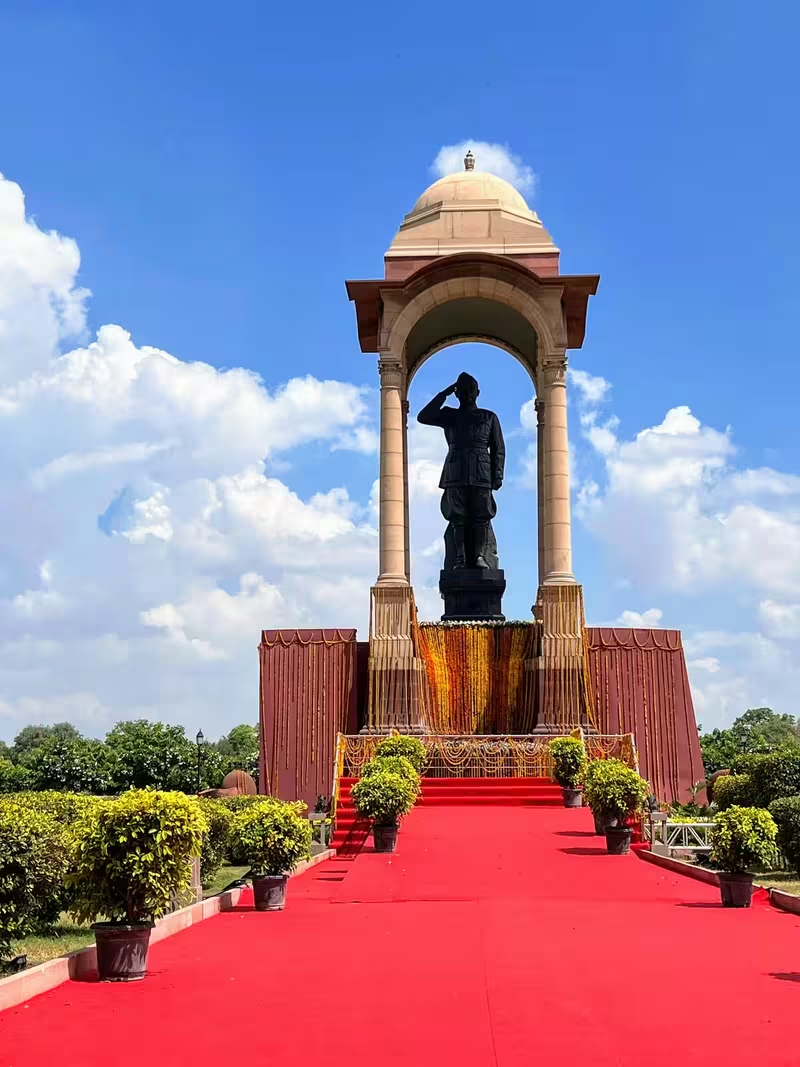
Subhas Chandra Bose: The Uncompromising Patriot
In the grand tapestry of India's struggle for freedom, few threads are as vibrant, controversial, and fiercely independent as the life of Subhas Chandra Bose. Known to a billion people as Netaji (Respected Leader), his was a path of fire and conviction, a stark alternative to the mainstream non-violent movement. Bose was a charismatic intellectual, a political strategist, and a military commander who believed that India’s freedom could not be begged for, but had to be seized. His journey, from the corridors of Cambridge to the battlefields of Southeast Asia, remains a powerful saga of uncompromising patriotism.
Early Life & Forging of a Rebel
Subhas Chandra Bose was born on 23 January 1897, in Cuttack, then part of the Bengal Presidency, into a prosperous Bengali family. He was the ninth of fourteen children of Prabhavati Devi and Janakinath Bose, a successful and well-respected lawyer who served as a government pleader and was a member of the Bengal Legislative Council.
From a young age, Subhas was a precocious and introspective student. His early education at the Protestant European School gave him a fluency in English and an understanding of the colonial mindset. However, it was the spiritual teachings of Swami Vivekananda and Ramakrishna Paramahamsa that ignited his soul, instilling in him a deep sense of civilisational pride and a duty to serve his motherland.
This burgeoning nationalism found its first fiery expression during his time at Presidency College, Calcutta. In 1916, he was involved in the assault of Professor E.F. Oaten, who was known for his racist remarks against Indian students. While he may not have delivered the blow himself, Bose was identified as a key participant and was expelled from the university. This incident, though a setback to his academic career, cemented his reputation as a young man who would not tolerate insults to India's honour.
Following his father's wishes, Bose sailed to England in 1919 to take the prestigious Indian Civil Service (ICS) examination. In a remarkable display of intellect, he passed with distinction, securing the fourth rank in 1920. For any other young Indian, this would have been the pinnacle of success—a guaranteed life of power and privilege. But for Bose, it was a moral crisis. He could not reconcile serving the very administration that was subjugating his country. In April 1921, he resigned from the ICS, writing in a letter to his brother Sarat Chandra, "Only on the soil of sacrifice and suffering can we raise our national edifice." He had chosen his path.
The Political Ascent and Ideological Rift
Returning to India in 1921, Bose immediately immersed himself in the nationalist movement. He met with Mahatma Gandhi, but found himself more drawn to the dynamic leadership of Chittaranjan Das (Deshbandhu), a prominent Bengali nationalist leader who became his political mentor. Under Das's guidance, Bose rose swiftly through the ranks of the Indian National Congress (INC).
He became the CEO of the Calcutta Municipal Corporation in 1924, with C.R. Das as the Mayor, where he demonstrated exceptional administrative skills. However, his revolutionary zeal and suspected connections with nationalist militants led to his arrest in 1925. He was imprisoned without trial in the harsh conditions of Mandalay prison in Burma, a period that tested his physical and mental endurance but only hardened his resolve.
Released in 1927, Bose emerged as a leading voice of the younger, more radical faction of the Congress, alongside Jawaharlal Nehru. The two became General Secretaries of the party and championed the cause of Purna Swaraj—complete and unconditional independence. This stood in direct opposition to the older guard's demand for Dominion Status within the British Empire. Bose's fiery speeches and organizational skills made him a national icon, particularly among the youth.
His political career reached its zenith when he was unanimously elected President of the Indian National Congress for its Haripura session in 1938. As President, he initiated the National Planning Committee, a forward-thinking body tasked with drawing up a blueprint for India's industrial and economic development after independence, with Nehru as its chairman.
The turning point came in 1939. Believing that the Congress needed a leader who would issue an ultimatum to the British to grant independence within six months, Bose decided to stand for re-election at the Tripuri session. This was a direct challenge to the party establishment and Mahatma Gandhi, who backed his own candidate, Pattabhi Sitaramayya. In a stunning result, Bose won the election. Gandhi famously declared, "Pattabhi's defeat is my defeat." The victory was short-lived. The Congress Working Committee, dominated by Gandhi's loyalists, refused to cooperate with him, making it impossible for him to function. Heartbroken but unbowed, Bose resigned as Congress President in April 1939.
He immediately formed the Forward Bloc in May 1939, a new political faction within the Congress, aiming to consolidate all the radical, anti-imperialist forces in the country. This marked his definitive break from the Gandhian path.
The Great Escape and the Axis Alliance
With the outbreak of World War II in September 1939, Bose saw a historic opportunity. He believed in the age-old revolutionary maxim: "My enemy's enemy is my friend." He began advocating for a mass civil disobedience movement to pressure the British, who were now vulnerable. The colonial government, viewing him as a dangerous threat, placed him under house arrest in Calcutta in July 1940.
What followed was one of the most audacious escape stories in modern history. In the early hours of 17 January 1941, Bose slipped out of his heavily guarded ancestral home, disguised as a Pathan insurance agent named Muhammad Ziauddin. He was driven by his nephew Sisir Kumar Bose to a remote railway station, from where he embarked on a perilous journey across northern India to Peshawar. From there, with the help of local networks, he crossed the treacherous mountains into Afghanistan.
After a tense wait in Kabul, he secured passage to the Soviet Union and finally reached Berlin, Germany, in April 1941. In Germany, Bose sought support from the Nazi regime for India's freedom. He established the Free India Centre and began broadcasting anti-British propaganda to India via Azad Hind Radio. He also raised the Indische Legion, a military unit of about 3,000 soldiers recruited from Indian prisoners of war captured by the Axis forces in North Africa. It was here, in Germany, that he was first addressed as "Netaji."
By 1943, Bose realized that a direct military assault on British India was not feasible from distant Germany. The theatre of action had to be Southeast Asia, where Japan was winning the war. In a feat of extraordinary courage, he undertook a three-month-long, clandestine journey, first aboard a German U-boat and then a Japanese submarine, to arrive in Singapore in July 1943.
Azad Hind: The Provisional Government and the INA
In Southeast Asia, Bose was greeted as a saviour by the Indian expatriate community and the remnants of the first Indian National Army (INA), which had been formed by Rash Behari Bose. On 5 July 1943, he took formal command of the movement and electrified his followers with his famous call to arms: "Dilli Chalo!" (On to Delhi!).
On 21 October 1943, in a landmark event, he announced the formation of the Arzi Hukumat-e-Azad Hind (Provisional Government of Free India) in Singapore. With himself as the Head of State, Prime Minister, and Minister for War, this government was immediately recognized by nine Axis-aligned countries, including Japan, Germany, and Italy. It had its own currency, court, and civil code, and it was a powerful symbol of Indian sovereignty.
Under his command, the Indian National Army (Azad Hind Fauj) was revitalized. It grew to an estimated 40,000 soldiers, united by his promise: "Give me blood, and I shall give you freedom!" A remarkable feature of the INA was its complete communal harmony—Hindus, Muslims, and Sikhs served together without any religious friction. Furthermore, Bose established the Rani of Jhansi Regiment, an all-female infantry combat unit led by Captain Lakshmi Sahgal, a revolutionary step far ahead of its time.
In early 1944, the INA, fighting alongside the Japanese army, launched its offensive. They crossed the Burma border and advanced onto Indian soil. On 19 March 1944, the tricolor of Free India was hoisted in Moirang, Manipur. It was a moment of immense symbolic victory. However, the campaign was doomed. The relentless monsoon, severe lack of supplies, and a powerful Allied counter-attack forced the INA and the Japanese to retreat. The dream of marching into Delhi remained unfulfilled.
The Final Mystery and Enduring Legacy
As the war ended with the Axis defeat, Netaji Subhas Chandra Bose was reportedly on a flight from Taiwan to Tokyo when his plane crashed on 18 August 1945. He is said to have succumbed to severe burns. While this remains the official account accepted by most governments and historians, the circumstances of his death have been a subject of intense debate and numerous conspiracy theories in India for decades.
Though his military campaign failed, Netaji's ultimate impact on India's freedom was profound. After the war, the British decided to put on trial three of the INA's top officers—Shah Nawaz Khan (a Muslim), Prem Kumar Sahgal (a Hindu), and Gurbaksh Singh Dhillon (a Sikh)—at the Red Fort in Delhi. The Red Fort Trials of 1945-46 backfired spectacularly. Instead of portraying the INA soldiers as traitors, the trials revealed their patriotic fervor to the Indian public, igniting a wave of popular support across the country.
The trials and the stories of the INA's bravery are widely credited with shattering the loyalty of the British Indian Armed Forces, the very pillar of the Raj. The subsequent Royal Indian Navy mutiny in 1946, along with other unrest in the armed forces, sent a clear signal to London that the British could no longer rely on Indian soldiers to maintain their empire. Many historians, and even the British Prime Minister Clement Attlee who signed off on independence, later acknowledged that the actions of Bose and the INA were a decisive factor in their decision to leave India.
Today, Subhas Chandra Bose is revered as one of India's greatest heroes. His slogan, "Jai Hind" (Victory to India), which was the official salutation of the Azad Hind government, is used today by the Indian Armed Forces and is a common patriotic greeting. His legacy is a complex one—celebrated for his fierce, uncompromising nationalism and supreme sacrifice, while his alliance with the fascist Axis powers remains a point of academic debate. Yet, for millions of Indians, he remains Netaji, the valiant leader who dared to challenge an empire with the sword, a timeless symbol of courage, and the patriot who truly gave his all for the freedom of his motherland.